Loading
Watercolor Daily · Reviews
Winsor & Newton Cotman Watercolor Review: 48 Colors Decoded
Cotman watercolor review, a sound student paint if you pick the right tubes. All 48 colors checked for pigment codes, lightfastness and price per ml.
9 min readBy Arthur Sterling
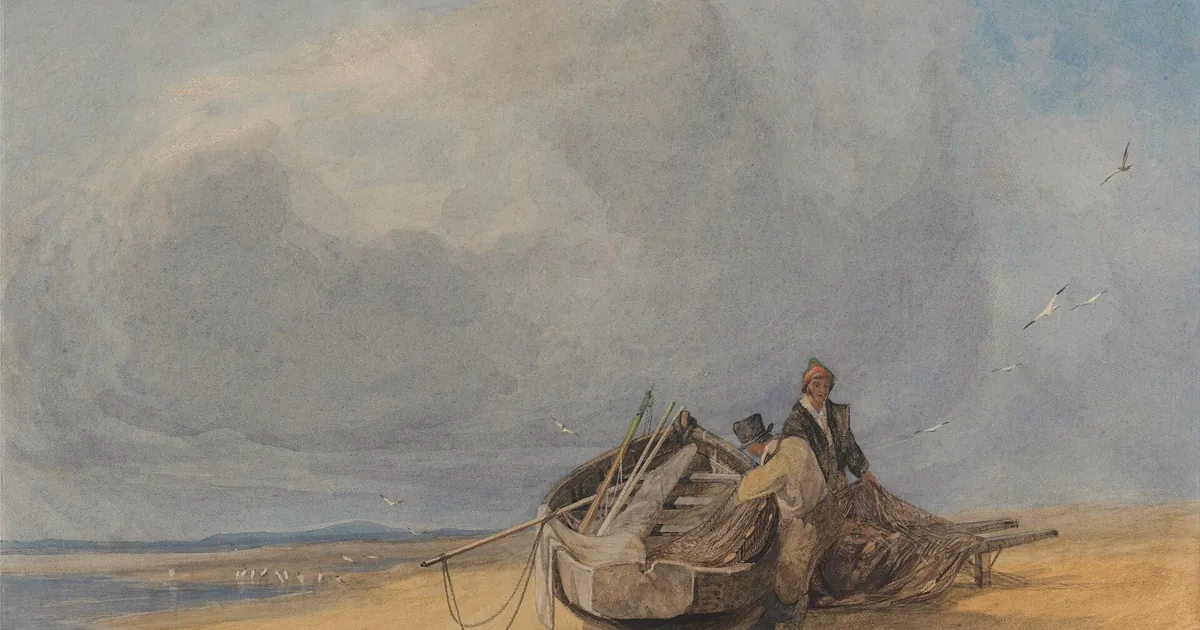
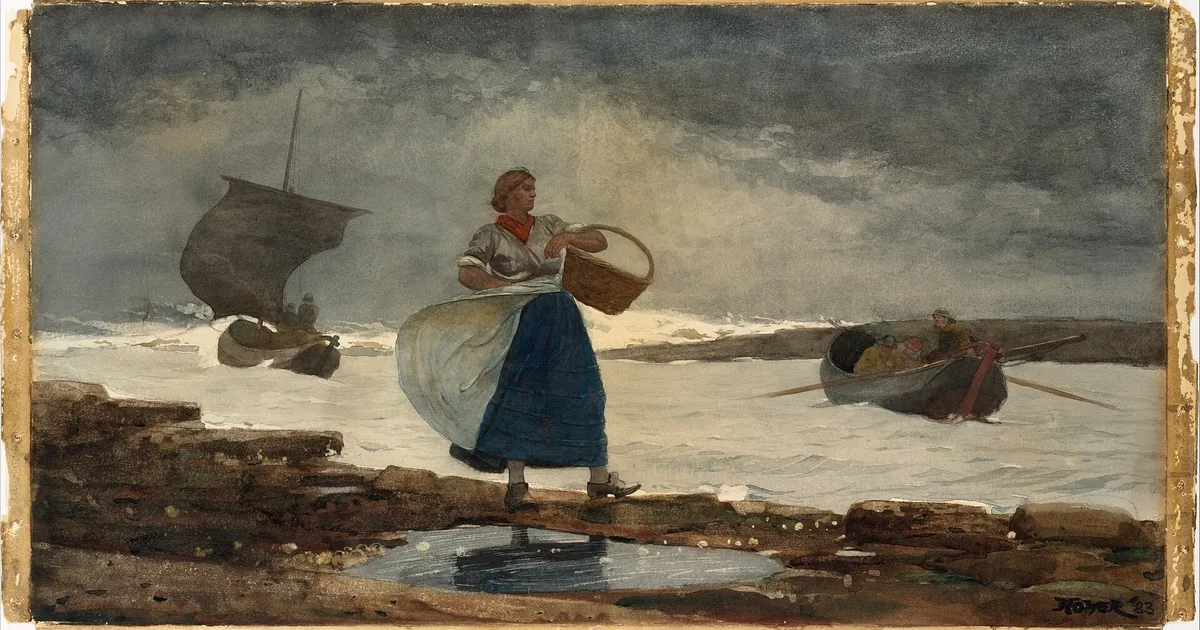
Painting: John Sell Cotman, Yarmouth Sands, Norfolk, via Google Art Project and Wikimedia Commons, public domain
Review
Winsor & Newton Cotman Water Colours
Winsor & Newton · London, UK
7.8
Score / 10
- Grade
- Student Grade
- Format reviewed
- 8 ml and 21 ml tubes, half pans
For
- Pigment codes and a permanence rating published for all 48 colors
- 19 of the 40 standard colors are single-pigment paints
- Every color sits in the top two classes of the maker's permanence scale
- About $0.38 to $0.53 per ml at Blick, against $1.78 for a Professional tube
Against
- Reduced pigment load compared with the Professional range, by the maker's own statement
- 13 colors are hues that imitate a costlier pigment
- 16 of the 40 standard colors carry no ASTM lightfastness rating
- Several colors share the same pigments under different names
Verdict
Cotman is a dependable student paint with an unusually open specification sheet, best bought as a few single-pigment tubes instead of a large set.
This Cotman watercolor review starts from one table. Winsor & Newton publishes the pigment codes, opacity and permanence of all 48 Cotman colors. We read every row, counted what is in the range, and checked today's prices at Blick. We didn't paint lab tests of our own, so nothing here is a drying time or a swatch result. The count shows which tubes are worth buying and which ones double up on pigments you already own.
Key Takeaways
- 48 colors. 40 standard colors plus 8 metallic and iridescent ones, in 8 ml tubes, 21 ml tubes and half pans.
- 19 single-pigment colors among the 40 standard ones, by the maker's own table.
- 13 hues. These imitate costlier pigments such as cobalt, cadmium and cerulean.
- Permanence. All 48 are rated Permanent or Extremely Permanent by Winsor & Newton. 24 of the 40 standard colors also carry an ASTM I or II rating.
- Price. $4.25 for an 8 ml tube at Blick on 2026-11-14, about $0.53 per ml.
- Main limit. Less pigment per tube than the Professional range.
Overview: What This Cotman Watercolor Review Covers
Cotman is the student range from Winsor & Newton, the London paint maker founded in 1832. The range is named after the English watercolor painter John Sell Cotman, whose Yarmouth Sands is shown above. The maker describes it as an affordable range sold in half pans and tubes.
Student grade means a paint built to a lower price than artist grade. Winsor & Newton says how it gets there. Its product pages state that Cotman uses "fine art pigments with reduced pigment load than the Professional Watercolour range." The company doesn't publish how much less, so there's no ratio to quote.
Two things set Cotman apart from most student paints. First, the specification is open. The composition table lists every pigment code, which is the Colour Index name printed as letters and numbers, such as PB29 for ultramarine. Second, the Professional range sits right above it with many of the same pigments. That makes moving up one tube at a time simple. Our guide to the difference between student and artist grade watercolor explains that step in detail.
Cotman competes with other student lines such as Van Gogh and Daler-Rowney Aquafine. This review doesn't rank it against them. It checks Cotman against its own data sheet.
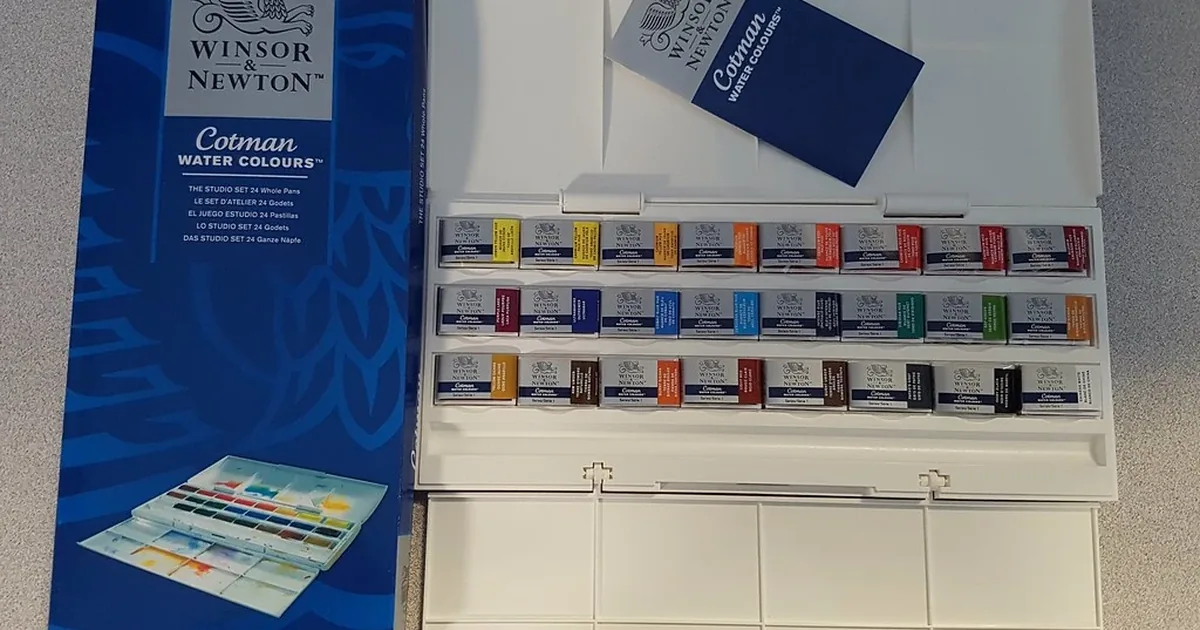
For the paint in use, this nine-minute review and demo by painter Eve Bolt works through the Cotman pocket set.
Performance: What the Pigment Table Says
A paint's handling starts with its pigments, so this Cotman watercolor review leans on the composition table. Here is what it shows for the 40 standard colors.
Transparency. 28 colors are listed as transparent and 12 as opaque. Transparent paint lets the white paper shine through, which is what gives watercolor its glow. The opaque group is mostly earth colors and blacks: Yellow Ochre, Indian Red, Light Red, Burnt Umber.
Staining. 13 colors are marked staining, meaning the color grips the paper and is hard to lift off with a damp brush. The list includes five of the six cadmium hues, both Hooker's Greens, Intense Blue and Permanent Rose. If you like to lift paint to make highlights, plan around these.
Granulation. Only one standard color is marked granulating: Ultramarine. Granulation means the pigment settles into the dips of the paper and leaves a speckled texture. Painters who want that look across a whole palette will find little of it here. Our explainer on granulating watercolors covers which pigments do it.
Lightfastness. This is how well a color resists fading in light. ASTM, the standards body, rates it from I (excellent) to V. In Cotman, 17 standard colors are rated ASTM I and 7 are rated II. The other 16 show no ASTM rating. For those, the only guide is the maker's own scale, where all 48 colors are either Permanent or Extremely Permanent.
The table can't tell you about strength. Reduced pigment load means a brushload of Cotman carries less color than a brushload of Professional. Painters on r/watercolor often describe this as needing more paint to get a dark wash. That matches the maker's statement, though nobody publishes a number for it.
The 13 Hues, and the Duplicates Hiding in the Range
A hue is a paint that imitates a named pigment with cheaper ones. Cotman has 13. Some of them are far from the name on the tube.
| Cotman color | What is in the tube | What that means |
|---|---|---|
| Cobalt Blue Hue | PB29, PW5 | Ultramarine plus white |
| Cerulean Blue Hue | PB15 | Phthalo blue |
| Viridian Hue | PG7 | Phthalo green |
| Cadmium Yellow Hue | PY65, PY97 | Two modern yellows, no cadmium |
| Cadmium Red Hue | PR149, PR255 | Two modern reds, no cadmium |
| Alizarin Crimson Hue | PR179 | A perylene red, rated ASTM I |
A hue isn't automatically a bad paint. Alizarin Crimson Hue is a single pigment with the top lightfastness rating. But Cobalt Blue Hue will behave like ultramarine with white in it, because that's what it is.
The table also shows colors that share pigments, which matters if you're buying a big set:
- Alizarin Crimson Hue and Rose Madder Hue are both PR179.
- Burnt Sienna, Indian Red and Light Red are all PR101, a synthetic iron oxide.
- Payne's Gray and Indigo both list PB15, PB29 and PBk7.
- Hooker's Green Dark and Hooker's Green Light both list PB15, PG7 and PY139.
- Permanent Rose and Purple Lake are both PV19.
The shades differ, since the same pigment can be made in different versions and ratios. Even so, you rarely need both members of a pair. With blue, yellow and an earth color you can also mix your own greens and skip the three-pigment ones.
Rubric Assessment
Pigment Quality: 7/10
19 of 40 standard colors are single pigments, and every code is published. The marks come off for the 13 hues and the reduced pigment load.
Permanence: 8/10
Every color sits in the top two classes of the maker's scale, and 24 standard colors have an ASTM I or II rating. The 16 without an ASTM rating keep this from a higher mark.
Handling: 7/10
On paper, the range leans transparent and smooth, with almost no granulation and 13 staining colors. That suits flat washes and glazing. It gives less texture than mineral-heavy artist ranges.
Range and Formats: 8/10
48 colors, two tube sizes and half pans. Blick confirms open stock in both 8 ml and 21 ml tubes, so you can replace one color at a time. Our half pans vs tubes guide helps you pick a format.
Value: 9/10
Value is where a Cotman watercolor review gets easy. Prices at Blick on 2026-11-14, using ultramarine as the test color:
| Paint | Size | Price | Per ml |
|---|---|---|---|
| Cotman Ultramarine | 8 ml | $4.25 (list $6.89) | $0.53 |
| Cotman Ultramarine | 21 ml | $8.02 | $0.38 |
| Professional French Ultramarine | 5 ml | $8.90 | $1.78 |
The Cotman tube costs about a third as much per ml as the Professional tube, and the 21 ml size about a fifth. Prices move with sales, so check before you buy.
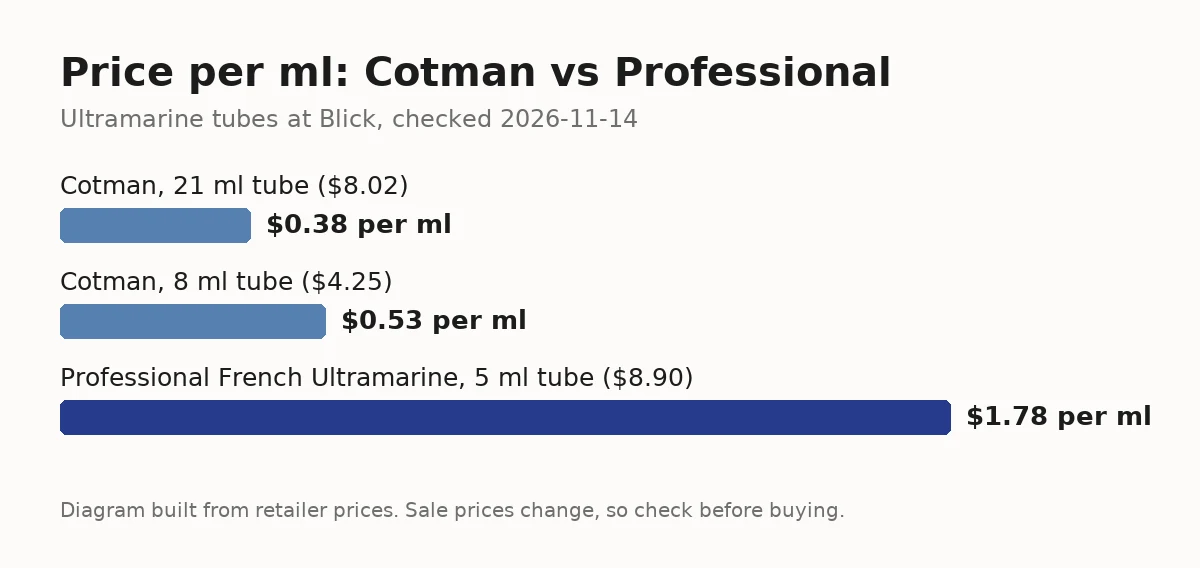 A diagram of the Blick prices above. The Professional tube costs more than three times as much per ml as either Cotman size.
Best Cotman Colors to Start With
You don't need a 24-color set. These six are all single-pigment paints in the maker's table, so mixes stay clean:
- Lemon Yellow Hue (PY175), a cool yellow.
- Permanent Rose (PV19), a cool pinkish red, ASTM II.
- Ultramarine (PB29), a warm blue, ASTM I, and the one granulating color.
- Intense Blue (PB15), a cool phthalo blue, ASTM II. It stains, so use a little.
- Burnt Sienna (PR101), a warm earth, ASTM I.
- Yellow Ochre (PY42), a soft earth yellow, ASTM I.
Ultramarine and Burnt Sienna together give a range of grays and browns. For a fuller plan, see the split-primary palette guide, which pairs a warm and a cool version of each primary. If you would rather buy a ready-made box, our list of the best watercolor paints for beginners covers the Cotman pocket set.
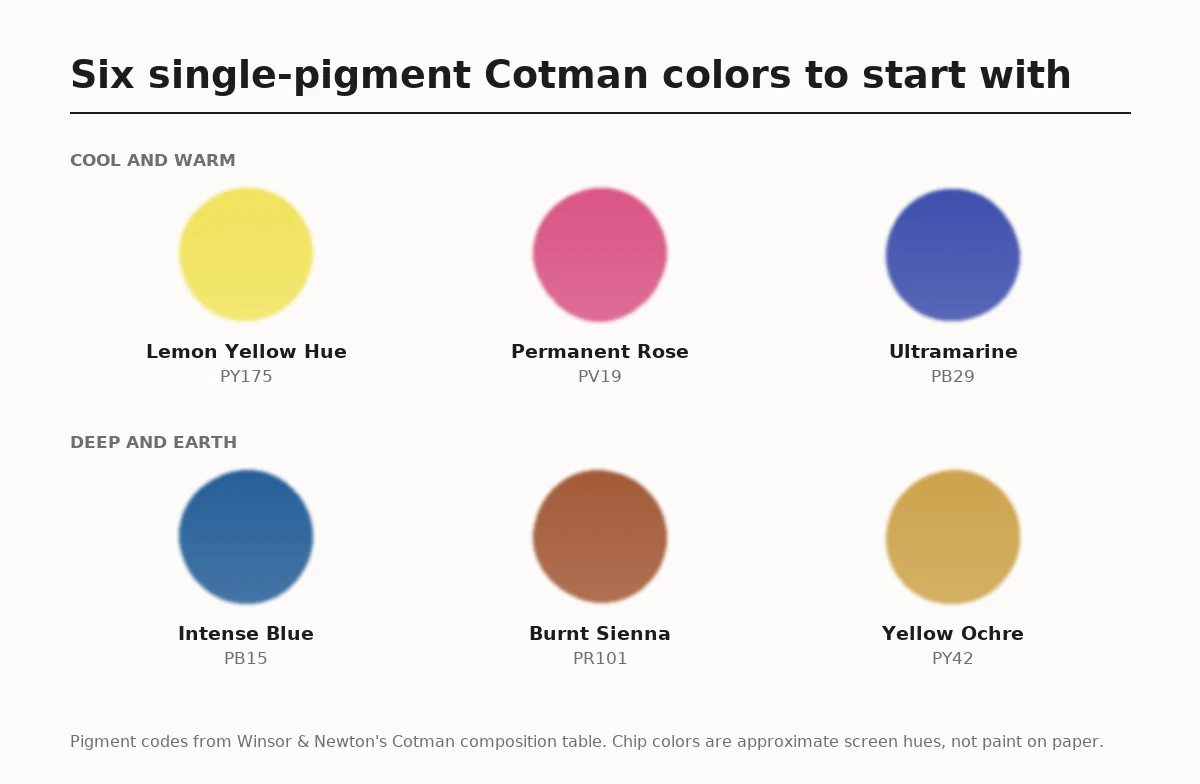 A diagram of the six starter colors and their pigment codes. The chips are screen approximations, not paint on paper.
Verdict: Cotman Watercolor Review Score
Score: 7.8/10. A sound student paint with an honest data sheet, held back by lower pigment load and a range padded with hues and near-duplicates.
The Good
- Pigment codes, opacity and permanence published for all 48 colors
- 19 single-pigment colors among the 40 standard ones
- No color rated below Permanent on the maker's scale
- 8 ml tubes at $4.25 and 21 ml tubes at $8.02 at Blick
- The Professional range uses many of the same pigments, so upgrading is easy
The Cons
- Reduced pigment load, with no published figure for how much
- 13 hues, some far from their names (Cerulean Blue Hue is phthalo blue)
- 16 standard colors have no ASTM lightfastness rating
- Five pairs or groups of colors share the same pigments
Cotman suits beginners, sketchers and anyone practising washes who wants to use paint freely without counting the cost. It's less suited to painters who want deep darks from a small amount of paint, or granulating texture. A published pigment-load figure and ASTM ratings for the full range would raise the score.
Frequently Asked Questions
Is Cotman watercolor good? Yes, for a student paint. Winsor & Newton publishes the pigment codes and a permanence rating for all 48 Cotman colors, and every one is rated Permanent or Extremely Permanent on the maker's scale. The trade-off is a reduced pigment load, so you need more paint to reach a dark color.
What is the difference between Cotman and Winsor & Newton Professional? Pigment load and pigment choice. Winsor & Newton says Cotman has a reduced pigment load compared with Professional. Cotman also replaces costly pigments with hues: its Cobalt Blue Hue is ultramarine (PB29) plus white (PW5). At Blick, Cotman costs about $0.53 per ml and Professional about $1.78.
Is Cotman watercolor lightfast? Mostly, as far as the published data goes. Of the 40 standard colors, 17 are rated ASTM I and 7 are rated ASTM II. The other 16 have no ASTM rating listed, so the only guide is Winsor & Newton's own scale, which rates them Permanent.
Are Cotman watercolors single pigment? Some are. By the maker's composition table, 19 of the 40 standard colors use one pigment, including Ultramarine (PB29), Permanent Rose (PV19), Burnt Sienna (PR101) and Yellow Ochre (PY42). The other 21 are mixtures of two or three pigments. Sap Green, for example, lists three.
What does hue mean on a Cotman tube? Hue means the paint imitates a named pigment with cheaper ones. Cotman has 13 hue colors. Cerulean Blue Hue is phthalo blue (PB15), and Viridian Hue is phthalo green (PG7). A hue can be a good paint, but it will not mix or lift like the pigment it is named after.
Should a beginner buy Cotman tubes or pans? Either works. Cotman comes in 8 ml tubes, 21 ml tubes and half pans. Tubes are cheaper per ml, and at Blick the 21 ml tube costs about $0.38 per ml against $0.53 for the 8 ml size. Pans suit painting outdoors, because the box is the palette.
References
- Winsor & Newton: Cotman Watercolour composition and permanence table - Pigment codes, opacity, permanence, ASTM lightfastness, staining and granulation for all 48 colors. Checked 2026-11-14.
- Winsor & Newton: Cotman Watercolour range - Range description, formats and the 48-color count.
- Blick: Winsor & Newton Cotman Watercolor Tubes - Tube sizes and prices on 2026-11-14.
- Handprint: watercolor pigment reference - Background on the pigments behind each Colour Index code.
- Winsor & Newton on YouTube: Cotman Watercolour Field Box - The maker's own video of a Cotman pan set in use.
- Eve Bolt on YouTube: Cotman Watercolour Complete Pocket Set, Review & Demo - An independent painter's review and demo of a Cotman pan set.

Written by
Arthur SterlingSupplies & Reviews Editor
Arthur Sterling writes Watercolor Daily's supply reviews and brand comparisons: paints, cotton papers, and brushes, compared on published specifications.
NextKeep reading
Reviews / 9 min
Van Gogh Watercolor Review: 72 Colors and Pigments Checked
Reviews / 9 min
Canson XL Watercolor Paper Review: 6 Pads and Prices Checked
Reviews / 8 min
Daniel Smith vs Winsor & Newton: Pro Watercolor Review
Reviews / 9 min
Baohong Watercolor Paper Review: 3 Ranges, Priced vs Arches
Features / 14 min
Daniel Smith vs Schmincke Watercolor: 5 Real Differences
Reviews / 8 min
Arches Watercolor Paper Review: Is It Worth the Price?
Features / 10 min
Student vs Artist Grade Watercolor: 6 Pigments Compared
Guides / 12 min
Watercolor Pans vs Tubes: What to Buy First, Priced per ml
Disclaimer
This article is published for informational purposes and is not professional advice. Product formulations, pigment sources, packaging and store listings change. Check the details that matter to you (price, pigment content, regional availability) with the manufacturer or retailer before you buy.
Brands in this article
Winsor & Newton