Loading
Watercolor Daily · Features
Student vs Artist Grade Watercolor: 6 Pigments Compared
Student vs artist grade watercolor differs most in pigment load and in which pigments each line uses. Six Cotman and Professional colors compared by code.
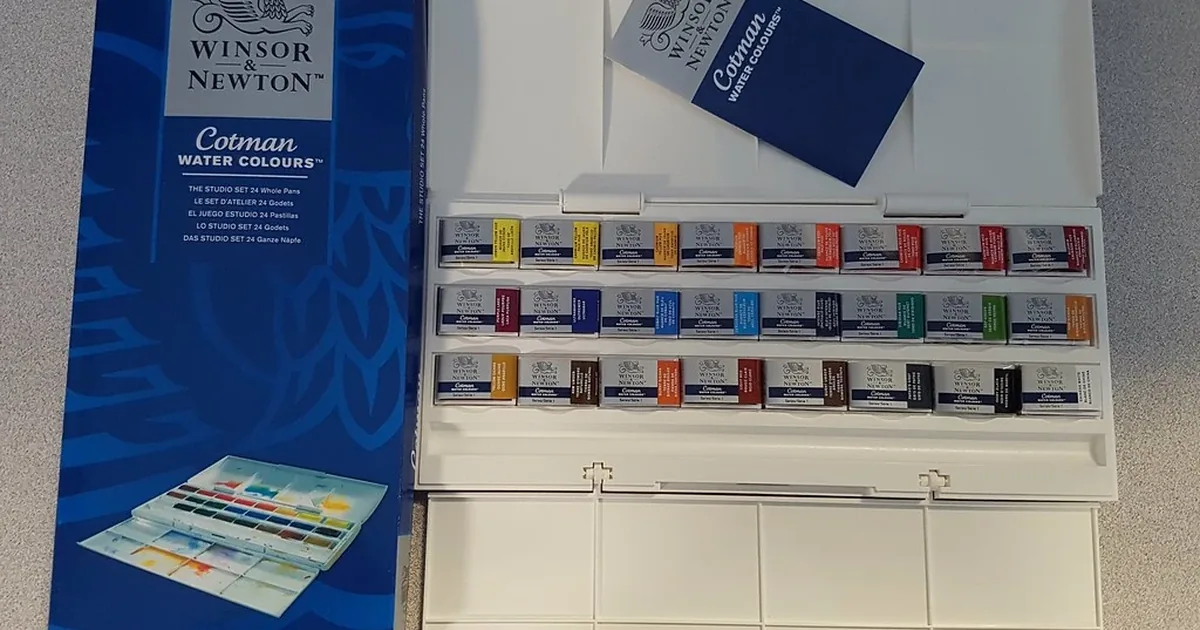
Photo: CharmaineZoe's Marvelous Melange, Flickr, CC BY 2.0
Student vs artist grade watercolor comes down to two things you can check on the label. How much pigment is in the tube, and which pigment it is. In Winsor & Newton's two lines, three of the six colors compared here use exactly the same pigment in the student and the artist tube. The other three use different pigments under similar names. For those colors, paying more buys you a different paint, not only a stronger one.
The comparison is uneven on purpose. Cotman is a student range and Professional is an artist range from the same maker, so price and pigment load are expected to differ. What's worth knowing is which colors differ by pigment and which only by strength.
In short: Winsor & Newton says Cotman has a reduced pigment load compared with Professional. Ultramarine (PB29), Permanent Rose (PV19) and phthalo blue (PB15) use the same pigment in both lines. Cobalt blue, cadmium yellow and cerulean do not: the Cotman versions are hues made from cheaper pigments. Upgrade those first.
Student vs artist grade watercolor? (quick answer)
Artist grade carries more pigment and uses the expensive pigments that student lines imitate with hues. When both lines use the same pigment code, student paint behaves the same way, only weaker. Buy artist grade first for the colors whose pigment changes.
Overview
Winsor & Newton Cotman is the company's student watercolor range, named after the painter John Sell Cotman. Winsor & Newton sells it in 8 ml tubes, half pans and 21 ml tubes. The company's own pages are inconsistent about its size: the product pages say 40 colors and the range page says 48. Every Cotman color checked for this comparison is Series 1, the same price whatever the pigment.
Winsor & Newton Professional is the artist range. Its product pages list 115 colors, 85 of them made from a single pigment. They come in 5 ml tubes, half pans, 14 ml tubes and, for some colors, 37 ml tubes. Professional colors are priced by series: among the colors compared here, from Series 1 for phthalo blue up to Series 4 for cobalt and cadmium.
Both lines publish the same facts for every color. Each product page gives the pigment code, a lightfastness rating, a permanence rating, the opacity, and whether the paint granulates or stains. That makes a fair comparison possible, color by color. The ratings are Winsor & Newton's own scales, such as "Excellent" and "Very Good" for lightfastness, not ASTM categories.
Comparing two lines from one maker removes a variable. Both come from the same company, so the differences below are down to pigment choice and pigment load rather than two factories' recipes.
Student vs Artist Grade Watercolor: Pigment Load Analysis
Winsor & Newton states the difference in pigment load directly. Every Cotman product page carries the same line: Cotman Watercolours use "fine art pigments with reduced pigment load than the Professional Watercolour range, making them an accessible choice while still uncompromising on quality."
Winsor & Newton doesn't publish how much less pigment Cotman carries, so there's no exact ratio to quote. In practice, reduced pigment load means a brushload of student paint gives less color than the same brushload of artist paint. You can still reach a dark color with Cotman. You need more paint, or less water, to get there, and the darkest mixes may not get as deep as the artist version.
This matters most in two situations. The first is glazing, where you build color in thin transparent layers: weaker paint needs more layers, and each extra layer disturbs the ones below. The second is darks. A rich shadow mixed from ultramarine and burnt sienna depends on getting a lot of pigment onto the paper in one pass.
For light washes and practice studies, the gap matters less, since a pale sky wash is mostly water in either line.
Which Colors Use the Same Pigment in Both Lines
Three Cotman colors use exactly the same pigment code as their Professional equivalents:
- Ultramarine, PB29. Cotman Ultramarine is PB29, Series 1. Professional French Ultramarine is PB29, Series 2. Winsor & Newton marks both as transparent and granulating, with Excellent lightfastness.
- Permanent Rose, PV19. Both lines sell Permanent Rose as PV19, a quinacridone, rated Very Good for lightfastness. In Professional it is a Series 3 color.
- Phthalo blue, PB15. Cotman Intense Blue (Phthalo Blue) is PB15. Professional sells the same pigment code as Winsor Blue in a Red Shade and a Green Shade, both Series 1.
For these colors, the student tube teaches you the same mixing behavior as the artist tube. The color, transparency, granulation and staining all match. The difference is pigment load, so the artist tube gives you a stronger color from less paint.
That makes these the colors to buy in student grade first. Permanent Rose shows the price gap most clearly. It is a Series 3 color in Professional, yet Cotman prices the same PV19 pigment as Series 1.
Student vs Artist Grade Watercolor: Hue Colors Analysis
Three other pairs share a name but not a pigment. In each case the Cotman version is a hue, meaning a color made from cheaper pigments to resemble the original:
- Cobalt blue. Cotman Cobalt Blue Hue is PB29 and PW5: ultramarine with zinc white. Professional Cobalt Blue is PB28, genuine cobalt aluminate, Series 4, semi-transparent and granulating.
- Cadmium yellow. Cotman Cadmium Yellow Hue is PY65 and PY97, which Winsor & Newton describes as arylide pigments chosen to resemble cadmium yellow. Professional Cadmium Yellow is PO20 and PY35, both cadmium pigments, Series 4 and opaque.
- Cerulean blue. Cotman Cerulean Blue Hue is listed as PB15, a phthalocyanine, and rated opaque. Professional Cerulean Blue is PB35, a cobalt-based pigment, Series 3, semi-opaque and granulating.
These pairs behave differently on paper. Genuine cobalt and cerulean granulate. A hue built on phthalo, or on ultramarine mixed with white, settles and mixes in its own way. Phthalo in particular stains strongly, and genuine cerulean does not. If you learn cerulean from a phthalo-based hue, you're learning a different paint.
Hues have real advantages. Arylide yellows avoid the cost and toxicity of cadmium, and a phthalo-based blue is lightfast and bright. Read the code on the tube so you know which pigment you're buying. Get the genuine one when you want the way that pigment behaves.
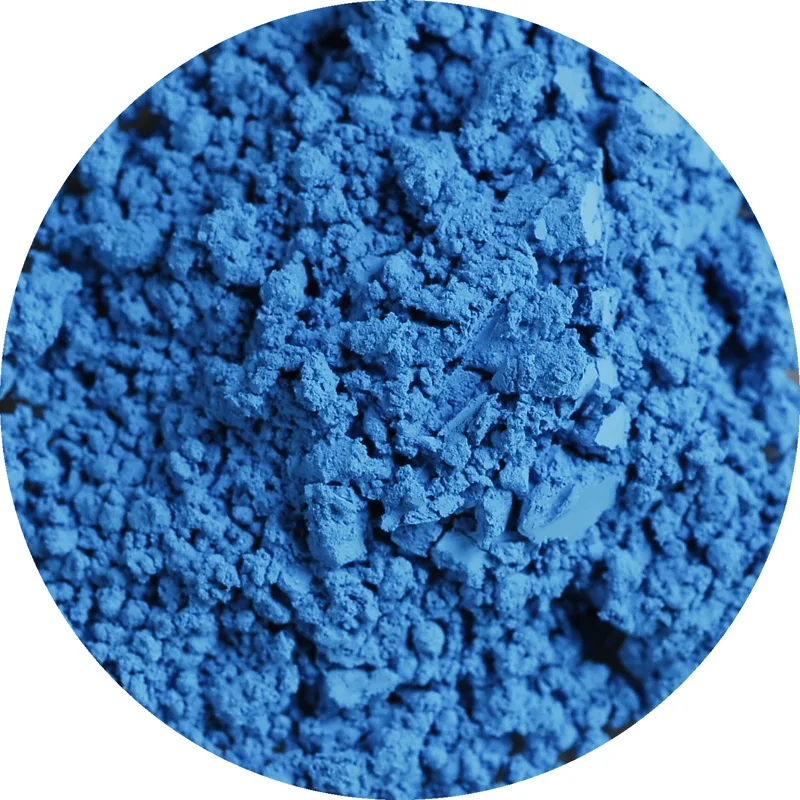 Dry PB35 cerulean pigment, the cobalt-based pigment Winsor & Newton lists for Professional Cerulean Blue. Cotman Cerulean Blue Hue is made from phthalo blue instead. Photo: Stephhzz, Wikimedia Commons, CC BY-SA 3.0.
Price, Tube Size and Range Size
Every Cotman color checked here is Series 1. Professional colors are priced by series, so cobalt, cerulean and cadmium colors cost much more than Series 1 colors such as Winsor Blue.
The tube sizes differ too. A Cotman tube holds 8 ml, against 5 ml for the smallest Professional tube. The larger sizes are 21 ml for Cotman and 14 ml for Professional. Compare prices per milliliter, not per tube, because the student tube is the larger one.
The range sizes are far apart. Professional lists 115 colors, 85 of them single pigments. Cotman lists 40 or 48 depending on the page, many of them hues. For a beginner's palette of six to twelve colors, either range has enough. The bigger Professional range matters once you want specific pigments that Cotman does not offer at all.
Side-by-Side Summary
- Pigment load: Cotman: reduced, per Winsor & Newton / Professional: full.
- Colors in range: Cotman: 40 or 48 / Professional: 115.
- Single-pigment colors: Cotman: not stated / Professional: 85.
- Tube sizes: Cotman: 8 ml, 21 ml / Professional: 5 ml, 14 ml, 37 ml for some colors.
- Pricing: Cotman: Series 1 for every color checked / Professional: Series 1 to 4 among colors checked.
- Ultramarine: PB29 in both.
- Permanent Rose: PV19 in both.
- Phthalo blue: PB15 in both.
- Cobalt blue: Cotman: PB29 + PW5 hue / Professional: PB28.
- Cerulean blue: Cotman: PB15 hue / Professional: PB35.
GODEEPER: Six of these pigments can carry a whole palette. Which six, and how to mix clean secondaries from them, is in the split-primary guide. Split-Primary Palette Guide: Mix Any Color with 6 Tubes →
Who Should Buy Which
Buy student grade (Cotman) if you are learning, practicing daily, or painting studies you'll throw away. Choose colors whose pigment matches the artist line, such as ultramarine, Permanent Rose and phthalo blue. Then the habits you build carry over when you upgrade.
Buy artist grade (Professional) if you want a specific pigment's behavior, such as the granulation of genuine cobalt or cerulean. It also suits glazing many layers, where you need strong color from little paint. Buy these colors first, before replacing the shared-pigment colors you already have.
For most painters, the answer to student vs artist grade watercolor is both: a mixed palette is a reasonable place to stay. A student ultramarine and an artist ultramarine are the same pigment at different strengths, so there's no rush to replace one with the other.
GODEEPER: If you are still choosing your first brushes, the brush guide explains why the size number on a round does not match between brands. Best Watercolor Brushes for Beginners: 3 Shapes to Buy →
Frequently Asked Questions
What is the difference between student and artist grade watercolor? Artist grade paint carries more pigment and uses the costly pigments that student lines replace. Winsor & Newton says its Cotman student range has a reduced pigment load compared with Professional, and Cotman colors labeled hue, such as Cobalt Blue Hue, use cheaper pigments to imitate the original.
Is artist grade watercolor worth it for beginners? For a few colors, yes. Where both lines use the same pigment, such as ultramarine PB29 or phthalo blue PB15, student paint teaches you the same mixing behavior. Spend artist-grade money first on colors whose pigment differs, such as cobalt blue PB28 or cerulean PB35.
Can you mix student and artist grade watercolors on one palette? Yes. Both are watercolors from the same maker and mix freely on the palette and paper. Just expect the student color to look weaker beside the artist one at the same dilution. It carries less pigment per brushload, so you may need more of it.
What does hue mean on a watercolor tube? Hue means the color imitates a pigment it does not contain. Winsor & Newton's Cotman Cobalt Blue Hue, for example, is made from ultramarine PB29 and zinc white PW5 rather than cobalt PB28. Check the pigment code on the label to see what is really in the tube.
Do student grade watercolors fade? Not necessarily. Many student colors use lightfast pigments, and Winsor & Newton rates all six Cotman colors compared here as Permanent. Lightfastness depends on the specific pigment, so read the rating printed for each color rather than assuming a whole student line is fugitive.
Related Reading
- Watercolor for Beginners: Essential Supplies and Buying Guide: the rest of the starter kit, from cotton paper to palette.
- Daniel Smith vs Winsor & Newton: Pro Watercolor Review: how two artist-grade ranges compare once you're ready to upgrade.
- Best Watercolor Paper for Beginners: Why 100% Cotton Matters: why the paper changes the result more than the paint grade.
References
- Winsor & Newton: Cotman Watercolour range - Range description, formats and color list.
- Winsor & Newton: Cotman Cobalt Blue Hue - Pigment code, series and the reduced pigment load statement.
- Winsor & Newton: Cotman Cadmium Yellow Hue - Arylide pigment codes for the hue.
- Winsor & Newton: Professional Cobalt Blue - Pigment code, series and range size.
- Winsor & Newton: Professional Cadmium Yellow - Cadmium pigment codes and series.
- Winsor & Newton: Professional Cerulean Blue - Pigment code and granulation.
- ASTM D5067: Standard Specification for Artists' Watercolor Paints - The standard covering pigment identification, lightfastness and consistency for artists' watercolors.
- Bianca Santiago on YouTube: Winsor & Newton Cotman vs Pro, Side-by-Side - Video swatch comparison of the two lines.

Written by
Arthur SterlingSupplies & Reviews Editor
Arthur Sterling writes Watercolor Daily's supply reviews and brand comparisons: paints, cotton papers, and brushes, compared on published specifications.
NextKeep reading
Guides / 12 min
Watercolor Pans vs Tubes: What to Buy First, Priced per ml

Features / 12 min
Ceramic vs Plastic Watercolor Palette: 5 Differences

Features / 11 min
Best Travel Watercolor Sets: 5 Pocket Boxes Compared

Guides / 9 min
Watercolor for Beginners: Essential Supplies & Buying Guide

Features / 13 min
Best Watercolor Paints for Beginners: 5 Sets Compared
Reviews / 8 min
Daniel Smith vs Winsor & Newton: Pro Watercolor Review
Guides / 11 min
Dry Brush Watercolor Technique: 8 Tips for Broken Texture
Guides / 14 min
How to Clean Watercolor Brushes: 7 Steps, 3 Ways to Dry
Disclaimer
This article is published for informational purposes and is not professional advice. Product formulations, pigment sources, packaging and store listings change. Check the details that matter to you (price, pigment content, regional availability) with the manufacturer or retailer before you buy.
Brands in this article
Winsor & Newton