Loading
Watercolor Daily · Features
Watercolor Block vs Pad vs Sheets: Cost per Square Inch
Watercolor block vs pad comes down to flatness against price. Arches blocks, pads and full sheets compared per sheet and per square inch, with Blick prices.
11 min readBy Arthur Sterling
Watercolor block vs pad is a question about flatness and money. The same Arches 300 gsm cotton sheet comes glued on four sides as a block, bound on one edge as a pad, and loose as a full 22 by 30 inch sheet. The paper is identical. What changes is whether it stays flat when wet, and what each square inch costs you.
This comparison prices all three formats at the same size and surface, using Blick's listed prices on 7 November 2026, and says which format earns its price for which kind of painting.
In short: A block holds the sheet flat under a wet wash and costs about $2.45 per 9 by 12 inch page at Blick. A pad of the same paper costs about $1.60 per page but ripples when wet. A 22 by 30 inch sheet at $9.74 is the cheapest per square inch by a wide margin, and cutting it into quarters gives you four 11 by 15 inch pieces for about the price of block pages. Buy the block for wet-on-wet, the pad for sketches and dry work, and full sheets once you own a board and clips.
Watercolor block vs pad: which should you buy? (quick answer)
Buy a block if you paint wet washes and don't want to stretch paper. Buy a pad if you paint small, mostly dry, and want the cheapest way to try a good sheet. Buy full sheets once you paint often, because they cost about a third less per square inch than the block and let you choose your own size.
Overview
The watercolor block vs pad question starts with how each one is bound. A block is a stack of sheets, usually 20 at 300 gsm, glued together around all four edges. One short section of an edge is left unglued so you can slide a knife in. You paint on the top sheet while it is still attached. The glue holds the sheet's edges, so when the paper swells with water it can't lift into ripples, and when it dries it pulls itself flat again. Then you cut it free.
A pad is the same sheets bound on one short edge, either glued or taped. Each sheet is free on three sides, so a wet wash makes it buckle. Arches' own range page lists its pads as glued on the short side, 12 sheets at 300 gsm. Blick lists the 9 by 12 inch cold press pad as a fold-over pad with the same 12 sheets.
A full sheet is 22 by 30 inches with four deckle edges, sold singly or in packs. You cut it down and either tape or stretch it before painting.
All three formats here are Arches Aquarelle: 100 percent cotton, made on a cylinder mould and gelatin sized to the core, which is what lets the sheet take heavy washes and lifting. The paper weight guide explains the 300 gsm and 640 gsm options. Arches also sells 640 gsm (300 lb) blocks with 10 sheets, for painters who want a sheet heavy enough not to need a block at all.
Watercolor Block vs Pad vs Sheet: Price per Square Inch
The three Arches cold press products below are the same 300 gsm (140 lb) paper. Prices are Blick's listed price on 7 November 2026.
| Format | Blick price | Sheets | Price per sheet | Area per sheet | Price per sq in |
|---|---|---|---|---|---|
| Block, 9 x 12 in, glued 4 sides (item 10020-1003) | $48.93 (list $81.55) | 20 | $2.45 | 108 sq in | 2.3 cents |
| Pad, 9 x 12 in, fold-over (item 10183-1009) | $19.24 (list $35.15) | 12 | $1.60 | 108 sq in | 1.5 cents |
| Full sheet, 22 x 30 in, natural white (item 10011-1002) | $9.74 (list $14.60) | 1 | $9.74 | 660 sq in | 1.5 cents |
Two things stand out. The pad and the full sheet cost the same per square inch, within rounding. And the block costs about 55 percent more per square inch than either. That premium buys the four-sided glue and nothing else.
The full sheet's advantage is what you can cut from it. Quartered, a 22 by 30 sheet gives four 11 by 15 inch pieces at $2.44 each. That is the price of one block page, for a sheet with 53 percent more area. Cut into 9 by 12 pieces you get four with some waste, at $2.44 each, which is a block page for pad money, except you have to hold it flat yourself.
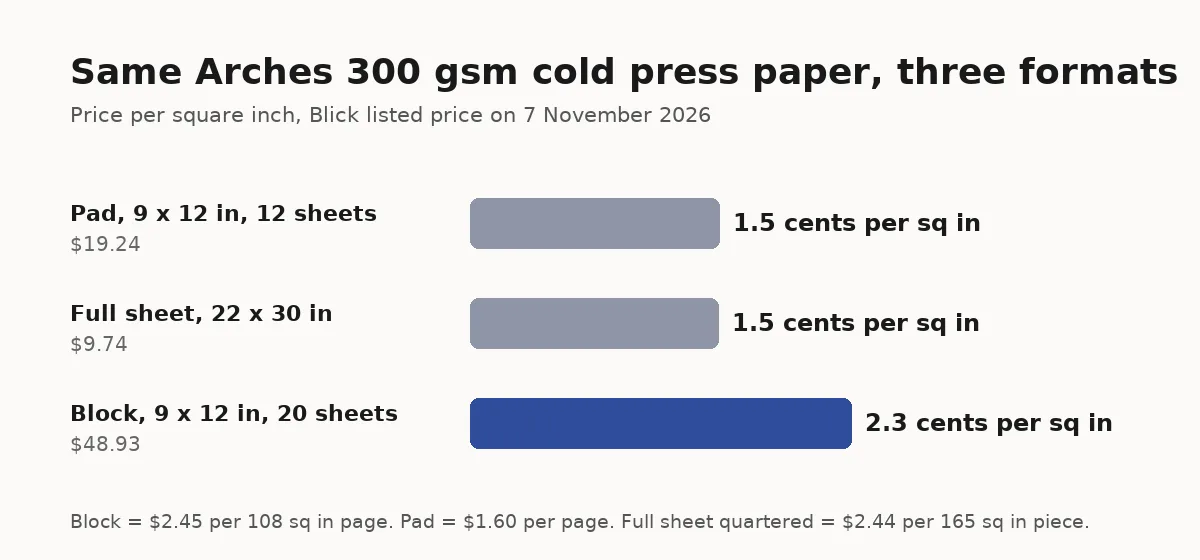 Blick listed prices on 7 November 2026 for the same Arches cold press paper in three formats. The block's premium pays for the glue, not the paper.
GODEEPER: The 300 gsm sheet in all three formats buckles under heavy water unless something holds it. The stretching guide shows the tape, staple and gummed-tape methods for loose sheets. How to Stretch Watercolor Paper: 3 Methods by Weight →
When the Block Earns Its Price
The block wins whenever the paper will get wet across most of its surface. A wet-on-wet sky, a full-sheet wash, salt texture, anything where you flood the paper and wait. On a pad the sheet rises into ridges within a minute, the wash runs into the valleys and dries darker there, and you spend the painting fighting the paper. On a block the sheet stays put. The wet-on-wet technique guide assumes the paper is held flat, and a block is the simplest way to do that.
It also wins for travel. A block is its own board. You can paint on a train seat or a park bench with nothing to clip, and the stack underneath gives a firm surface. For plein air painters the block is often the whole reason to own one.
The block's rule is patience. The sheet has to dry completely before you cut it off, because the flattening happens as it dries under tension. Cut it damp and it curls like a pad page would have. Painters who like to work on two or three pieces at once find this annoying, since the block holds one sheet at a time. Some get around it with two blocks.
A smaller point: a block's edges are cut, not deckled. If you want the ragged deckle edge for framing, only full sheets have it.
When the Pad Is the Better Buy
The pad wins for anything that does not soak the paper: pen and wash sketches, small dry-brush work, color charts, practice swatches, lettering. For those, the sheet never gets wet enough to buckle, so the block's glue would be wasted money. A pad also lets you tear out and discard a failed page without cutting, and lets you work on several pages in one sitting.
It is also the cheap way to test an expensive paper. At $19.24 for 12 Arches sheets, the pad lets you find out whether you like a cotton sheet before committing to a block at $48.93 or a pack of full sheets. If you find the best watercolor paper for beginners guide persuasive but the price alarming, the pad is where to start.
To paint wet on a pad, clip it to a board. Four bulldog clips, one on each side, hold the top sheet nearly as flat as a block does, as long as you leave them on until the sheet is dry. It is more fiddly than a block, and it doesn't travel as well, but it closes most of the gap.
GODEEPER: Pads and blocks are mostly cold press. If you are choosing a surface as well as a format, the texture comparison explains what each one does to a wash. Hot Press vs Cold Press Watercolor Paper: Which to Buy →
When Full Sheets Win
Once you paint regularly, full sheets are the format to move to. They are the cheapest per square inch of the three, you choose the size by where you cut, and you get the deckle edges. The same $48.93 that buys a 9 by 12 block buys five full sheets, which is twenty 11 by 15 quarter sheets, or ten 15 by 22 half sheets.
The cost is in the set-up. A full sheet needs a board, and a wet painting on it needs tape or stretching. You also need to store sheets flat, which means a drawer or a portfolio rather than a shelf. None of this is hard, but it is why most painters start on a block and move to sheets later rather than the other way round.
Watercolor block vs pad vs sheet, then, is mostly a question of where you are. The pad is for trying the paper. The block is for painting wet without fuss. The sheets are for when you paint enough that the block's premium adds up.
Analysis: Pay for the Glue Only When You Need It
Strip the watercolor block vs pad question back to what you are paying for and the choice gets simple. The paper is the same Arches Aquarelle in all three. The pad charges you for the paper. The block charges you for the paper plus the four-sided glue that keeps it flat, and at Blick's prices that glue costs about 55 percent extra per square inch. The full sheet charges you for the paper and nothing else, and leaves the flattening to you.
So the block is worth its price exactly when the glue does work you would otherwise do yourself: wet washes, travel, and painters who don't want to stretch. It is not worth its price for dry work, for practice, or for anyone who already owns a board and a roll of gummed tape.
The pad and the full sheet tie on price per square inch. The pad wins on convenience at small sizes, and the sheet wins the moment you want anything larger than the pad, or a deckle edge, or a quarter sheet that costs what a block page does but is half as large again.
One caution on the numbers. Blick's prices on the day were well under list: the block was $48.93 against a $81.55 list, the pad $19.24 against $35.15. At list price the block's premium over the pad shrinks to about 28 percent per square inch, which changes the arithmetic without changing the advice. Check the day's price, and if the block is on sale, the glue is cheap.
Frequently Asked Questions
Is a watercolor block better than a pad? For wet work, yes. A block is glued on all four edges, so the sheet can't buckle while you paint and dries flat. A pad is glued or taped on one edge only, so a wet wash ripples. The block costs more per sheet, about $2.45 against $1.60 for Arches 9 by 12 at Blick in November 2026.
Do you have to wait for a watercolor block to dry before removing the sheet? Yes. The point of the block is that the glue holds the sheet flat while it dries, so let the painting dry completely, then slide a palette knife or butter knife into the unglued gap and run it around all four sides. Removing a damp sheet undoes the flattening and can tear the edge.
Are loose watercolor sheets cheaper than a block? Much cheaper per square inch. An Arches 22 by 30 inch sheet cost $9.74 at Blick in November 2026, about 1.5 cents per square inch, against 2.3 cents for the 9 by 12 block. Cut one full sheet into four quarter sheets and each one costs about the same as a block page while being half as big again.
What is the difference between a block and a pad of watercolor paper? The glue. A block has the whole stack glued on all four sides with one small gap for a knife. A pad is bound on one short edge, by glue or tape, so each sheet lifts freely. Same paper, same weight, same surface. The block only adds the four-sided binding and the price that comes with it.
Can you paint on a watercolor pad without it buckling? Only with light washes. A 300 gsm (140 lb) sheet in a pad will ripple under a wet sky, and the ripples pool paint. Clip the pad to a board on all four sides, or tear the sheet out and stretch it, and it behaves like a block page. For small dry work the pad is fine as it is.
Related Reading
- Best Watercolor Sketchbooks: 4 With 100% Cotton Paper: the fourth format, bound books, and which ones use the same cotton sheets.
- Best Travel Watercolor Sets: 5 Pocket Boxes Compared: the paint boxes that pair with a block on a park bench.
- Rough Watercolor Paper: Granulation, Dry Brush and 6 Steps: Arches sells all three formats in rough as well as cold press.
- Watercolor for Beginners: Essential Supplies & Buying Guide: where paper sits in a first shopping list.
References
- Arches: ARCHES Aquarelle range, blocks glued on 4 sides and pads glued on short side
- Blick: Arches Watercolor Block, 9 x 12 in, Cold Press, 20 Sheets
- Blick: Arches Watercolor Pad, 9 x 12 in, 140 lb, Cold Press, Fold-over, 12 Sheets
- Blick: Arches Natural White Watercolor Paper, 22 x 30 in, Cold Press, 140 lb, Single Sheet
- Handprint: Watercolor papers
- Pexels: Paper, paints, paintbrush and jar, photo by Marharyta Shtyfura (hero image, Pexels licence)

Written by
Arthur SterlingSupplies & Reviews Editor
Arthur Sterling writes Watercolor Daily's supply reviews and brand comparisons: paints, cotton papers, and brushes, compared on published specifications.
NextKeep reading
Guides / 11 min
How to Stretch Watercolor Paper: 3 Methods by Weight
Features / 12 min
Watercolor Paper Weight GSM: 190 vs 300 vs 640 Explained
Guides / 12 min
Rough Watercolor Paper: Granulation, Dry Brush and 6 Steps
Features / 12 min
Best Watercolor Sketchbooks: 4 With 100% Cotton Paper
Features / 11 min
Hot Press vs Cold Press Watercolor Paper: 3 Surface Types
Guides / 9 min
Best Watercolor Paper for Beginners: Why 100% Cotton Matters
Features / 13 min
Best Watercolor Paints for Beginners: 5 Sets Compared
Features / 11 min
Best Travel Watercolor Sets: 5 Pocket Boxes Compared
Disclaimer
This article is published for informational purposes and is not professional advice. Product formulations, pigment sources, packaging and store listings change. Check the details that matter to you (price, pigment content, regional availability) with the manufacturer or retailer before you buy.
Brands in this article
Arches