Loading
Watercolor Daily · Features
Granulating Watercolors Explained: 7 Pigments That Settle
Granulating watercolors are paints whose heavy mineral pigment settles into the paper's texture as it dries. Seven that do it, and how to control it.
12 min readBy Elena Vance
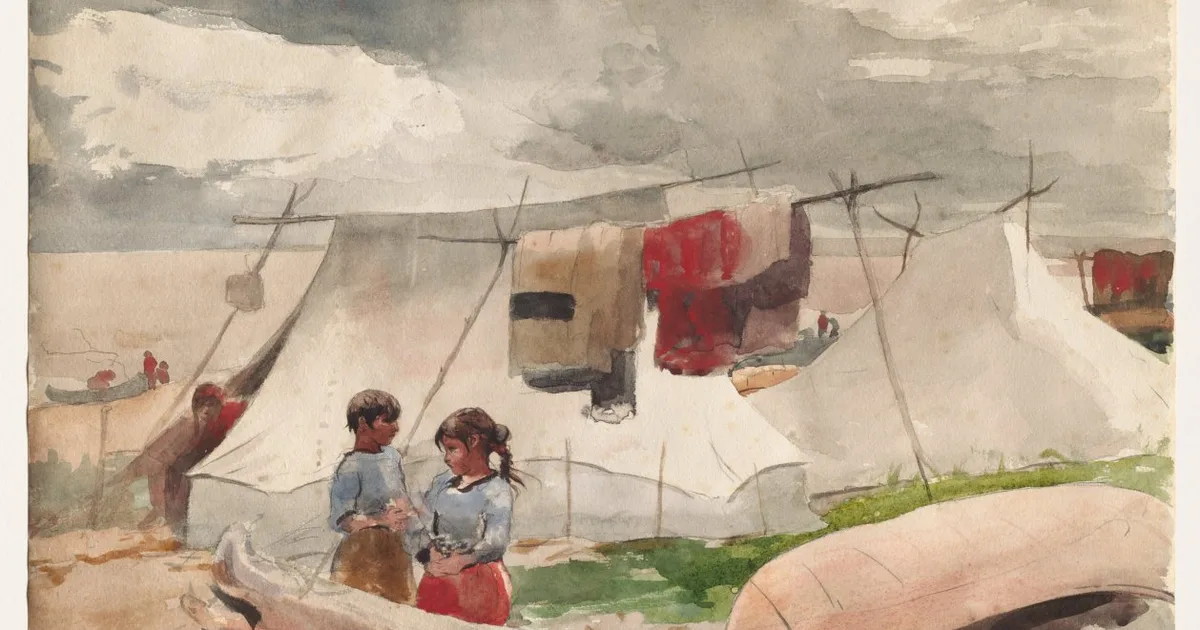
Granulating watercolors are the paints that dry with a speckle. Lay a wash of French Ultramarine on cold press paper and, as it dries, the pigment drifts into the hollows of the sheet and leaves a fine grain that a phthalo blue never shows. Painters either love it or wonder why their sky looks dusty.
This article explains what the grain is, which seven common pigments make it, how to get more or less of it, and when it helps a painting.
In short: Granulation happens when a dense, usually mineral, pigment sinks out of the wash and settles into the paper's texture. Daniel Smith rates French Ultramarine (PB29) and Burnt Sienna (PBr7) as granulating, and the phthalos, quinacridones, Hansa Yellow and Pyrrol Scarlet as non-granulating. Rough paper, more water and an undisturbed drying wash increase it. Use it for skies, stone, snow shadows and bark. Avoid stacking it in many glazes, where it goes dense.
What are granulating watercolors? (quick answer)
They are watercolors whose pigment particles clump and settle into the paper's texture as the wash dries. The wash does not spread into a smooth film. Jane Blundell, writing for Daniel Smith, defines granulation as the effect you get when the pigment particles clump together rather than settling evenly on the painted surface.
Overview
Every watercolor is pigment floating in water and gum arabic. While the wash is wet, the particles float. As it dries, light particles stay spread out. They dry as an even stain. Heavy particles sink. Daniel Smith's note on granulation says the pigment drops out of the binder and water solution and settles into the valleys of your watercolor paper, and that the heavier, denser pigments usually create granulation.
That is why the list of granulating watercolors is mostly a list of minerals. Daniel Smith says that with few exceptions, granulating paints contain one or more inorganic pigments containing metal. Ultramarine is a synthetic mineral. The earths are iron oxides. Cobalt and cerulean are cobalt compounds. The organic pigments are different. The phthalos and quinacridones that fill most bright palettes are fine, even, man-made particles. They are not much denser than the water, so they stay put and dry smooth. Blundell's rule of thumb is that the finer the particles, the less they granulate.
The paper decides how visible the grain is. Granulation needs hollows to settle into. A rough sheet shows it most. Cold press shows it clearly. Hot press barely shows it at all. The rough watercolor paper guide goes into what the deepest texture does to a wash.
7 Granulating Watercolors and What They Do
These seven cover the granulating pigments a painter is most likely to meet. The ratings come from Daniel Smith's own color pages and tutorials, checked on 7 November 2026. Other makers' versions of the same pigment usually behave the same way. Granulation belongs to the pigment, not the brand.
1. French Ultramarine (PB29). The everyday granulating blue. Daniel Smith rates it transparent, medium staining and granulating. The grain is fine and even, which suits skies, shadows on snow and the grey mixes it makes with an earth. Daniel Smith also sells a plain Ultramarine Blue from the same pigment with a smaller particle size, which it describes as slightly greener and cooler.
2. Burnt Sienna (PBr7). The everyday granulating earth. Daniel Smith rates it semi-transparent, non-staining and granulating. Mixed with French Ultramarine it gives a grey that separates into warm and cool flecks as it dries, the mix Blundell built her Jane's Grey convenience color from.
3. Cobalt Blue (PB28). Daniel Smith rates it semi-transparent, low staining and granulating, lightfastness I, and names it with Lunar Black as a typical granulating pigment. Caroline Buchanan's tutorial for the same maker lists it as a luminous color with some graininess. It is the cleaner, cooler alternative to ultramarine for a granulating sky.
4. Cerulean Blue (PB35). Daniel Smith rates it semi-transparent, non-staining and granulating. Buchanan lists cerulean among the sedimentary pigments she glazes over a stained first wash, where the grains separate enough to let the lower color sparkle through. It is pale, opaque and settles heavily.
5. Lunar Black (PBk11). An iron oxide black that Daniel Smith names first among its granulating pigments and Blundell calls perhaps the most spectacularly granulating pigment. It dries as a mottled, almost reticulated texture that works for rock, bark and stormy water.
6. Buff Titanium. Blundell's palette staple, which she describes as a granulating ecru color for marble, snow gums and pastel mixes. It is the granulating pigment to reach for when you want texture in a pale passage.
7. Goethite (PY43). Blundell's other staple, a brown ochre she pairs with Buff Titanium for beach and sandstone colors. Daniel Smith rates it granulating and lightfastness I, and like most earths it lifts easily.
Two pigments that look like they should granulate don't. Hansa Yellow Medium (PY97) and Pyrrol Scarlet (PR255) are both rated non-granulating by Daniel Smith, as are Phthalo Blue (PB15:3), Phthalo Green (PG7) and Quinacridone Rose (PV19). A six-tube split-primary palette built from those plus French Ultramarine therefore has exactly one granulating color in it.
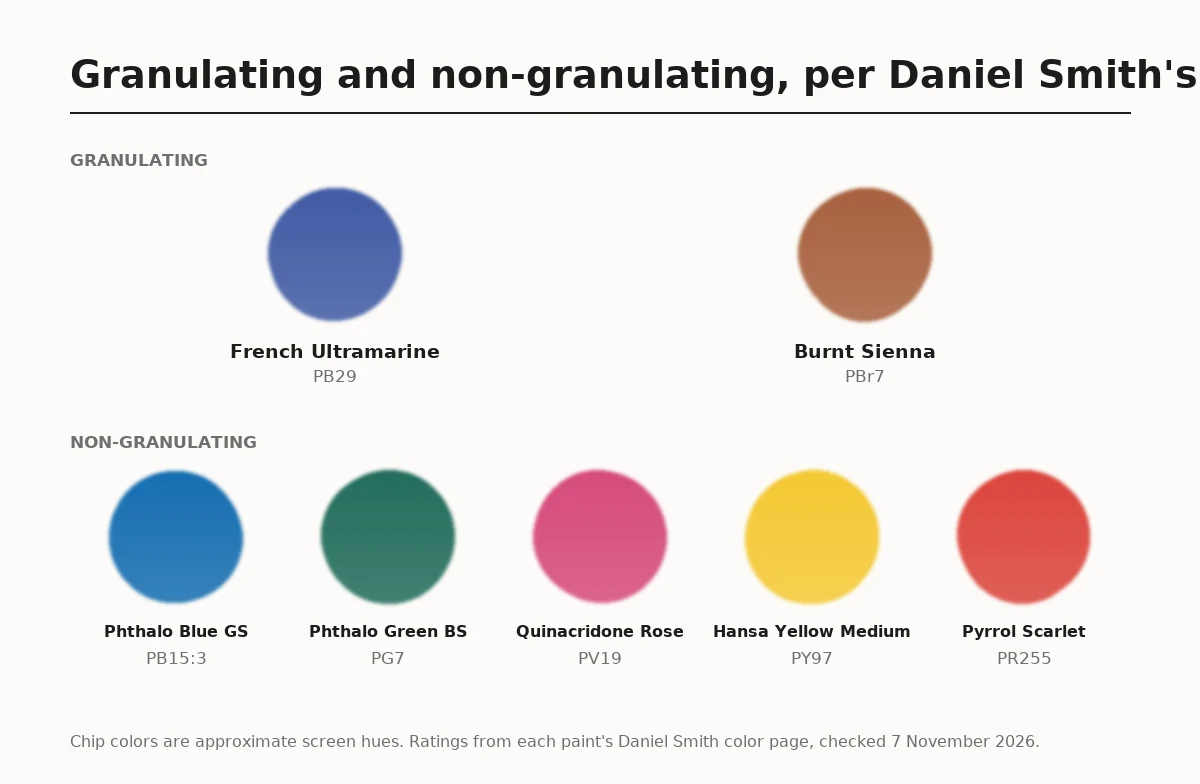 Daniel Smith's own ratings for the tubes this site uses most. Chip colors are approximate screen hues, not paint on paper.
GODEEPER: Granulation is one of four properties Daniel Smith lists for every color, beside transparency, staining and lightfastness. The student-grade comparison shows which of those survive the move to a cheaper paint. Student vs Artist Grade Watercolor: 6 Pigments Compared →
How to Get More Granulation, or Less
More water. A wet wash gives the heavy particles time and room to sink. Blundell says more water increases the effect. Daniel Smith adds a detail most painters miss: the effect increases with deionized or distilled water, because tap water's minerals interfere with how the particles settle.
Rougher paper. Deeper hollows catch more pigment. Rough shows the most, then cold press. On hot press the same wash dries nearly flat.
Leave it alone. Granulation happens while the wash dries. Brushing back into it, tilting the board or blotting while it is wet redistributes the particles and flattens the grain. Lay the wash and walk away.
Dry it flat. A tilted board pulls the heavy pigment downhill and piles it at the bottom edge. Flat drying spreads it evenly into the texture.
For less, do the opposite. Thinner washes, hot press paper, a tilted board and a quick dryer all reduce the grain. Or switch pigment: Phthalo Blue (PB15:3) instead of ultramarine gives a flat sky with no speckle at all, and Daniel Smith's smaller-particle Ultramarine Blue granulates less than French Ultramarine.
Mix granulating with non-granulating. This is the trick behind separating mixes. A granulating blue mixed with a non-granulating yellow dries with the blue grain sitting in the hollows and the yellow staining the peaks, so the green looks alive. Daniel Smith's note describes the same thing with Lunar Blue and Nickel Azo Yellow.
Supergranulating Watercolors
Schmincke's Horadam Supergranulation range takes the separating-mix idea and sells it in a tube. Each color is two or three granulating pigments blended so they pull apart as they dry. Blick lists Shire Blue, for example, as PY159 (zirconium praseodymium yellow), PB29 (ultramarine) and PG26 (cobalt green deep), at $23.50 for a 15 ml tube on 7 November 2026, item 00323-5062. Other colors in the line pair the same PY159 with cerulean, cobalt green or iron oxides.
They are convenience mixes, and that's fine. The point is that the pigments are chosen for how far apart they settle, which is hard to judge from a palette mix until you have tried many. If you already own French Ultramarine and Burnt Sienna, you own a supergranulating grey. If you want the glacier greens and desert oranges without the experimenting, the tubes save time. The Daniel Smith vs Winsor & Newton comparison covers how the big makers label granulation on their charts.
When Granulating Watercolors Help and When They Hurt
They help wherever the subject has texture you would otherwise paint by hand. Stone, bark, sand, weathered wood, rust, a cloudy sky, the shadow side of a snowdrift. One wash of a granulating pigment does the work of a hundred dry-brush marks. They also help in greys. A grey mixed from two granulating pigments separates into warm and cool flecks instead of drying as a flat dead tone, which is why ultramarine and burnt sienna is the standard shadow mix.
They hurt in three places. The first is a flat passage that should read as smooth: a clear sky, a glass, a porcelain cup. Granulation reads as dirt there. The second is glazing. Buchanan's tutorial warns that when sediments are glazed over sediments, a thickness or density eventually occurs, and that reworking them dissolves the under-color and leaves a scar. Keep granulating colors to one or two layers, or glaze a non-granulating color over them instead. The glazing guide sorts pigments by what stacks cleanly. The third is lifting. The earths and ultramarine lift easily. That is useful, but a damp brush dragged across a dry granulating wash will pick it up when you didn't mean to.
GODEEPER: The snow guide uses French Ultramarine's grain on purpose, for shadows that read as snow texture without any drawing. How to Paint Snow in Watercolor: 9 Tips for Clean Whites →
Analysis: One Granulating Blue Is Enough to Start
A beginner doesn't need a drawer of granulating watercolors. One granulating blue and one granulating earth give you the sky, the shadow grey and most of the textures above. That means French Ultramarine and Burnt Sienna. Both are rated lightfastness I by Daniel Smith, both are cheap series 1 or 2 colors, and between them they granulate in mixes as well as alone.
Add the rest as the subjects demand them. Cobalt Blue when ultramarine's warmth is wrong for a cool sky. Cerulean for a pale granulating sky over a stained wash. Lunar Black and the PrimaTeks when you paint rock and water and want the heaviest texture available. Buff Titanium and Goethite if, like Blundell, you paint sandstone and beaches.
The one habit to build early is matching the pigment to the passage. Granulating watercolors in a textured subject look like skill. The same paint in a smooth subject looks like a mistake, and the fix is usually a different tube rather than a different technique.
Frequently Asked Questions
What does granulation mean in watercolor? Granulation is the speckled, mottled texture a wash gets when the pigment particles clump and settle into the hollows of the paper instead of spreading evenly. Daniel Smith says it happens with specific pigments, nearly all of them inorganic metal-based ones that are denser than the water and binder they float in.
Which watercolors granulate the most? The heavy mineral pigments. Daniel Smith names Lunar Black (PBk11) and Cobalt Blue (PB28) as typical, and Jane Blundell calls PBk11 perhaps the most spectacularly granulating pigment. Ultramarine (PB29), the earths such as Burnt Sienna (PBr7), cerulean (PB35), Buff Titanium and Goethite (PY43) all granulate. Phthalos and quinacridones don't.
How do you make watercolor granulate more? Use rougher paper, more water, and let the wash dry undisturbed on a flat surface. Jane Blundell says rougher paper and more water increase the effect, and Daniel Smith adds that it increases with deionized or distilled water. Tilting or brushing the wash while it dries flattens the texture.
Are granulating watercolors good for beginners? Yes, with one caution. One granulating blue, French Ultramarine (PB29), gives a beginner free texture in skies, shadows and snow. The caution is layering. Daniel Smith's tutorials note that sedimentary colors glazed over each other go dense, and they can lift and scar if you brush over them again. Keep them to one or two layers.
What are Schmincke supergranulating watercolors? A Horadam range built from two or three granulating pigments in one tube, so the colors separate as they dry. Blick lists Shire Blue, for example, as PY159, PB29 and PG26 at $23.50 for 15 ml in November 2026. They're convenience mixes, so you can get similar effects by mixing your own granulating pigments.
Related Reading
- Hot Press vs Cold Press Watercolor Paper: 3 Surface Types: how much grain each surface shows from the same wash.
- Best Watercolor Paints for Beginners: 5 Sets Compared: which starter sets include a granulating blue.
- 10 Easy Winter Watercolor Ideas From a 4-Tube Palette: ten scenes that lean on ultramarine's grain for snow.
- Flat Wash Watercolor Technique: Flat and Graded in 5 Steps: the wash a granulating pigment needs to settle evenly.
References
- Daniel Smith: What causes granulation in watercolors?
- Daniel Smith: Jane Blundell, Granulating Watercolors What and Why
- Daniel Smith: Making Sense of Staining, Sedimentary and Transparent Pigments, by Caroline Buchanan
- Daniel Smith: French Ultramarine Watercolor
- Daniel Smith: Burnt Sienna Watercolor
- Daniel Smith: Phthalo Blue (Green Shade) Watercolor
- Daniel Smith: Cobalt Blue Watercolor
- Daniel Smith: Cerulean Blue Watercolor
- Daniel Smith: Goethite (Brown Ochre) Watercolor
- Blick: Schmincke Horadam Aquarell Shire Blue, Supergranulation, 15 ml
- Handprint: The watercolor pigments
- The Cleveland Museum of Art: Winslow Homer, Indian Camp, Roberval, P.Q., 1895 (hero image, CC0)

Written by
Elena VancePigments & Color Editor
Elena Vance writes Watercolor Daily's pigment and color coverage: Colour Index codes, lightfastness ratings, transparency, and palette building.
NextKeep reading
Guides / 9 min
Split-Primary Palette Guide: Mix Any Color with 6 Tubes
Guides / 12 min
Rough Watercolor Paper: Granulation, Dry Brush and 6 Steps
Reviews / 8 min
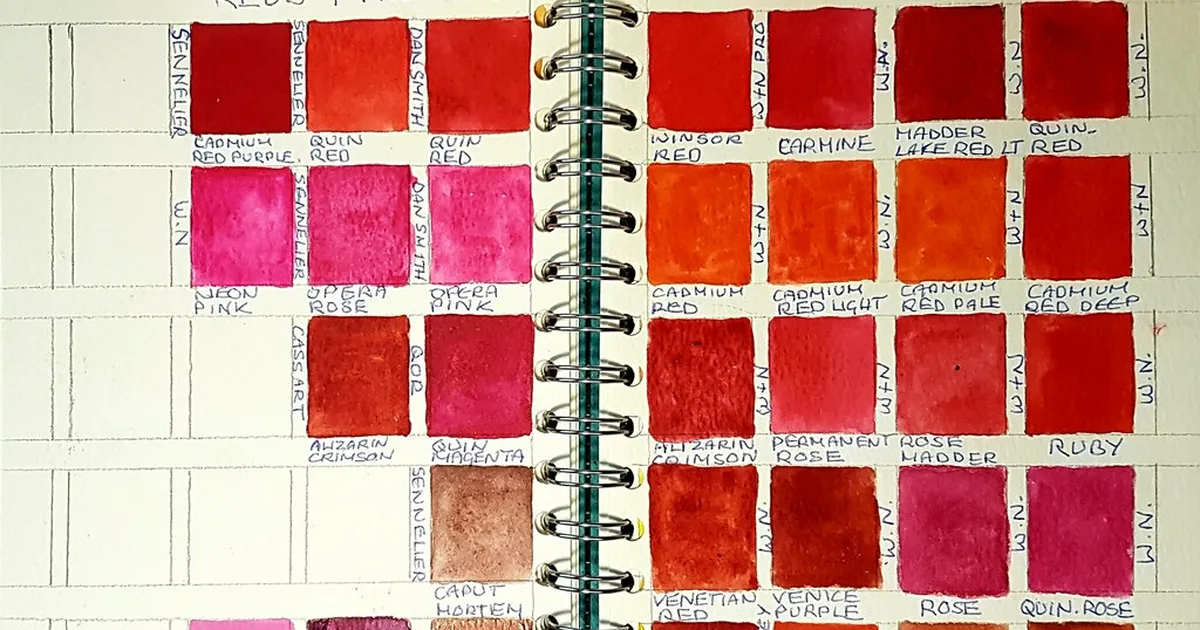
Daniel Smith vs Winsor & Newton: Pro Watercolor Review
Guides / 9 min
Watercolor for Beginners: Essential Supplies & Buying Guide
Features / 14 min
12 Easy Watercolor Flower Ideas Sorted by Brush Stroke
Features / 14 min
10 Watercolor Birthday Card Ideas From 3 Tubes of Paint
Features / 11 min
Watercolor Block vs Pad vs Sheets: Cost per Square Inch
Features / 13 min
Best Watercolor Paints for Beginners: 5 Sets Compared
Disclaimer
This article is published for informational purposes and is not professional advice. Product formulations, pigment sources, packaging and store listings change. Check the details that matter to you (price, pigment content, regional availability) with the manufacturer or retailer before you buy.
Brands in this article
Daniel Smith