Loading
Watercolor Daily · Features
10 Easy Winter Watercolor Ideas From a 4-Tube Palette
Easy winter watercolor ideas, 10 scenes painted from 4 tubes with no green or white paint. Each lists its colors, pigment codes, paper, time and steps.
13 min readBy Marcus Reed
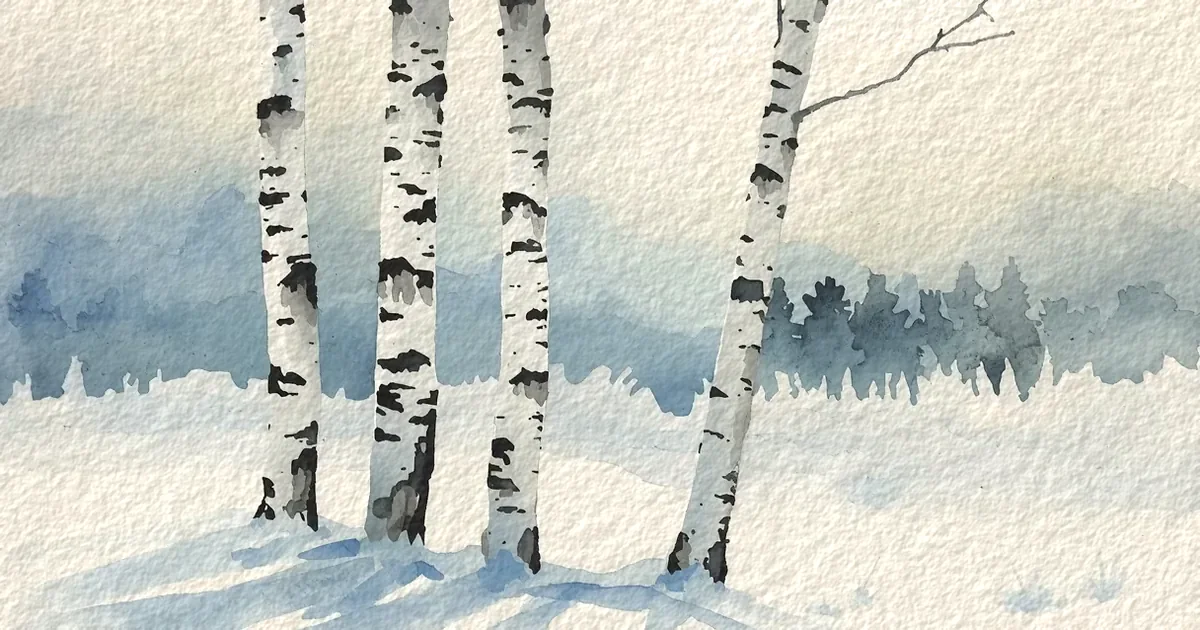
These 10 easy winter watercolor ideas all come from four tubes of paint, and none of them needs a green or a white tube. You mix every pine, shadow and grey from a blue, a brown, a yellow and a red. The snow is simply the paper you leave alone.
Most winter idea lists give you a picture and a title. Each idea below also gives you the colors with their pigment codes, the paper, a rough time and the order to paint it in.
In short: Buy four tubes: French Ultramarine (PB29), Burnt Sienna (PBr7), Hansa Yellow Medium (PY97) and Pyrrol Scarlet (PR255). Paint on 300 gsm (140 lb) cold-press paper. Start with the birch trees, which take about 20 to 30 minutes, then work up to the fog forest and the fox.
Which easy winter watercolor ideas should you try first? (quick answer)
Birch trees in snow, a snowy mountain range and a frozen pond. Each one is mostly bare paper with a few pale washes, so there is little to mix and almost nothing to fix. Paint those first, then try the sunset and the fog forest, which need a wet-on-wet sky.
Overview
Every idea on this list uses the same short supply list.
Paper. Cold-press watercolor paper at 300 gsm (140 lb). Cold press means the sheet has a light tooth, or grain, that holds paint well. Winter skies are big wet washes, so use a block glued on four sides or a stretched sheet. If you're working from loose sheets, here is how to stretch watercolor paper so it dries flat.
Brushes. A medium round (around a size 8) for skies and trees, and a small round (around a size 4) for twigs, beaks and window frames. A flat brush helps for the sunset, but a big round works too.
Paint. Four tubes, all from Daniel Smith's Extra Fine range. Each is a single pigment rated lightfastness I (Excellent) on the maker's chart, which means it won't fade on display.
- Blue, French Ultramarine (PB29): a warm, transparent blue that granulates, meaning its pigment settles into the paper's grain. That speckle reads as snow texture.
- Brown, Burnt Sienna (PBr7): a transparent, non-staining earth. "Non-staining" means you can still lift it out with a damp brush after it dries.
- Yellow, Hansa Yellow Medium (PY97): a mid yellow for sunsets, lit windows and greens.
- Red, Pyrrol Scarlet (PR255): a bright red for the cardinal, berries and the mug. Daniel Smith rates it semi-transparent and medium staining.
Four mixes do most of the work. Snow shadow is very watery blue with a touch of brown. Bark grey is the same two colors, much stronger. Winter green is blue and yellow with a little brown to dull it. Fox orange is brown with a touch of red. The split-primary palette guide explains why a short palette mixes cleaner colors than a big set.
Two extras are optional: masking fluid for snowflakes, and an opaque white such as Winsor & Newton Titanium White (PW6) for a few late highlights.
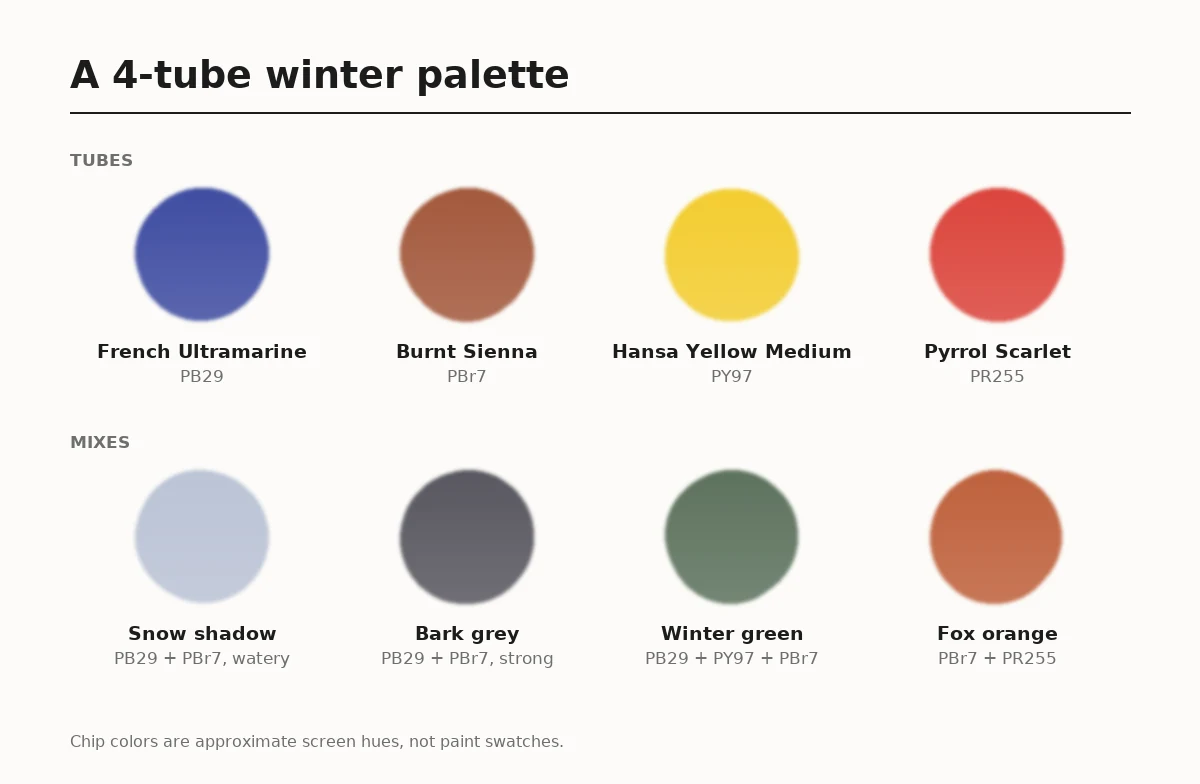 Chart of the four tubes and the four mixes used across the ideas. Chip colors are approximate screen hues.
Easy Winter Watercolor Ideas: Snowy Landscapes
These five winter watercolor ideas are mostly sky, snow and a few trees. Start here.
1. Birch Trees in Snow
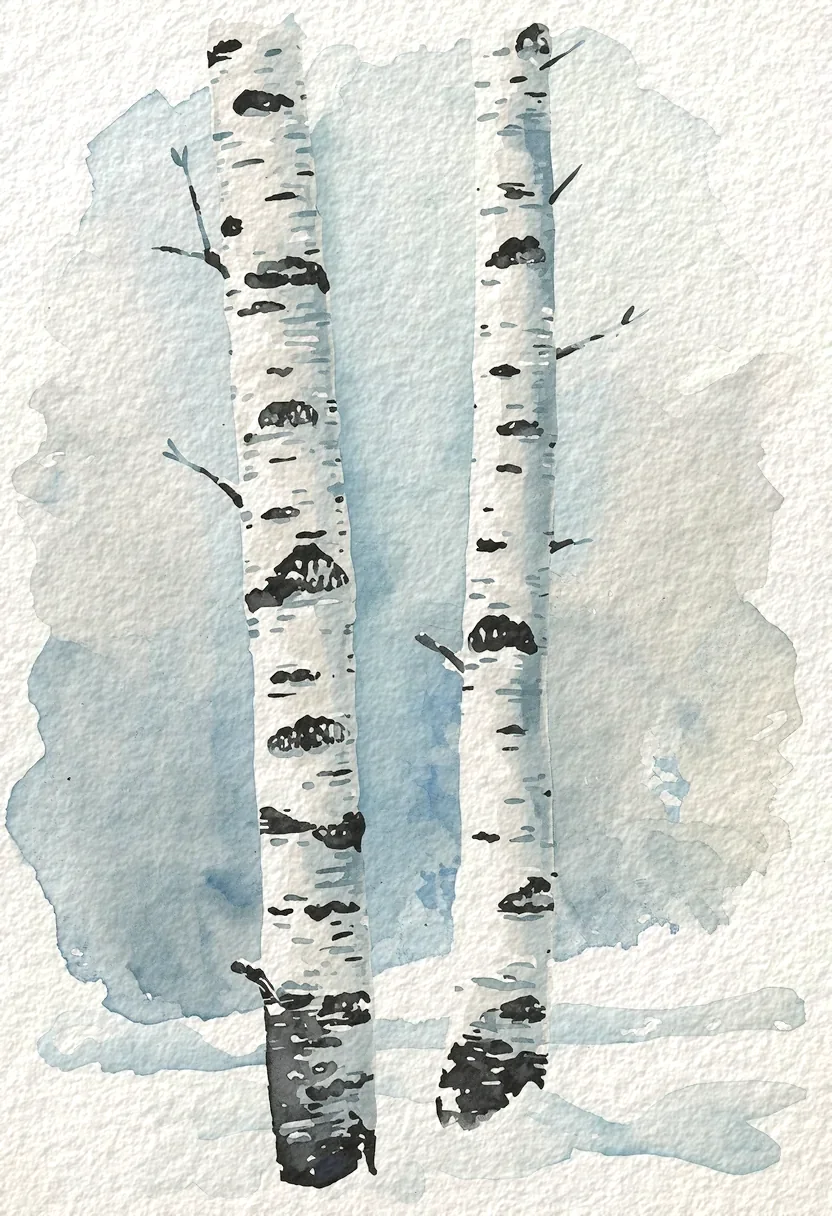 Two birch trunks left as bare paper, the bark added as dark dashes once the background dried.
Three or four white trunks standing in snow, with a soft blue-grey wood behind them. It is the easiest idea on the list.
- Palette: blue (PB29), brown (PBr7)
- Paper: 300 gsm cold press
- Time: about 20 to 30 minutes · Difficulty: easy
1. Paint around the trunks. Wash pale snow shadow over the background, leaving three or four vertical strips of bare paper. 2. Let it dry. Wait until the shine is gone and the paper feels cool, not damp. 3. Add the bark. Paint short sideways dashes of bark grey across each trunk, then a pale blue shadow at each base.
2. Snowy Mountain Range
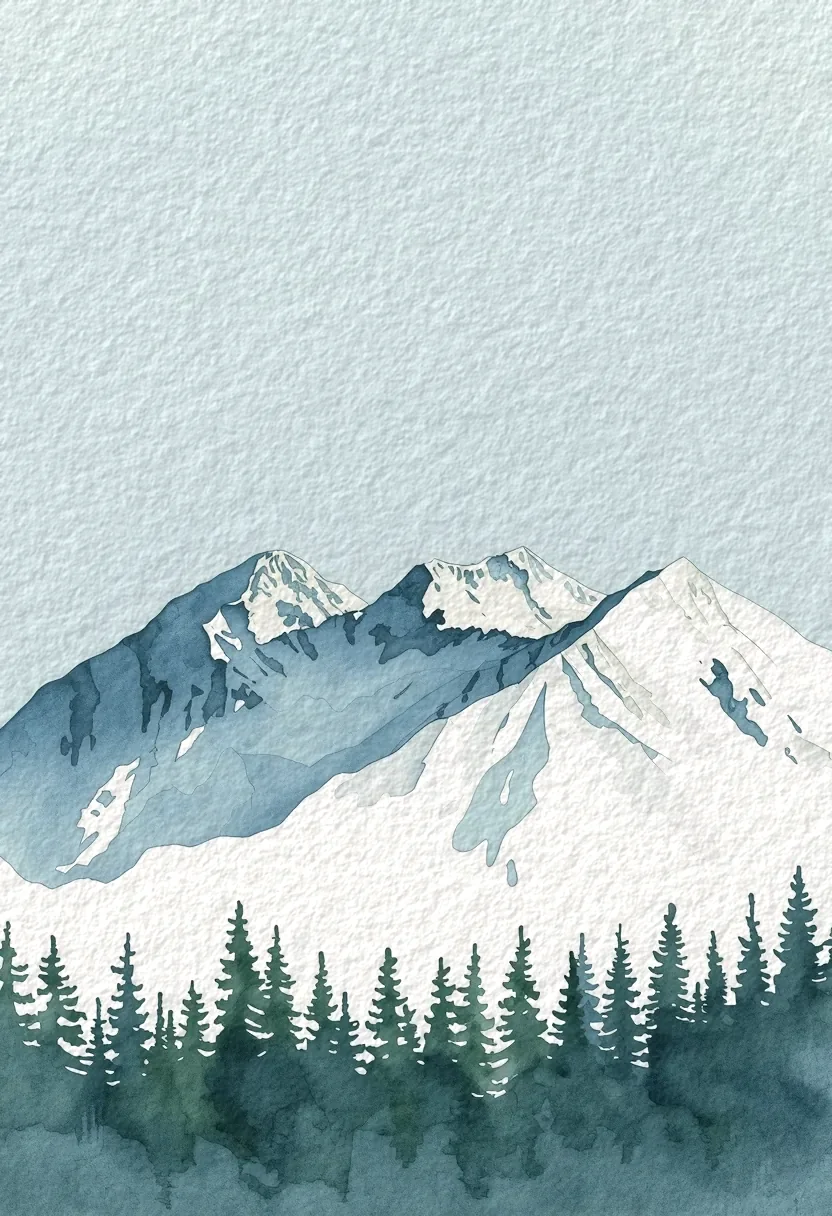 The shadowed faces carry the paint. The sunlit slopes are untouched paper.
A row of peaks with sunlit snow on one side and blue shadow on the other. The light side is just paper.
- Palette: blue (PB29), brown (PBr7), a little yellow (PY97)
- Paper: 300 gsm cold press
- Time: about 25 minutes · Difficulty: easy
1. Paint the sky. Lay a pale blue wash across the top, stopping at the mountain outline. 2. Shade one side. When the sky is dry, paint snow shadow down the left face of each peak and leave the right face white. 3. Add a foreground. Paint a band of winter green trees along the bottom to set the mountains back in the distance.
3. Frozen Pond
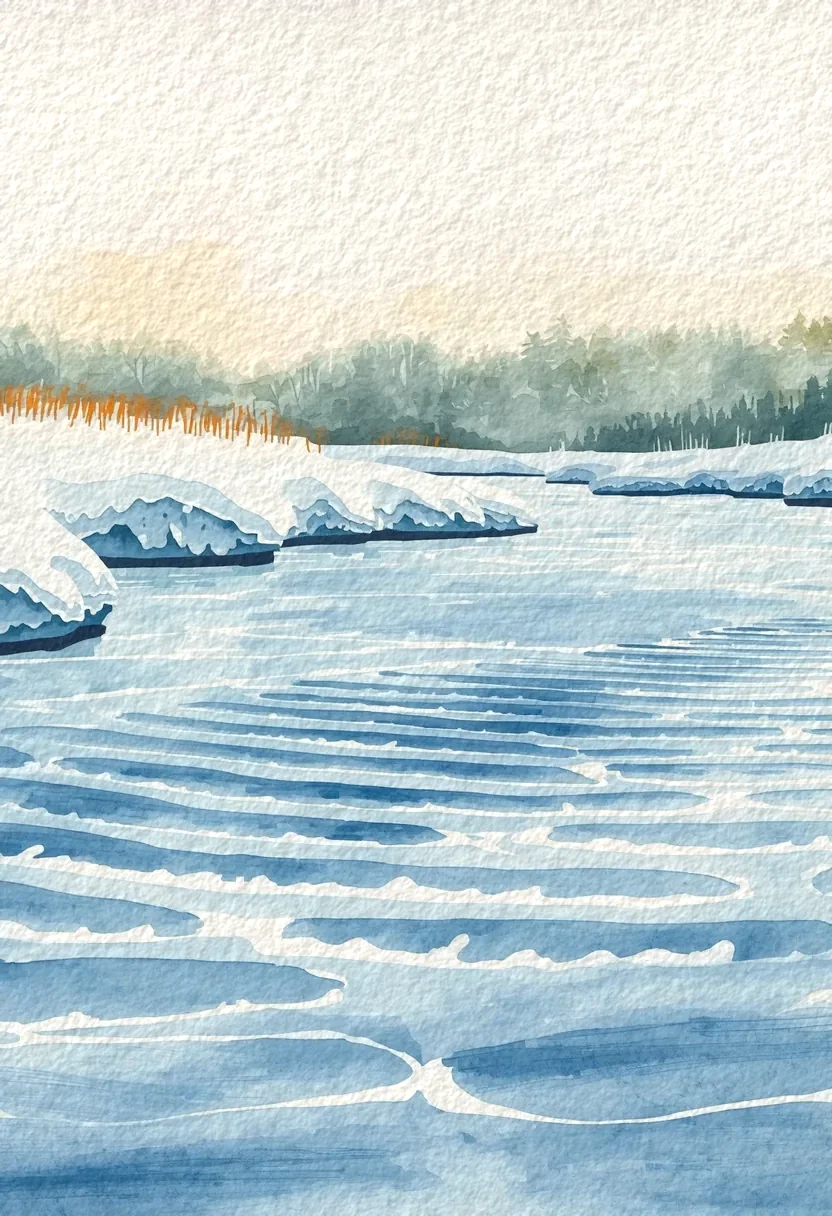 Long horizontal strokes with white gaps make the ice read as flat. The brown reeds on the far bank are an optional extra.
A flat pond under a pale sky, ringed by snow banks and a distant tree line. Horizontal strokes make the ice look flat.
- Palette: blue (PB29), yellow (PY97), brown (PBr7)
- Paper: 300 gsm cold press
- Time: about 30 minutes · Difficulty: easy
1. Paint the tree line. Brush winter green onto damp paper along the horizon so the far trees stay soft. 2. Stroke in the ice. When dry, pull long horizontal strokes of pale blue across the pond, leaving thin white gaps between them. 3. Shade the banks. Paint a curved blue shadow where each snow bank meets the ice.
4. Winter Sunset Over a Snowfield
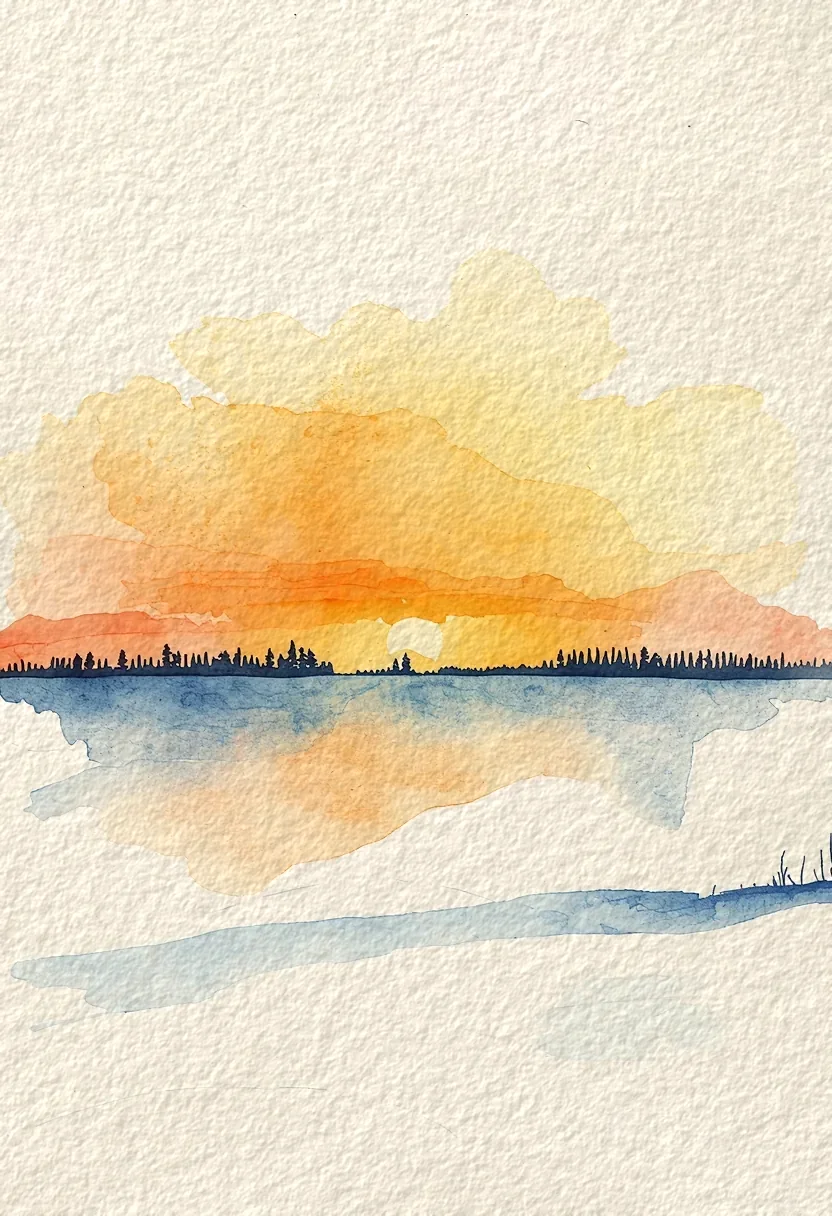 Yellow and orange melt into each other because they went onto wet paper. The field below is mostly bare paper.
A glowing sky that fades from yellow to peach to blue, over a field of snow with long shadows. The sky is one wet-on-wet wash.
- Palette: yellow (PY97), red (PR255), blue (PB29)
- Paper: 300 gsm cold press, taped or blocked
- Time: about 35 minutes · Difficulty: easy+
1. Wet the sky. Brush clean water over the sky area only, stopping at the horizon. 2. Drop in the colors. Lay yellow at the horizon, a peach of yellow and a touch of red above it, and pale blue at the top. Let them blend on their own. The wet-on-wet watercolor technique guide covers the timing. 3. Add the field. When dry, paint a few dark tree shapes on the horizon and long blue shadows across the white field.
5. Foggy Pine Forest
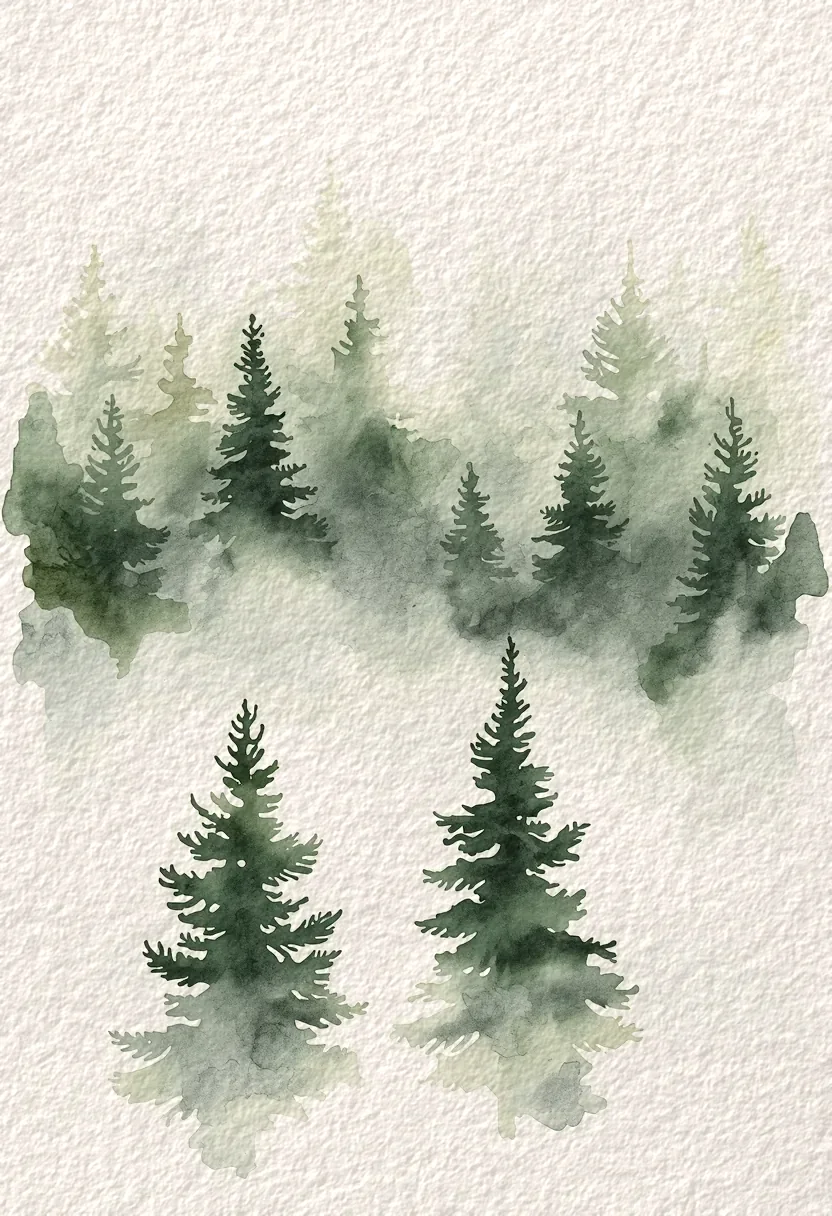 Three rows of pines, each one darker and sharper than the row behind it.
Rows of pines that fade into mist, pale at the back and dark at the front. It teaches you to paint in layers of light to dark.
- Palette: blue (PB29), yellow (PY97), brown (PBr7)
- Paper: 300 gsm cold press
- Time: about 45 to 60 minutes · Difficulty: intermediate
1. Paint the far trees. On damp paper, touch in very pale winter green pine shapes so they blur into the fog. 2. Paint the middle row. When dry, add slightly darker pines in front, wet-on-dry, so their edges stay sharper. 3. Paint the front row. Finish with two or three dark pines in strong winter green and bark grey at the bottom of the page.
The middle and front rows use the wet-on-dry watercolor technique. Each layer has to dry before the next, or the rows melt into one.
GODEEPER: Every landscape above leans on clean whites and blue shadows. The snow guide covers masking fluid, salt texture and opaque white in more depth. How to Paint Snow in Watercolor: 9 Tips for Clean Whites →
Winter Watercolor Ideas With Animals and Plants
These three winter watercolor ideas add one bright color against the snow. They take a little more care with drying.
6. Cardinal on a Snowy Branch
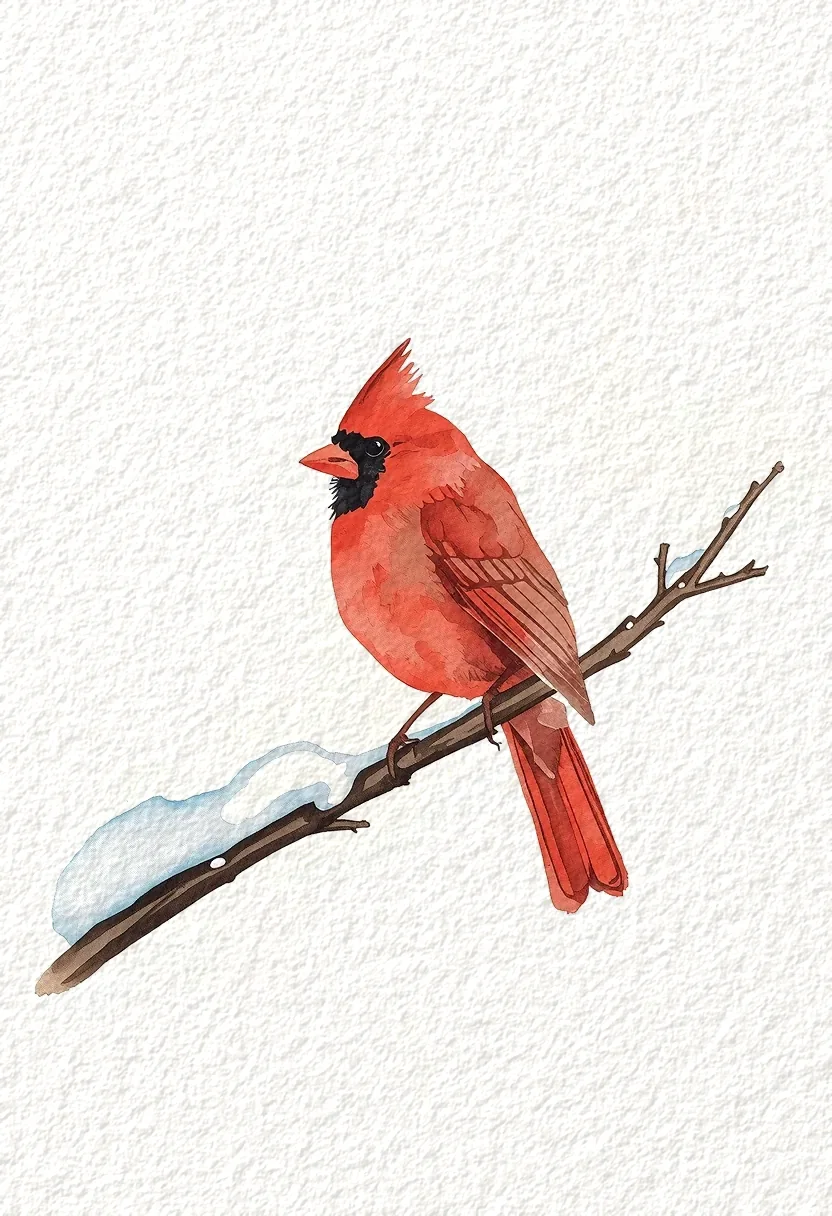 One bright red against a white page. The snow on the branch is bare paper with a touch of blue.
A red bird on a dark branch, with a cap of snow on the twig. The red against white does most of the work.
- Palette: red (PR255), brown (PBr7), blue (PB29)
- Paper: 300 gsm cold press
- Time: about 30 to 40 minutes · Difficulty: easy+
1. Paint the body. Paint the bird's round body in red, leaving a tiny dot of paper for the eye's shine. 2. Darken the wing. While the body is still damp, touch red mixed with a little brown onto the wing so it blends softly. 3. Add the branch and mask. When dry, paint the branch in bark grey with bare paper left along its top for snow, then the dark face mask around the beak.
7. Winter Berries on Bare Twigs
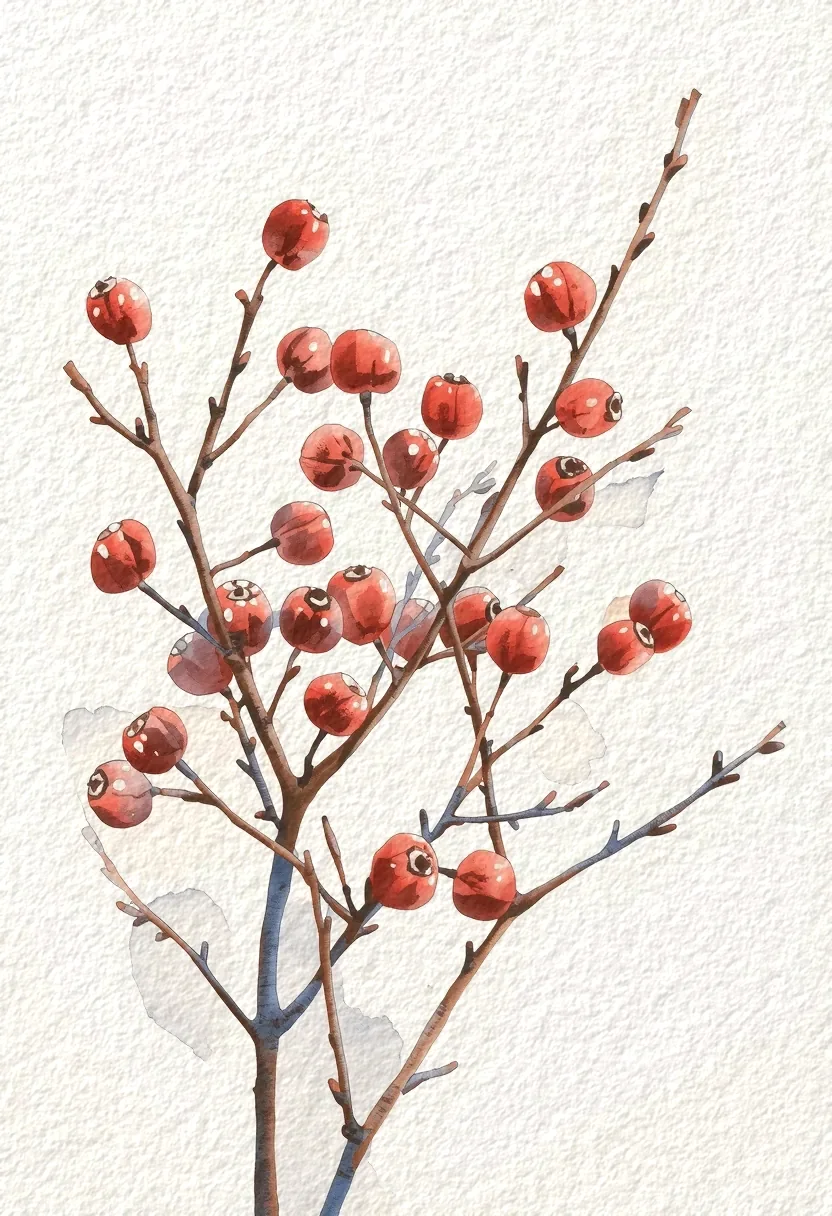 Each berry keeps a small dot of bare paper, which reads as shine.
Clusters of red berries on thin brown twigs, against a pale frosty background. The berries need only one color.
- Palette: red (PR255), brown (PBr7), blue (PB29)
- Paper: 300 gsm cold press
- Time: about 25 minutes · Difficulty: easy
1. Paint the twigs. Use the small round and burnt sienna to draw a few thin, branching twigs. 2. Add the berries. When the twigs are dry, paint small red circles in clusters, skipping a dot near the top of each for shine. 3. Add a frosty wash. Brush very pale blue around the outer edges of the page, so the center stays bright.
8. Red Fox in the Snow
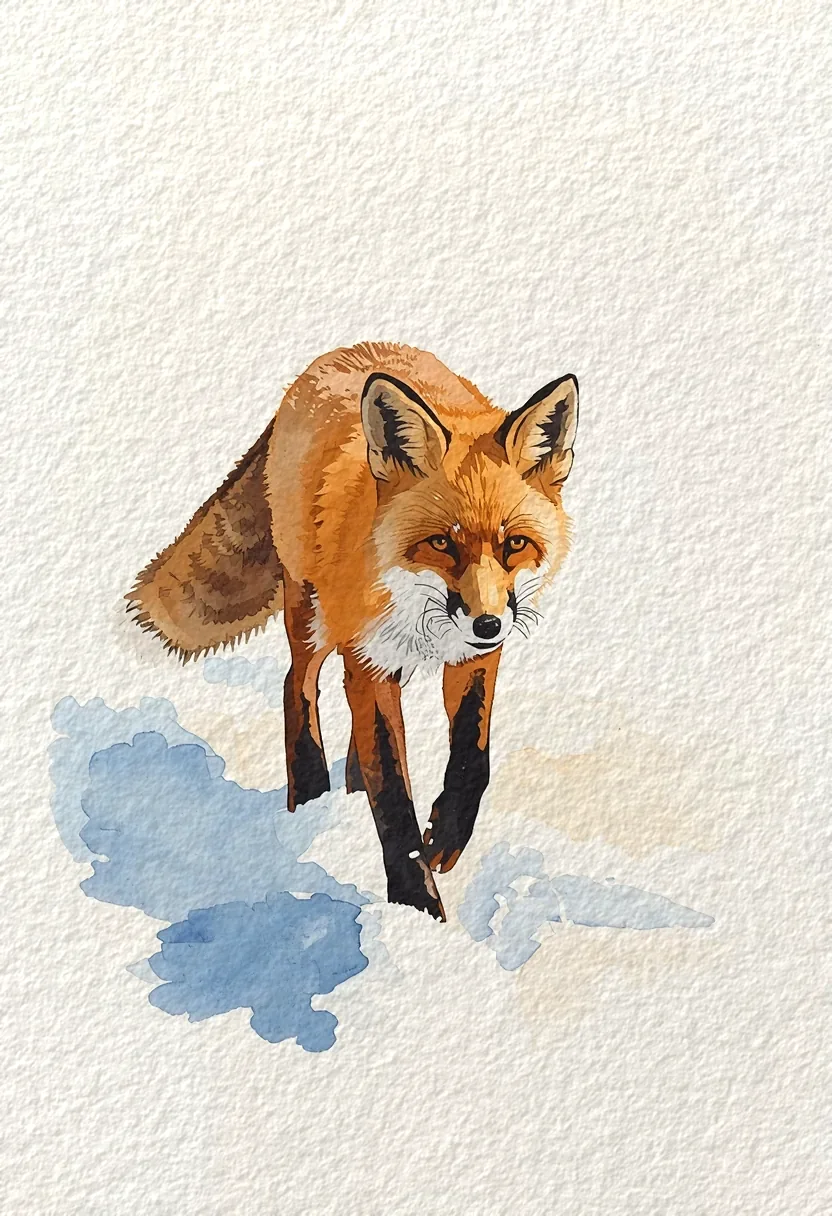 The white chest is bare paper, and the blue patches under the paws keep the fox standing in the snow.
A fox curled or walking through snow, with a white chest and dark legs. This one has the most shapes, so save it for later.
- Palette: brown (PBr7), red (PR255), blue (PB29)
- Paper: 300 gsm cold press
- Time: about 45 to 60 minutes · Difficulty: intermediate
1. Paint the coat. Fill the body and tail with fox orange, leaving the chest and tail tip as bare paper. 2. Darken the legs and ears. When dry, paint the lower legs and ear backs in bark grey. 3. Ground it. Paint a pale blue shadow under the fox so it sits in the snow instead of floating.
GODEEPER: French Ultramarine granulates more on a rough sheet, which suits snow shadows and fox fur. The rough paper guide shows how texture changes a wash. Rough Watercolor Paper: Granulation, Dry Brush and 6 Steps →
Cozy Winter Watercolor Ideas
These last two easy winter watercolor ideas are warm scenes, for evenings when you want something quick and bright.
9. Mug of Hot Cocoa With Steam
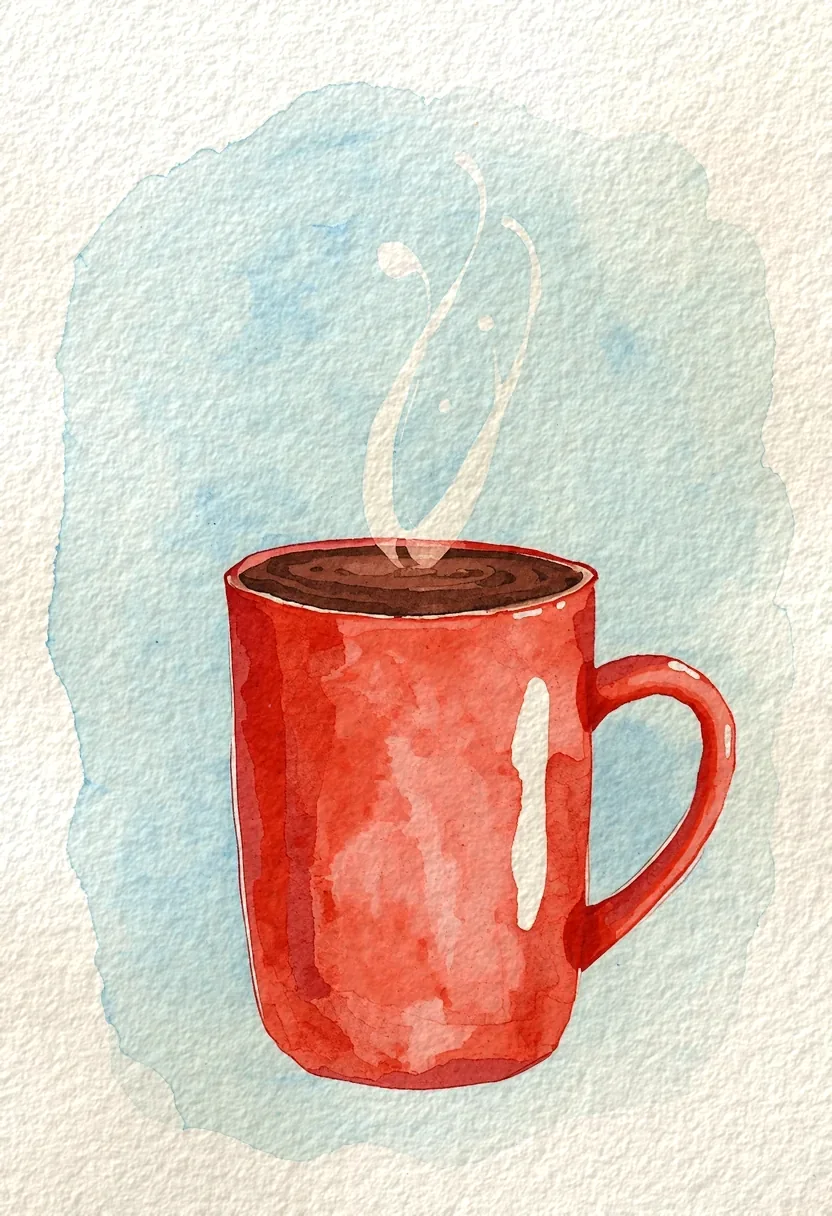 The steam is paper left white inside the blue background.
A red mug with dark cocoa and a few wisps of steam rising. The shapes are simple, and it makes a nice small piece to frame.
- Palette: red (PR255), brown (PBr7), blue (PB29)
- Paper: 300 gsm cold press
- Time: about 20 to 30 minutes · Difficulty: easy
1. Paint the mug. Paint the mug body in red, leaving a thin white strip down one side for the shine. 2. Add the cocoa. When dry, fill the top oval with a dark mix of brown and a little blue. 3. Leave the steam. Paint a pale blue background behind the mug and leave two or three curvy wisps of bare paper for steam.
10. Cabin With a Glowing Window at Dusk
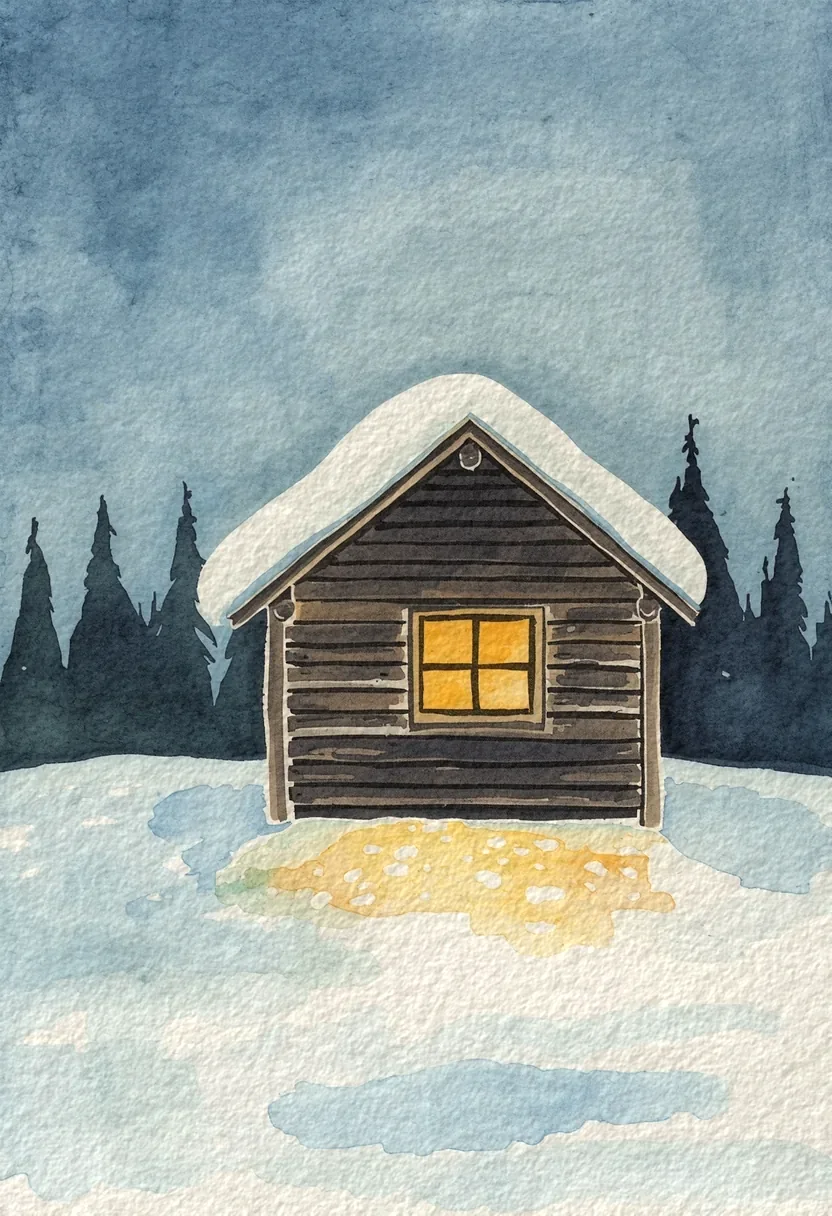 The window light spills onto the snow as a soft yellow wash.
A small cabin under a dim evening sky, roof covered in snow, one window glowing yellow. The glow is bare paper tinted with yellow.
- Palette: blue (PB29), brown (PBr7), yellow (PY97)
- Paper: 300 gsm cold press
- Time: about 40 minutes · Difficulty: easy+
1. Paint the dusk sky. Wash a darker blue-grey across the sky, leaving the roof line white. 2. Paint the cabin. When dry, paint the walls in bark grey, leaving a small square for the window. 3. Light the window. Fill the window with yellow, then soften a faint yellow halo onto the snow just below it.
Analysis: Which Easy Winter Watercolor Ideas to Paint First
Work through these easy winter watercolor ideas in an order that builds one skill at a time. Start with the birch trees (idea 1), which teach you to paint around white shapes. The mountains (idea 2) add shadow on one side, and the frozen pond (idea 3) adds soft edges on damp paper.
From there, the sunset (idea 4) is your first full wet-on-wet sky. The fog forest (idea 5) is the hardest landscape, because it asks you to wait between three layers. If it goes muddy, the layers were not dry.
The berries (idea 7) and the mug (idea 9) are good rest days. They're small, quick and use one main color. The cardinal (idea 6) and the fox (idea 8) come last, since they need both soft blending and crisp edges in one piece.
Because all 10 ideas share four tubes, you can paint in batches. Mix one big pool of snow shadow and use it for ideas 1, 2, 3 and 8 in a single sitting. Then mix winter green for 2, 3 and 5. Painting two ideas side by side uses the drying time well, since one dries while you work on the other.
Frequently Asked Questions
What is the easiest winter scene to paint in watercolor? Birch trees in snow. You paint a pale blue-grey background and leave a few vertical strips of paper white for the trunks. Once it dries, a few dark dashes turn the strips into birch bark. There is no drawing and no blending, and a first try takes about 20 to 30 minutes.
What colors do I need for winter watercolor paintings? Four tubes cover every idea here: French Ultramarine (PB29), Burnt Sienna (PBr7), Hansa Yellow Medium (PY97) and Pyrrol Scarlet (PR255). Mix muted winter greens from the blue and yellow, and snow greys from the blue and brown. You don't need a green or white tube.
What paper should I use for winter watercolor scenes? Cold-press watercolor paper at 300 gsm (140 lb), ideally 100% cotton. Winter skies and sunsets are big wet washes, and lighter paper buckles under them. Use a block glued on four sides, or stretch a loose sheet first so it dries flat and the washes stay even.
How do you paint white snow in watercolor without white paint? Leave the paper bare. In transparent watercolor the paper is the brightest white you have, so snow is the area you don't paint. You shape it with pale blue-grey shadows around it and dark trees or buildings behind it. Keep opaque white for a few last-minute specks only.
How long does a simple winter watercolor painting take? Most ideas here take 20 to 45 minutes, and much of that is drying time between layers. The fog forest and the fox take longer, around an hour, because each layer must dry before the next goes on. Paint two ideas side by side to use the waiting time.
Related Reading
- 12 Easy Watercolor Christmas Card Ideas for Beginners: holiday cards from a five-tube palette, with the same idea format.
- Best Watercolor Paper for Beginners: Why 100% Cotton Matters: why cotton paper keeps a wet winter sky workable for longer.
- Best Watercolor Brushes for Beginners: 3 Shapes to Buy: the round and flat brushes these ideas call for.
References
- Daniel Smith: French Ultramarine Watercolor
- Daniel Smith: Burnt Sienna Watercolor
- Daniel Smith: Hansa Yellow Medium Watercolor
- Daniel Smith: Pyrrol Scarlet Watercolor
- Daniel Smith: Watercolor pigment characteristics chart (PDF)
- Winsor & Newton: Professional Watercolour Titanium White
- Handprint: The watercolor pigments

Written by
Marcus ReedTechnique Editor
Marcus Reed writes Watercolor Daily's step-by-step technique guides: wet-on-wet washes, glazing, dry brush, and the water control underneath them.
NextKeep reading
Features / 14 min
12 Easy Watercolor Ideas for Beginners From 3 Tubes
Features / 14 min
11 Christmas Watercolor Ideas to Paint With 5 Tubes
Features / 15 min
12 Easy Watercolor Christmas Card Ideas for Beginners
Features / 14 min
10 Watercolor Birthday Card Ideas From 3 Tubes of Paint
Features / 14 min
12 Easy Watercolor Flower Ideas Sorted by Brush Stroke
Guides / 10 min
How to Paint Snow in Watercolor: 9 Tips for Clean Whites
Guides / 11 min
Dry Brush Watercolor Technique: 8 Tips for Broken Texture
Guides / 14 min
How to Clean Watercolor Brushes: 7 Steps, 3 Ways to Dry
Disclaimer
This article is published for informational purposes and is not professional advice. Product formulations, pigment sources, packaging and store listings change. Check the details that matter to you (price, pigment content, regional availability) with the manufacturer or retailer before you buy.