Loading
Watercolor Daily · Guides
Best Watercolor Brushes for Beginners: 3 Shapes to Buy
16 min readBy Arthur Sterling
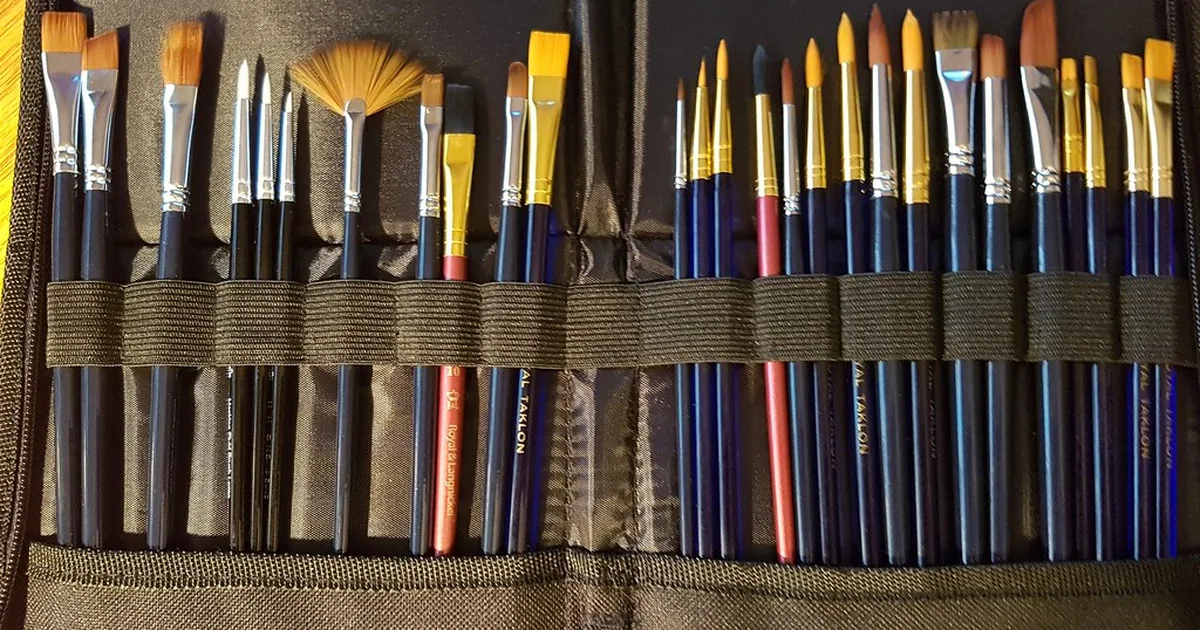
Photo: CharmaineZoe's Marvelous Melange, Flickr, CC BY 2.0
Review
Watercolor Brushes
The best watercolor brushes for beginners are three synthetic brushes: a medium round, a flat, and a soft mop or quill. That set covers washes, edges and detail for a fraction of what one sable costs. The harder part is choosing the round, because the number on the handle doesn't tell you how big the brush is. Blick states on its own product pages that brush sizes are not standardized between manufacturers. Below are the three shapes, the hair types, and a short test you can run before paying for any brush.
In short: Buy a synthetic round near size 8, a flat about one inch wide, and a soft synthetic mop or quill. Choose the round by its listed width in millimeters: Blick lists size 8 rounds from 4.40 mm (Escoda Optimo) to 5.1 mm (Da Vinci Casaneo). Skip Kolinsky sable until you can clean and store brushes without thinking about it.
What are the best watercolor brushes for beginners? (quick answer)
A synthetic round around size 8, a one-inch flat and a synthetic mop or quill. Pick the round by its width in millimeters, test that it returns to a sharp point when wet, and leave natural sable for later.
Key Takeaways
- The best watercolor brushes for beginners come in three shapes: a round for painting and detail, a flat for edges and even washes, and a mop or quill for wetting paper and laying large washes.
- Size numbers aren't a standard. Three size 8 rounds sold at Blick measure 4.40 mm, 4.5 mm and 5.1 mm wide.
- Start with synthetics. Princeton's Neptune and Heritage lines are built to imitate squirrel and sable at a much lower price.
- Check the point before the brand. A wet round that won't come back to a single sharp tip will fight you on every detail.
- Rinse, reshape and dry flat after each session, and never leave a brush resting on its tip in the water jar.
Overview
This guide is for painters looking for the best watercolor brushes for beginners, whether that's a first purchase or a replacement for a cheap mixed set that came with a paint box. It explains what each of the three core shapes does, how synthetic, natural and blended hair behave, and how to judge a brush in a shop or on arrival.
It does not rank every brush on the market or cover specialty shapes such as fans, daggers and riggers. Those are worth buying once you know which marks you keep wanting to make.
You'll get more out of the advice if you already have paper that can take water. Brushes behave very differently on thin cellulose paper than on 300 gsm cotton, and a brush that seems to dump too much water on a cheap pad may be perfectly fine on a heavier sheet. No painting experience is assumed.
The in-store test in the Step-by-Step section takes a few minutes per brush, and brush care adds a few minutes to the end of each painting session.
Why Brush Size Numbers Do Not Match Between Brands
A size number only compares brushes within one maker's line. Blick lists the width and length of every brush it sells, and the figures for three size 8 rounds show the spread: 4.40 x 20 mm for an Escoda Optimo Kolinsky travel brush, 4.5 x 20 mm for a Dynasty Water Lily synthetic, and 5.1 x 25 mm for a Da Vinci Casaneo synthetic squirrel.
That is a difference of more than half a millimeter in width and five millimeters in length between brushes with the same number. In practice, the longer, fatter head carries more water and lays a broader stroke. The shorter one gives you more control at the tip.
Blick's product pages add that "brush sizes are not standardized," and that because fine art brushes are made by hand, two brushes from the same line can differ slightly too.
So when you shop for the best watercolor brushes for beginners, read the dimensions before you read the number. When a shop or maker lists width and length, compare those. When it doesn't, compare brushes side by side in the shop, or buy one brush first and measure it before ordering a set.
Most round brushes are sold in sizes that run from tiny 000 detail brushes up to around 24. For a first round, the middle of that range is the useful part, and it's where most of the best watercolor brushes for beginners sit.
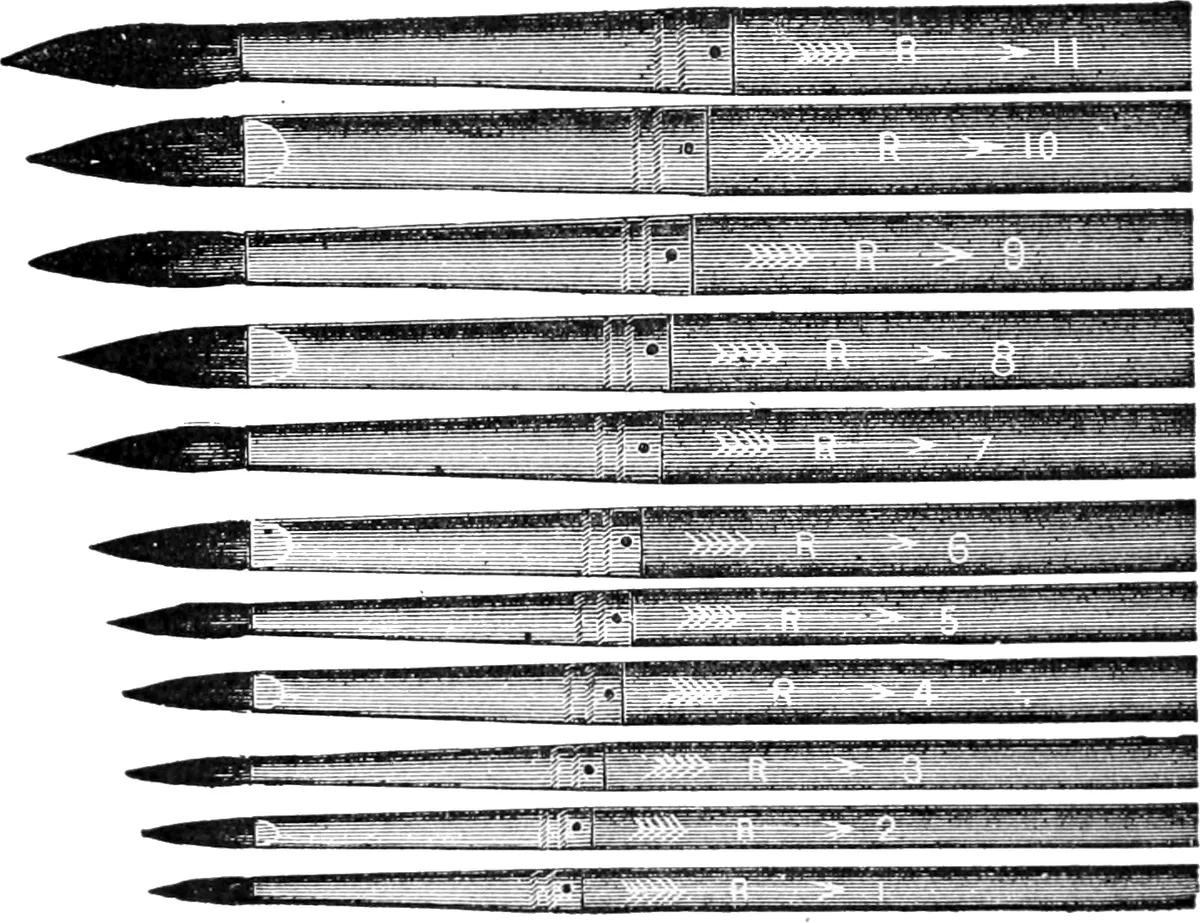 George D. Armstrong, Cyclopedia of Painting (1908), Fig. 25, public domain via Wikimedia Commons. Red sable rounds numbered 1 to 11. Within one line the sizes step up evenly, but nothing ties this maker's No. 8 to anyone else's.
Synthetic, Natural or Blend: Hair for the Best Watercolor Brushes for Beginners
Choose synthetic hair for your first brushes. Synthetics cost far less, survive scrubbing and accidental neglect, and the better modern fibers hold enough water for real washes. Natural hair brushes hold more and release it more evenly, but they're expensive and less forgiving of mistakes.
Synthetic sable: the all-round round
Synthetic sable is made to copy the spring and point of a sable round. Princeton's Heritage Series 4050 is a long-running example. Princeton says it was the company's first synthetic sable, introduced more than 30 years ago and made from a blend of golden taklon in multiple diameters "to enhance color holding capacity and natural snap." The company credits its development to the Japanese brush-maker Naohide Takamoto, the "Tak" in taklon.
Snap is the quality you feel when you press the tip down and lift: the hairs spring back to a point instead of staying bent. That spring is what makes a round controllable for lines and edges.
Synthetic squirrel: the water carrier
Squirrel hair is soft and very absorbent but has almost no spring, which is why natural squirrel is used for mops and washes rather than detail. Synthetic squirrel imitates that softness. Princeton describes its Neptune Series 4750 as "our softest and thirstiest synthetic brush," and Da Vinci sells its Casaneo line as synthetic squirrel too.
A synthetic squirrel round holds a lot of paint and releases it slowly, which suits wet-on-wet work and large washes. The trade-off is a softer belly that some beginners find harder to steer for fine lines.
Natural Kolinsky sable: the upgrade
Kolinsky sable is the traditional top tier for watercolor rounds. Winsor & Newton's Series 7 is the best-known line: the company says each brush is hand-made in England by brush makers with over 10 years of experience, and that the standard for the range was set in 1866, when Queen Victoria asked the firm to make the finest watercolor brushes in her favorite size, the No.7.
A good sable round holds a lot of water and keeps a fine point, but you pay many times the price of a synthetic of the same size. It also needs careful cleaning and storage. Buy one after you have a routine for looking after brushes, not before.
Blends: a middle path
Some brushes mix natural and synthetic hair to combine the water capacity of one with the spring and durability of the other. Silver Brush's Black Velvet line is sold as a blend of squirrel hair and synthetic filament. Princeton's Velvetouch Series 3950 is an all-synthetic version of the same idea, described as a "luxury synthetic blend" made for all media.
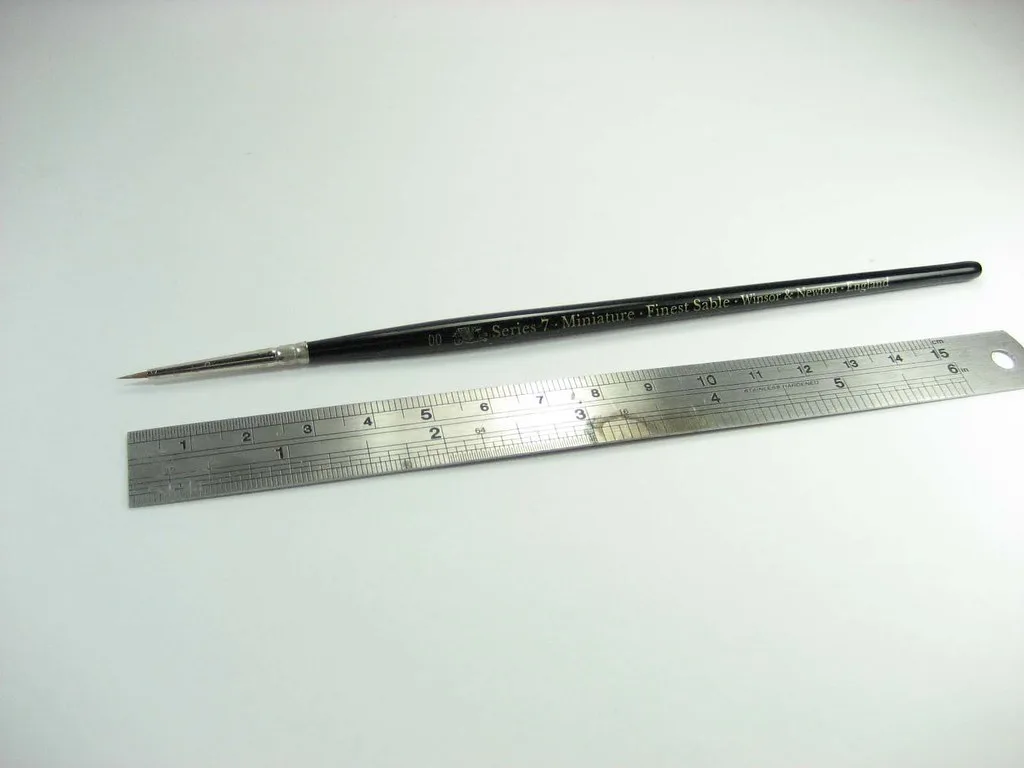 mechnine, CC BY 2.0 via Flickr. Two Winsor & Newton Series 7 Miniature brushes in size 00, the sable line described above in one of its smallest sizes.
GODEEPER: A soft, thirsty brush matters most when the paper is wet, and the wetness of the paper decides how far each stroke spreads. Wet-on-Wet Watercolor Technique: Complete Beginner Walkthrough →
The 3 Brush Shapes a Beginner Actually Needs
A round, a flat and a mop or quill cover nearly every mark in beginner watercolor, which is why they make up the best watercolor brushes for beginners. Buy those three before any specialty shape, and add a small round only if your medium round won't hold a fine enough point.
The round: your main brush
A round has hairs that come to a point. Pressed lightly, it paints a thin line. Pressed down onto its belly, it paints a broad stroke. That range is why a single good round can paint most of a small picture. A round near size 8 is the usual first choice. Check its width rather than trusting the number, as explained above.
The flat: edges and even washes
A flat has a square, straight edge. It paints crisp edges for buildings and horizons, lays even bands of color, and lifts paint cleanly when you need to soften an edge. A flat about one inch wide is useful for washes on quarter-sheet paper. A narrower flat, around half an inch, is easier to control for edges.
The mop or quill: wetting and washes
A mop or quill is a large, soft, rounded brush that holds a lot of water. You use it to wet the paper evenly before a wash, to lay skies and backgrounds, and to drop color into wet areas. Synthetic squirrel is a good fiber for this shape because absorbency matters more than spring here.
Optional: a small round or rigger
A small round, around size 2 to 4, handles fine details such as stems, eyelashes and window frames. A rigger is a thin brush with long hairs that paints long, even lines like branches and rigging. Both are useful later. Neither is essential for a first kit if your main round keeps a sharp point.
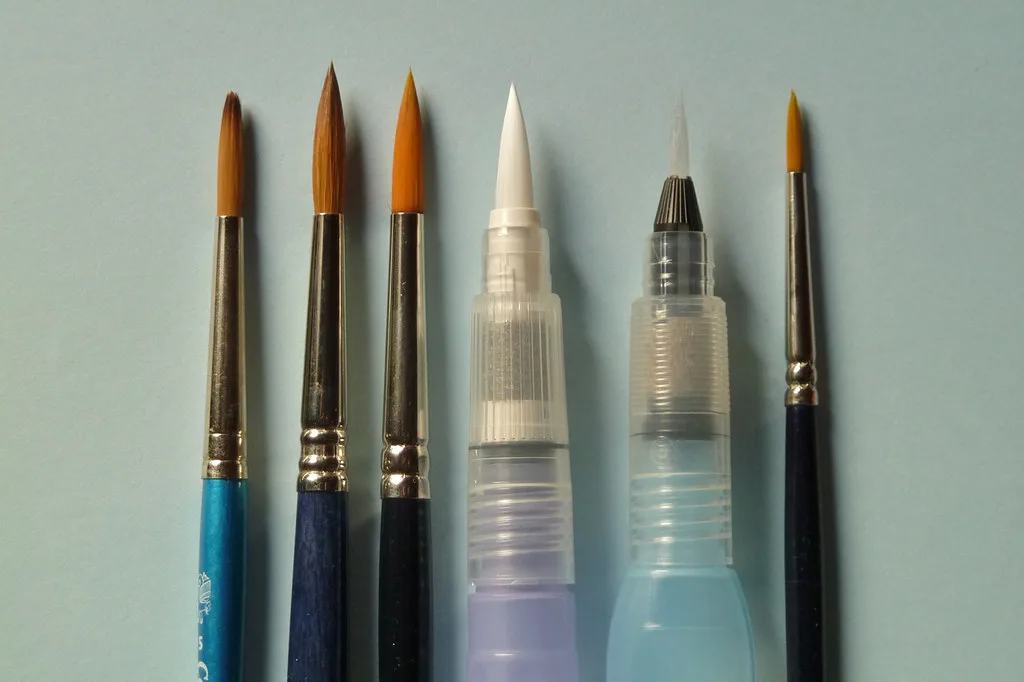 vinyleraser, CC BY-SA 2.0 via Flickr. Round brushes of different sizes next to two water brush pens. Each round tapers from a full belly to a single point, which is what lets one brush paint both broad strokes and thin lines.
Step-by-Step: How to Choose and Test Your First Brushes
1. Decide on the three shapes before you shop. Write down a round near size 8, a flat about one inch wide and a mop or quill. Having the list of the best watercolor brushes for beginners written down stops you from buying a large mixed set in which most brushes are shapes you will not use yet.
2. Compare widths, not size numbers. Look for the width and length in millimeters on the maker's page or the retailer listing. If two rounds share a number but one is noticeably wider, expect it to hold more water and paint a broader stroke. If no dimensions are listed, compare the brushes side by side in the shop.
3. Check the hair type on the label. Look for "synthetic sable" or "taklon" if you want a springy round for control, and "synthetic squirrel" for a soft, absorbent brush that carries washes. Among the best watercolor brushes for beginners, a synthetic sable round or a blend is the safer first choice because the spring makes lines easier to control.
4. Wet the round and test its point. Many art shops keep a water pot for testing. Dip the round, flick out the excess, and look at the tip. A good round comes back to a single sharp point. If the hairs split into two tips or flare out, choose another brush, because that fault does not improve with use.
5. Press and lift to test the spring. Press the wet tip gently onto your palm or a scrap of paper and lift it. A springy round returns to its point. A soft synthetic squirrel will stay bent more, which is normal for that fiber and fine for washes, but not ideal for detail work.
6. Check the ferrule and the handle. The metal ferrule holds the hair. It should be tight, with no wobble against the handle. A loose ferrule lets water reach the glue and the hairs start to fall out. Check that the handle is sealed and smooth, since a split handle swells as it gets wet.
7. Wash the new brush before its first painting session. New brushes often ship with a light coating, called sizing, that holds the tip in shape in the package. Rinse it out in clean, lukewarm water and reshape the tip before you start.
GODEEPER: A brush test is only fair on paper that can hold the water. Weight, fiber and sizing are explained in the paper guide. Best Watercolor Paper for Beginners: Why 100% Cotton Matters →
Tips for Buying and Caring for Watercolor Brushes
Buy single brushes before buying a set
Starter sets sold as the best watercolor brushes for beginners often include five to ten brushes, but only two or three of them may be shapes you'll use. Buying one good round, one flat and one mop separately usually gives you better brushes for a similar total, and you can check each point before paying.
Keep the shapes, swap the fibers later
Your first kit decides the shapes you learn with. The fiber can change later. When you upgrade, replace the brush you use most first, which for most painters is the round.
Store brushes so the tips stay straight
Dry brushes lying flat or standing tip up in a jar. A brush roll or a case with an elastic strap keeps tips from bending in a bag. Never close a wet brush inside a tight cap, since damp hairs trapped in the dark can rot the glue at the ferrule.
Use cheaper brushes for rough jobs
Masking fluid ruins good brushes because the latex dries in the hairs. Scrubbing and lifting dried paint wears down a fine point. Keep an old or inexpensive synthetic for both jobs.
Travel brushes for sketching outside
Travel brushes have a short handle that reverses into a cap to protect the tip. They're useful if you paint outdoors, but the short handle is less comfortable for long sessions at a desk. Buy one as an addition, not as your only round.
Clean off color before it dries
Rinse each brush as soon as you finish with it. Most watercolor rinses out with water alone. If staining pigments such as phthalo blue have tinted the hairs, a gentle brush soap and lukewarm water removes most of it. The tint does not affect how the brush paints.
Common Mistakes When Buying Watercolor Brushes
The most common mistake with the best watercolor brushes for beginners is buying by size number alone. A size 8 from one maker can be noticeably wider and longer than a size 8 from another, so compare the listed widths in millimeters, or measure one brush before ordering more from the same line.
Close behind it is the big mixed set. Wanting every option at once leaves you with brushes in shapes you won't use for months, and the round in a cheap set often won't hold a point. Three core shapes bought one at a time serve you better.
A soft mop as your only brush causes a different problem. Synthetic and natural squirrel hold water well but barely spring back, so lines and edges are hard to steer. Pair the mop with a springy round.
Leaving a brush tip-down in the water jar bends the hairs under the weight of the handle, and the bend sets permanently. Lay brushes across the jar or on a towel between strokes.
Then there's buying sable first. A Kolinsky round is expensive and easy to ruin while you're still learning brush care. Learn on synthetics, and upgrade your main round once cleaning and storage are a habit.
Frequently Asked Questions
What are the best watercolor brushes for beginners? Start with three synthetic brushes: a round around size 8, a flat about one inch wide, and a soft mop or quill for washes. Synthetic hair costs a fraction of sable, survives beginner mistakes, and modern fibers such as Princeton Neptune hold far more water than older nylon.
What size round brush should a beginner buy first? Buy a round near size 8, but compare the width in millimeters, not the number. Blick lists size 8 rounds at 4.4 mm wide for an Escoda Optimo and 5.1 mm for a Da Vinci Casaneo, because brush sizes are not standardized between manufacturers.
Are synthetic watercolor brushes good enough for beginners? Yes. Modern synthetics are the usual recommendation for beginners because they cost less, keep their point under heavy scrubbing, and are easy to replace. Princeton describes its Neptune synthetic squirrel as its softest and thirstiest synthetic, built to carry large washes like natural squirrel hair.
Is a Kolinsky sable brush worth it for a beginner? Usually not as a first brush. Kolinsky sable, such as Winsor & Newton's hand-made Series 7, holds a fine point and springs back well, but it costs many times more than a synthetic and is easy to damage while you are still learning to clean and store brushes.
How many watercolor brushes does a beginner need? Three cover almost everything: a medium round for most painting, a flat for straight edges and even washes, and a soft mop or quill for wetting paper and laying skies. A small round for details is a useful fourth brush, but a good round with a sharp point often covers that job too.
How do you clean watercolor brushes? Rinse in clean water until no color runs out, reshape the tip with your fingers, and let the brush dry lying flat or tip up. Never leave a brush standing on its tip in the water jar, because the weight of the handle bends the hairs out of shape permanently.
Related Reading
- Watercolor for Beginners: Essential Supplies and Buying Guide: the full starter kit, from paper and paint grade to palette and water jars.
- Split-Primary Palette Guide: Mix Any Color with 6 Tubes: which six tubes to load your new brushes with, and how to mix clean secondaries.
- Daniel Smith vs Winsor & Newton: Pro Watercolor Review: how two artist-grade paint ranges compare once you are ready to upgrade your paint.
References
- Princeton Brush Company: Neptune Series 4750 - Manufacturer description of the synthetic squirrel range.
- Princeton Brush Company: Heritage Series 4050 - History and fiber of Princeton's first synthetic sable.
- Princeton Brush Company: Velvetouch Series 3950 - Manufacturer description of the synthetic blend.
- Winsor & Newton: Series 7 Kolinsky Sable Brush - Hair type, construction and history of the range.
- Blick: Da Vinci Casaneo Round, Size 8 - Listed dimensions and Blick's note that brush sizes are not standardized.
- Blick: Escoda Optimo Kolinsky Travel Round, Size 8 - Listed dimensions of a size 8 sable travel round.
- Blick: Dynasty Water Lily Round, Size 8 - Listed dimensions of a size 8 synthetic round.
- Blick Art Materials on YouTube: Princeton Neptune - Short demonstration of the Neptune synthetic squirrel brushes.
- Teoh Yi Chie on YouTube: What Watercolour Brush Size to Get for Sketching - Video comparison of round brush sizes in use.
Was this guide helpful?

Written by
Arthur SterlingSupplies & Reviews Editor
Arthur Sterling writes Watercolor Daily's supply reviews and brand comparisons: paints, cotton papers, and brushes, compared on published specifications.
NextKeep reading
Features / 10 min
Synthetic vs Kolinsky Sable Brushes: What You Pay For
Guides / 14 min
How to Clean Watercolor Brushes: 7 Steps, 3 Ways to Dry
Guides / 12 min
Watercolor Pans vs Tubes: What to Buy First, Priced per ml
Features / 13 min
Best Watercolor Paints for Beginners: 5 Sets Compared
Guides / 11 min
Dry Brush Watercolor Technique: 8 Tips for Broken Texture
Features / 14 min
12 Easy Watercolor Flower Ideas Sorted by Brush Stroke
Features / 14 min
10 Watercolor Birthday Card Ideas From 3 Tubes of Paint
Guides / 11 min
Flat Wash Watercolor Technique: Flat and Graded in 5 Steps
Disclaimer
This article is published for informational purposes and is not professional advice. Product formulations, pigment sources, packaging and store listings change. Check the details that matter to you (price, pigment content, regional availability) with the manufacturer or retailer before you buy.