Loading
Watercolor Daily · Guides
How to Clean Watercolor Brushes: 7 Steps, 3 Ways to Dry
14 min readBy Arthur Sterling
Review
Watercolor Brushes
How to clean watercolor brushes comes down to four habits: get the paint out before it dries, use mild soap, keep water out of the ferrule, and never let the brush dry on its head. Watercolor washes out with water and soap, so the routine is short. Brushes are mostly ruined by bad rinsing and drying habits, such as a brush left standing in the jar.
This guide draws on the care pages of four brush makers: Winsor & Newton, da Vinci, Escoda and Princeton. They agree on almost everything except how a wet brush should dry, and each of their three answers has a reason behind it.
In short: Wipe off the extra paint, rinse under running water, then wash the hairs in your palm with a little mild soap until the lather runs clear. Use cool or lukewarm water, never hot. Squeeze out the water, reshape the tip, and dry the brush so nothing presses on its head: Winsor & Newton says upright, da Vinci says hanging tip down, Escoda says flat. Never leave a brush standing in the water jar.
How do you clean watercolor brushes? (quick answer)
Wipe the brush on a paper towel, rinse it under running water, and work a small amount of mild soap through the hairs in your palm. Rinse until the water runs clear. Then squeeze out the water, reshape the tip with your fingers and let it dry with nothing touching the head.
Overview
This guide shows how to clean watercolor brushes used with watercolor or gouache. It doesn't cover oil or acrylic, which need different cleaners. The method is the same for synthetic and natural hair, with one difference in soap, explained below.
You need very little:
- Two water jars. One for rinsing dirty paint, one kept clean for the last rinse.
- Mild soap. A plain hand soap or a brush soap. Da Vinci recommends a conditioning soap made from vegetable oils. Escoda sells a brush soap made with extra virgin olive oil.
- A paper towel or a lint-free cloth. For wiping paint off and pressing water out.
- Somewhere to dry the brushes. A flat towel works. A jar works only once the brush is completely dry.
A full wash of one brush takes two or three minutes, and a rinse between colors takes seconds. On water temperature, the makers only rule out hot. Winsor & Newton's own page says "cool water" in one step and "warm water, not hot" in its tips, so read it as cool to lukewarm.
Where Paint Hides in a Watercolor Brush
Paint rarely sticks to the tip. It collects at the heel, the thick part of the hair bundle where it disappears into the metal ferrule. A quick swish in the jar never reaches it.
A brush has four parts that matter here. The tip is the point. The belly is the fat middle that holds the water. The heel is where the hairs meet the ferrule. The ferrule is the metal tube, crimped onto the handle, that holds the hairs in glue.
Winsor & Newton describes what happens when pigment builds up at the base: the hairs splay and the tip loses its fine point. Da Vinci says the same thing about the ferrule, where pigment residue collects and slowly reduces the brush's spring and shape. So a brush that "won't point any more" is very often a dirty brush, not a worn-out one.
Two habits keep the heel clean. First, don't load paint up to the ferrule. Princeton tells painters not to immerse a brush in paint up to the ferrule, because wet paint is hard to remove from there and harder still once it dries. Second, wash with soap now and then, even when the brush looks clean. Rinsing moves the paint in the tip. Soap, worked in with your palm, is what lifts paint out of the heel.
Water causes damage too. If it sits in the ferrule, it can reach the glue and the wooden handle. Escoda tells painters to avoid wetting the crimp and the handle for that reason. The beginner brush guide shows how to check a ferrule for wobble before you buy, which is the first sign of glue failure.
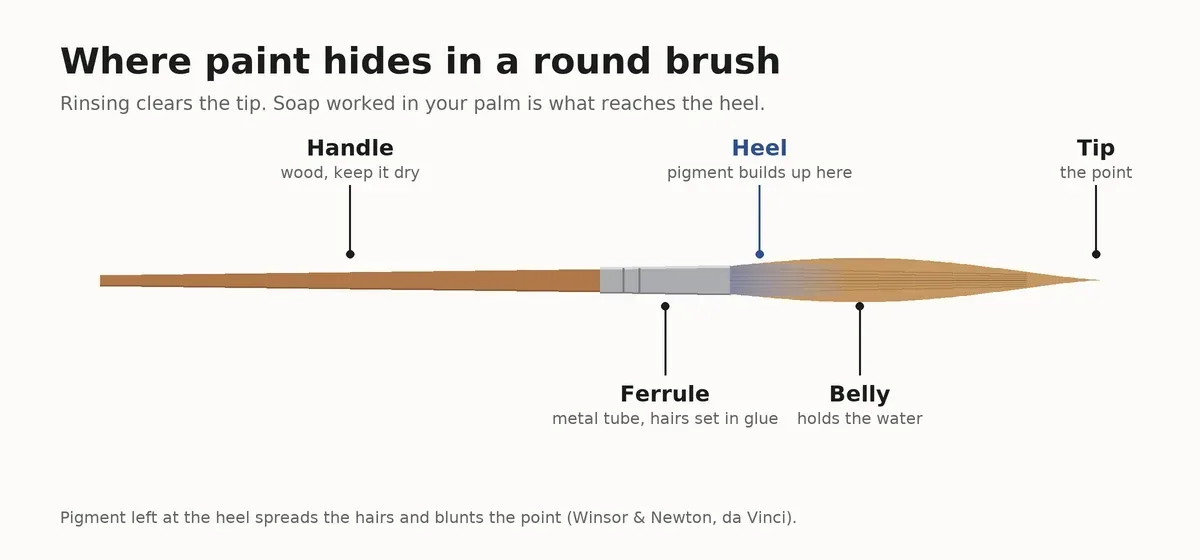 The heel, where the hairs enter the ferrule, is where pigment collects. A rinse clears the tip but rarely reaches it.
Step-by-Step: How to Clean Watercolor Brushes in 7 Steps
These seven steps show how to clean watercolor brushes properly at the end of a session. Between colors a quick rinse is enough, and that routine follows the list.
1. Wipe off the extra paint. Press the brush gently on a paper towel or a lint-free rag and draw it toward the tip. This takes most of the paint out before it reaches your water, so the rinse water stays cleaner. Never scrub the tip sideways on the towel.
2. Rinse under running water. Hold the brush under a running tap with the tip pointing down, and aim the water at the hairs, not the ferrule, so it runs out through the tip. Winsor & Newton starts its routine this way. If you have no tap, swish the brush in your clean jar, not the dirty one.
3. Wash with mild soap in your palm. Put a small amount of mild soap in your palm and swirl the brush in it in small circles. Use cool to lukewarm water. Winsor & Newton warns that hot water can make leftover paint coagulate, which means it thickens and clumps inside the hair bundle.
4. Work the heel gently. Press the belly of the brush into your palm so the soap reaches the heel. You'll often see color come out here even when the tip looked clean. Don't push the hairs backward or bend them hard against the ferrule.
5. Rinse and repeat until clear. Rinse the soap out and wash again. Escoda says to keep going until the foam is colorless, and da Vinci says until the lather turns white. Winsor & Newton says until the water runs clear. They all mean the same thing: stop when no more color comes out.
6. Squeeze out the water and reshape. Press the brush against a cloth or paper towel to pull out the water. Then shape the tip with your fingers, drawing a round back to a point or a flat back to a straight edge. A brush that dries bent keeps the bend.
7. Dry it with nothing touching the head. Lay it flat, stand it upright on the handle, or hang it tip down, depending on what you have. The next section explains why the makers disagree. Only put the brush in a jar or brush case once it is completely dry.
How to clean watercolor brushes between colors
Between colors, a rinse is enough. Use two jars: swish in the dirty jar to remove most of the color, then in the clean jar to finish. Touch the brush to a paper towel before picking up the next color. If the towel still shows the old color, rinse again. The two-jar habit keeps the clean jar clean enough that the last rinse really is clean water.
How to deep clean watercolor brushes
A deep clean is the full seven steps done twice, with more time on step 4. Use it on a brush that has lost its point, or one that has been used for gouache or a heavy staining color. If the brush has hardened paint in the heel, repeat the soap and palm work several times rather than leaving it to soak. Princeton warns against long soaks, and Escoda against wetting the ferrule and handle.
GODEEPER: Sable and synthetic hair react differently to soap, heat and neglect. The comparison explains what you are protecting in a Kolinsky round. Synthetic vs Kolinsky Sable Brushes: What You Pay For →
How to Dry Watercolor Brushes: Three Makers, Three Answers
Dry your brush so nothing presses on its head and no water sits in the ferrule for long. Past that, the makers give three different positions. Winsor & Newton and Princeton say upright, hairs up. Da Vinci says hanging, hairs down. Escoda says flat. Any of the three is safe if you follow its reason.
Here is what each one says, in their words:
| Maker | Drying position | Their wording |
|---|---|---|
| Winsor & Newton | Upright, hairs up | "Stand brushes upright with bristles facing upwards, allowing ferrules and handles to dry completely." |
| Princeton | Upright, on the handle | "Stand the brush upright on the handle to dry." |
| da Vinci | Hanging, hairs down | "Ideally, allow brushes to dry hanging with the bristles pointing downward." |
| Escoda | Flat | "Let them air dry horizontally." |
None of them explains the choice, so the reasoning below is ours, and it comes down to where gravity sends the leftover water.
Hanging, hairs down, sends every drop of leftover water away from the ferrule and out through the tip. The glue and the handle stay driest. The catch is that you need a brush holder that clips the handle. That's probably why da Vinci writes "ideally."
Upright, hairs up, keeps the tip from being touched or bent and needs only a jar. But any water left in the hair runs down into the ferrule. That's why Winsor & Newton adds that the ferrules and handles must dry completely, and why step 6 matters so much here. Squeeze out as much water as you can first.
Flat is the middle ground. Gravity doesn't push water toward the ferrule or away from it, and the brush can't fall over. Escoda's advice suits a kitchen towel on a table, which is what most people have. Just make sure the head hangs over the edge of the towel or lies free, not pressed into a fold.
None of the four positions lets the head touch anything, and Princeton says it outright: "Never let your brush rest on its head." A brush left standing tip-down in the water jar breaks that rule, and Escoda says such a brush will lose its shape.
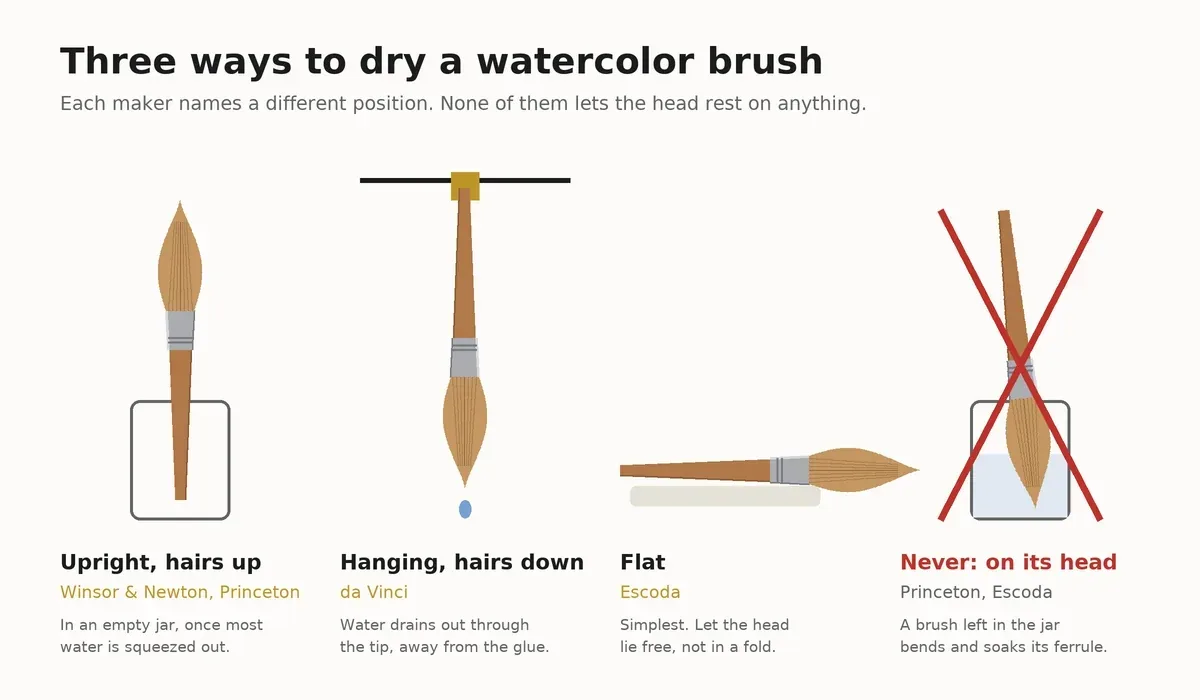 Three makers, three drying positions. The crossed-out brush, standing on its head in the water jar, is the one habit they all rule out.
Tips on How to Clean Watercolor Brushes Without Damage
Use soap that suits the hair
Synthetic hair tolerates almost any mild soap. Natural hair, such as sable or squirrel, carries natural oils. Winsor & Newton says strong soaps strip those oils, and da Vinci says degreasing soaps dry natural hair out and make it brittle. Dish soap is a degreaser by design. For a sable round, use a hand soap or a brush soap.
Accept stains from staining colors
The phthalo blues and greens, and other strongly staining pigments, will tint the hairs of a pale synthetic brush. The glazing guide lists which colors stain, and they are the same ones that stain brushes. Winsor & Newton is direct about it: minor stains are normal and don't affect performance or how long the brush lasts. If the lather runs clear, the brush is clean.
Wash a new brush before its first painting
New brushes often arrive with a stiff coating that holds the tip in shape in the package. Rinse it out in lukewarm water and reshape the tip before you paint. If you skip this, the coating washes out into your first painting.
Keep heat away
Da Vinci warns that direct heat, such as a radiator, damages the hairs, the wooden handle and the brush head. A hair dryer pointed at a brush is direct heat too. Let brushes dry at room temperature, even if it takes a few hours.
Give a sacrificial brush the rough jobs
Masking fluid, gouache and heavy scrubbing are hard on brushes. Keep one old synthetic for these jobs. The masking fluid guide explains the soap coating that keeps latex out of the hairs, and that brush should never be your best round.
Store brushes dry and protected
A jar, tip up, is fine for dry brushes at home. For travel, use a brush roll or a case that holds each brush in place. Never close a damp brush in a tight cap or case. The travel watercolor sets guide covers the pocket brushes that come in field boxes, which need the same care.
GODEEPER: Brushes and palettes stain for the same reason. The palette comparison covers which surfaces hold pigment and how to clean them. Ceramic vs Plastic Watercolor Palette: 5 Differences →
Common Mistakes When Cleaning Watercolor Brushes
Leaving the brush in the water jar. The handle's weight pushes the tip into the bottom of the jar and bends it, and the ferrule soaks. Princeton says never leave a brush soaking for an extended period. Take each brush out as soon as you finish with it.
Using hot water. Hot water can make leftover paint coagulate in the heel, according to Winsor & Newton. Cool or lukewarm water does the job just as well.
Scrubbing with dish soap. Dish soap is made to strip grease, and it strips the natural oils from sable and squirrel hair too. Save it for synthetic brushes if it's all you have, and rinse well.
Drying on the head or on a radiator. A brush that dries pressed against something keeps that shape. A brush dried over heat can split its handle and loosen its head.
Putting a wet brush away. A damp brush closed in a case or cap stays wet for days, and the water sits in the ferrule. Winsor & Newton says to store brushes in a jar or pot only once they are completely dry.
Frequently Asked Questions
How do you clean watercolor brushes? Wipe off the extra paint, rinse the brush under running water, then work a little mild soap through the hairs in your palm. Rinse and repeat until the water runs clear. Squeeze out the water, reshape the tip with your fingers, and let the brush dry without anything pressing on its head.
Can I use dish soap to clean watercolor brushes? It works, but it is not the best choice. Winsor & Newton warns that strong soaps strip the natural oils from the hairs, and da Vinci says degreasing soaps dry out natural hair and make it brittle. A mild hand soap or a brush soap made from vegetable oils is gentler, especially on sable.
Should watercolor brushes dry upright or flat? The makers disagree. Winsor & Newton and Princeton say stand them upright with the hairs up, da Vinci says hang them with the hairs pointing down, and Escoda says lay them flat. None of their positions lets the head rest on anything. Flat is the simplest choice for most people.
Is it bad to leave brushes in water? Yes. Princeton says never leave a brush soaking for an extended period, and Escoda warns that a brush left standing in the water jar with its hairs crushed on the bottom loses its shape. Escoda also says water on the ferrule and handle can ruin them.
Why are my watercolor brushes stained? Strong staining pigments, such as the phthalo blues and greens, dye the hairs. Winsor & Newton says minor stains in the bristles are normal and do not affect how the brush performs or how long it lasts. If the soap lather comes out clear, the brush is clean, whatever color the hairs are.
How often should I wash watercolor brushes with soap? Rinse with water every time you paint. Wash with soap whenever you finish a session with a staining color, and at least now and then for every brush, because pigment slowly builds up near the ferrule. A brush that no longer forms a sharp point usually needs a soap wash, not replacing.
Related Reading
- Watercolor for Beginners: Essential Supplies & Buying Guide: the full starter kit, with the brushes this routine keeps in shape.
- Watercolor Pans vs Tubes: What to Buy First, Priced per ml: which paint format to buy first, compared on price per ml.
- Split-Primary Palette Guide: Mix Any Color with 6 Tubes: the six-tube palette, including the phthalo blue that tints pale brushes.
References
- Winsor & Newton: How to care for your watercolour brushes
- da Vinci: How to clean brushes properly
- Escoda: How to take care of your brushes
- Princeton Brush Company: Brush care and cleaning
- Jane Blundell: Cleaning watercolour brushes (YouTube)
- The Cleveland Museum of Art: Brush Washer, Ru ware, late 1000s to 1127 (hero image, CC0)
Was this guide helpful?

Written by
Arthur SterlingSupplies & Reviews Editor
Arthur Sterling writes Watercolor Daily's supply reviews and brand comparisons: paints, cotton papers, and brushes, compared on published specifications.
NextKeep reading
Features / 10 min
Synthetic vs Kolinsky Sable Brushes: What You Pay For
Guides / 16 min
Best Watercolor Brushes for Beginners: 3 Shapes to Buy
Guides / 11 min
Dry Brush Watercolor Technique: 8 Tips for Broken Texture
Guides / 11 min
Flat Wash Watercolor Technique: Flat and Graded in 5 Steps
Guides / 12 min
Masking Fluid Watercolor Guide: 7 Steps and 3 Products

Guides / 11 min
How to Stretch Watercolor Paper: 3 Methods by Weight

Guides / 10 min
How to Paint Snow in Watercolor: 9 Tips for Clean Whites
Guides / 10 min
Wet-on-Dry Watercolor Technique: Crisp Edges in 6 Steps
Disclaimer
This article is published for informational purposes and is not professional advice. Product formulations, pigment sources, packaging and store listings change. Check the details that matter to you (price, pigment content, regional availability) with the manufacturer or retailer before you buy.