Loading
Watercolor Daily · Guides
Wet-on-Dry Watercolor Technique: Crisp Edges in 6 Steps
10 min readBy Marcus Reed
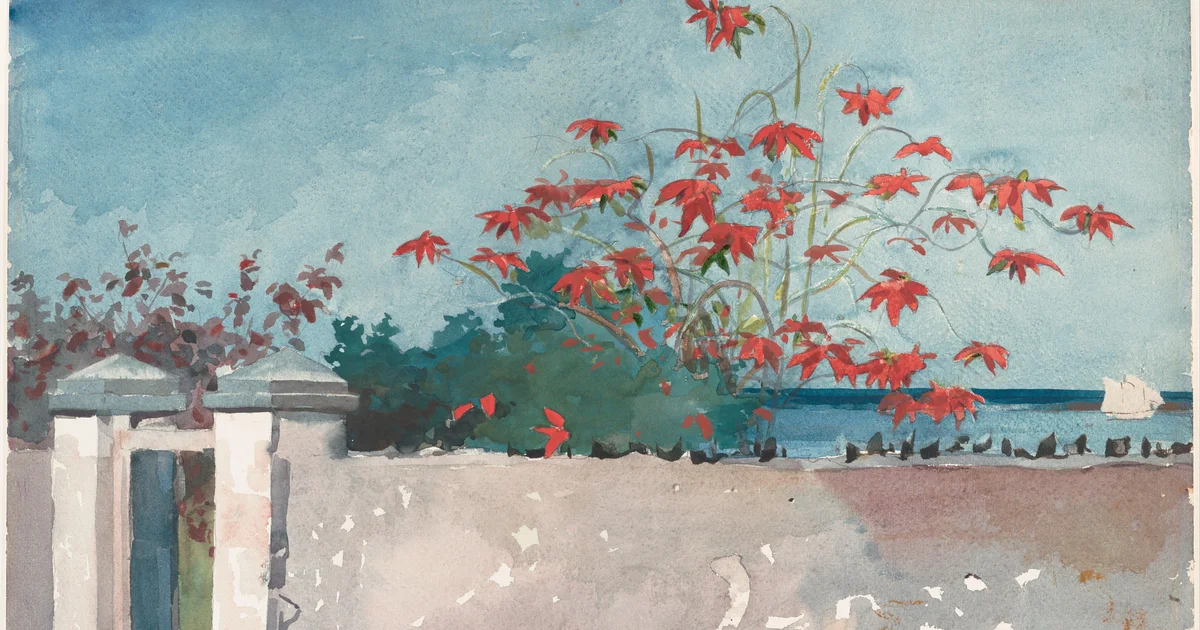
Painting: Winslow Homer, A Wall, Nassau (1898), The Metropolitan Museum of Art, public domain
Review
Watercolor Technique
The wet-on-dry watercolor technique means putting wet paint on paper that is completely dry. With no water on the surface to spread into, the paint stays where you put it and dries with a crisp edge. Most detail and layering in a painting is done this way. The difficult part is knowing when the paper is dry, because a sheet can look dry a long time before it is. Below is how to check, plus six steps to clean, layered wet-on-dry work.
In short: Wet-on-dry means wet paint on fully dry paper, so edges stay crisp. Wait until the paper is no longer cool to the touch. St Cuthberts Mill puts the open time of its Saunders Waterford at around 40 minutes and Bockingford at about 22. Paint each layer in one pass, and don't go back into it while it dries.
What is the wet-on-dry watercolor technique? (quick answer)
Wet paint brushed onto dry paper, or onto an earlier layer that has dried completely. The paint doesn't spread past the brushstroke, so it gives sharp edges and controlled shapes, which is why painters use it for detail and for building color in layers.
Key Takeaways
- Wet-on-dry needs the paper to be fully dry, not just matte. Damp paper turns crisp edges into blooms.
- Drying time depends on the sheet: St Cuthberts Mill gives around 40 minutes of open time for Saunders Waterford and about 22 for Bockingford.
- Lay each stroke once. Going back into a drying layer lifts pigment and leaves streaks.
- Staining, transparent colors such as Winsor Blue (PB15) are a sensible choice for under-layers you will paint over.
Overview
Wet-on-dry pairs with wet-on-wet. One lets paint spread into wet paper for soft edges, the other keeps it where you put it. Most paintings use both, usually a wet-on-wet background first and wet-on-dry shapes and details on top once it has dried.
You need:
- Paper: 300 gsm (140 lb) cotton, taped down so it stays flat as layers dry.
- Brushes: a round around size 8 for shapes, and a smaller round for details.
- Paint: any watercolor. For layering, a few transparent colors help, such as French Ultramarine (PB29), Permanent Rose (PV19) and Burnt Sienna (PR101), all listed as transparent on Winsor & Newton's product pages.
- Two water jars (one for rinsing, one clean), a tissue, and a hair dryer if you want to speed up drying.
Skill level: beginner. The wet-on-dry watercolor technique itself is simple. Waiting for each layer to dry is what takes practice.
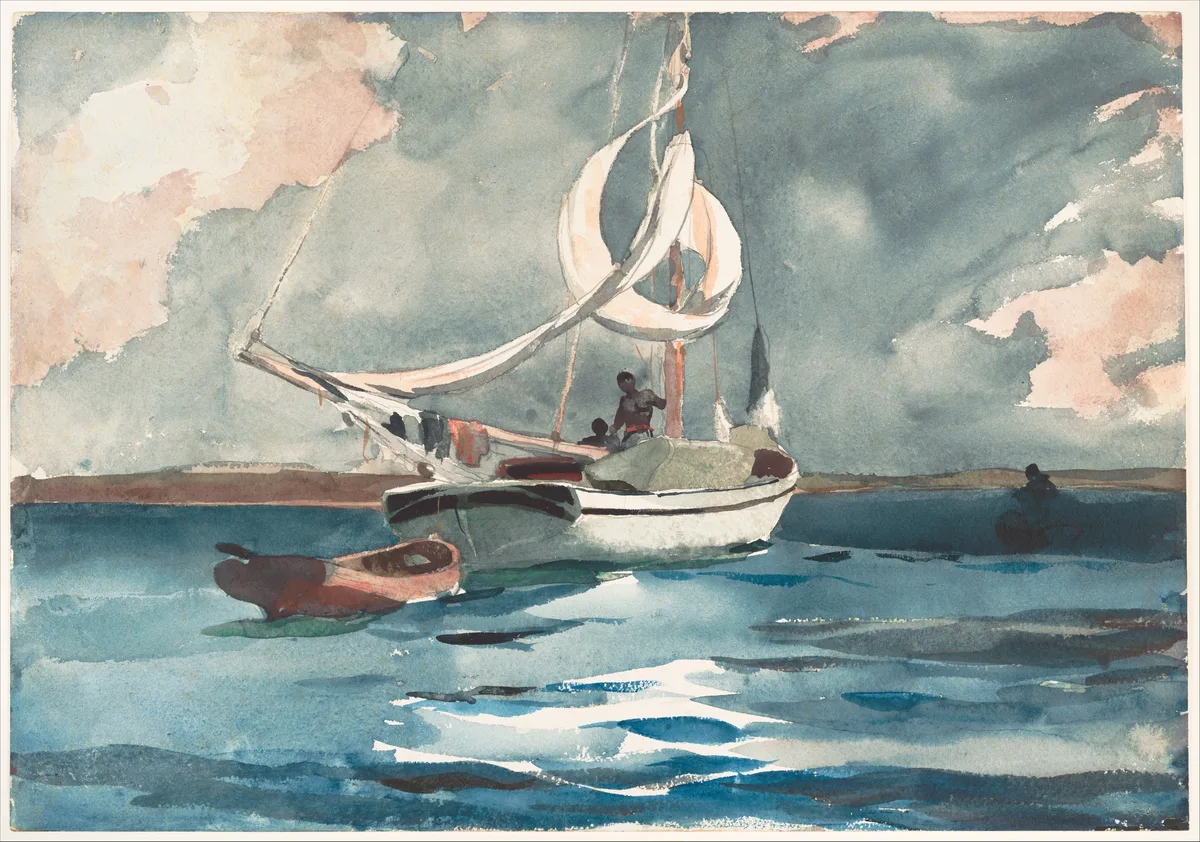 Winslow Homer, Sloop, Nassau (1899). The clouds have soft, blended edges, while the sails and hull are crisp shapes against the sky, so both kinds of edge sit in one painting. The Metropolitan Museum of Art, public domain.
How Long to Wait in the Wet-on-Dry Watercolor Technique
Wait until the paper is completely dry, not just matte. A sheet loses its shine well before the water inside it has gone, and painting on that damp-but-matte paper is the most common cause of blooms in wet-on-dry work. How long that takes depends on the paper, the amount of water you used, and the room.
Paper makers publish some useful numbers. St Cuthberts Mill gives the "open time" of its papers, meaning how long the sheet stays damp and workable after paint goes down:
| Paper | Open time, per St Cuthberts Mill |
|---|---|
| Saunders Waterford | around 40 minutes, most workable for around 25 |
| Bockingford | approx 22 minutes |
| Millford | roughly 40 minutes, stays wetter for longer |
For wet-on-wet, a long open time is a gift. For wet-on-dry, it's the wait you have to sit out before the next layer. If you paint on Saunders Waterford after a heavy wash, expect to wait longer than on Bockingford.
The mill also explains why patchy drying ruins the next layer. On a sheet that dries unevenly, it says, the result is often "blooms, hard edges, streaks, and unintended marks." So check the sheet itself before trusting a timer.
To check, look at the paper at a low angle against a light for any remaining shine, then rest the back of your fingers on it. Damp paper feels cool because the water is still evaporating. If it feels cool, wait. A hair dryer on a low setting speeds things up, but hold it at a distance and keep it moving, or it pushes wet paint across the sheet.
GODEEPER: Wet-on-wet works at the other end of this drying scale, while the paper is still shiny or damp. The wet-on-wet guide covers its four wetness stages. Wet-on-Wet Watercolor Technique: Complete Beginner Walkthrough →
Step-by-Step
1. Tape the paper and plan the order of layers. Tape all four edges of a 300 gsm sheet to a board. Decide what goes down first: light colors and large shapes first, darker colors and details last, because watercolor is transparent and you can't paint a light color over a dark one.
2. Mix enough paint before you start. Mix the color in a palette well, enough to finish the shape without stopping. Running out halfway means the first part starts drying while you mix more, and the join shows as a hard line.
3. Load the brush and paint the shape in one pass. Fill a size 8 round, touch the excess off on the rim of the well, and paint the shape. Keep a small bead of wet paint at the leading edge and pull it along, so each new stroke merges into wet paint instead of a drying edge.
4. Leave the layer alone while it dries. Don't go back to fix it. A brush dragged through half-dry paint lifts pigment and leaves streaks or blooms. If a part needs changing, change it in the next layer.
5. Check that the paper is fully dry. Look for any shine at a low angle and touch the back of your fingers to the sheet. Cool means damp. Wait, or use a hair dryer on low, held at a distance.
6. Paint the next layer over the dry one. Brush the second color over part of the first. Where they overlap, you get a third color through the transparent top layer, which is the basis of glazing. Winsor & Newton's own tutorial describes this as letting colors "create a glaze or new layer." Repeat steps 2 to 6 for each layer, finishing with the smallest details.
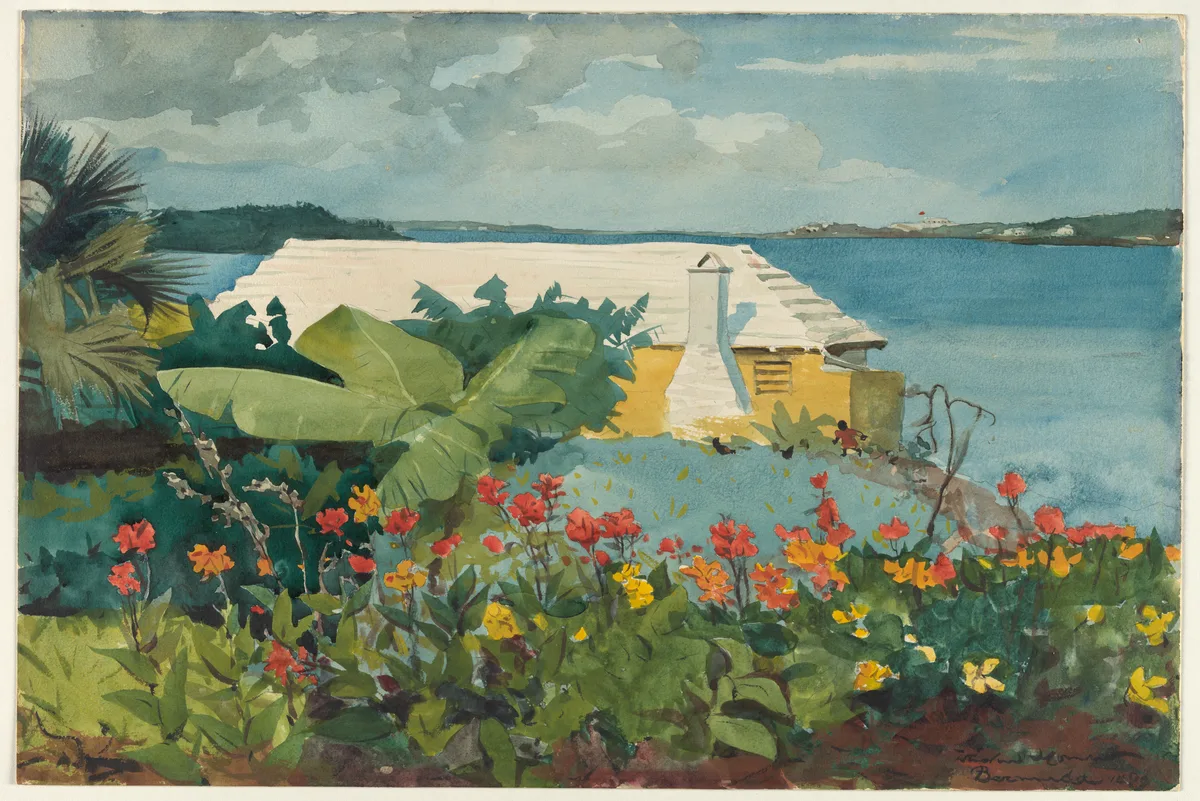 Winslow Homer, Flower Garden and Bungalow, Bermuda (1899). Each flower is a separate shape with a hard edge, sitting on the greens around it, the kind of result the layer-by-layer steps above build toward. The Metropolitan Museum of Art, public domain.
Tips
- Use staining colors underneath. Winsor & Newton lists Winsor Blue (Green Shade, PB15) and Permanent Rose (PV19) as staining. A staining color sinks into the paper fibers, so in practice it's less likely to lift and smear when you brush another layer over it. Granulating colors such as French Ultramarine (PB29) are easier to disturb, so glaze over them with a light touch.
- Watch the opacity. Winsor & Newton points out that "some colours are naturally more opaque than others." An opaque color laid over a dry layer covers it instead of glazing it. For layers you want to see through, choose colors listed as transparent.
- Soften a hard edge right away. If an edge comes out harder than you wanted, run a clean, damp brush along it while the paint is still wet. Once it dries, softening means lifting pigment, which is harder and works worse on staining colors.
- Plan darks to arrive in few layers. Each layer darkens the area and puts more water and brushwork on the same patch of paper. Mixing a dark strong enough to land in one or two passes keeps it cleaner than building it from many pale ones.
- Test on a scrap of the same paper. Before using the wet-on-dry watercolor technique on a finished piece, try it on a strip from the same pad. Open times differ by paper, so the strip tells you how long each layer really takes to dry.
GODEEPER: Layering works best with a short list of transparent colors. The split-primary guide covers six that mix cleanly. Split-Primary Palette Guide: Mix Any Color with 6 Tubes →
Frequently Asked Questions
What is the wet-on-dry watercolor technique? Wet-on-dry means brushing wet paint onto paper, or onto an earlier layer of paint, that has dried completely. Because there is no water on the surface for the paint to spread into, it stays where the brush puts it and dries with a crisp edge. It is the technique behind most detail and layering.
How long should watercolor dry before the next layer? Until the paper is fully dry, which depends on the sheet and the room. St Cuthberts Mill says its Saunders Waterford stays workable for around 40 minutes and Bockingford for about 22. Check by touch: a sheet that still feels cool against the back of your hand is still damp.
Why do I get blooms when painting wet-on-dry? Blooms, also called backruns or cauliflowers, appear when wetter paint touches a layer that is only damp, not dry. The extra water pushes pigment outward into a ragged edge. Wait until the earlier layer is completely dry, or work into it while it is still evenly wet.
What is the difference between wet-on-wet and wet-on-dry? Wet-on-wet puts paint onto wet paper, so it spreads and gives soft, unpredictable edges. Wet-on-dry puts paint onto dry paper, so it stays in place with crisp edges. Most paintings use both: wet-on-wet for skies and backgrounds, wet-on-dry for shapes, layers and detail on top.
Can you soften a hard edge after wet-on-dry paint dries? Partly. Run a clean, damp brush along the edge and blot with a tissue to lift a little pigment. Non-staining colors lift more easily than staining ones such as phthalo blue, which Winsor & Newton lists as staining. It is easier to soften the edge while the paint is still wet.
Related Reading
- Best Watercolor Brushes for Beginners: 3 Shapes to Buy: the round that holds a point for crisp wet-on-dry edges.
- Hot Press vs Cold Press Watercolor Paper: 3 Surface Types: why edges look sharper on smooth paper.
- Student vs Artist Grade Watercolor: 6 Pigments Compared: which pigments are identical in student and artist paint.
References
- St Cuthberts Mill: Why Even Drying Matters in Watercolour Paper - Open times for Saunders Waterford, Bockingford and Millford, and the effects of uneven drying.
- Winsor & Newton: Professional Watercolour Winsor Blue (Green Shade) - PB15, transparent and staining.
- Winsor & Newton: Professional Watercolour French Ultramarine - PB29, transparent and granulating.
- Winsor & Newton: TATE Collection II, Singer Sargent Watercolour - Step-by-step tutorial with layering and glazing over dry paint.
Was this guide helpful?

Written by
Marcus ReedTechnique Editor
Marcus Reed writes Watercolor Daily's step-by-step technique guides: wet-on-wet washes, glazing, dry brush, and the water control underneath them.
NextKeep reading
Guides / 10 min
How to Paint Snow in Watercolor: 9 Tips for Clean Whites
Guides / 12 min
Masking Fluid Watercolor Guide: 7 Steps and 3 Products
Guides / 12 min
Glazing Watercolor Technique: 6 Steps to Layer Clean Color
Guides / 11 min
Flat Wash Watercolor Technique: Flat and Graded in 5 Steps
Guides / 11 min
Dry Brush Watercolor Technique: 8 Tips for Broken Texture

Guides / 11 min
How to Stretch Watercolor Paper: 3 Methods by Weight
Guides / 14 min
How to Clean Watercolor Brushes: 7 Steps, 3 Ways to Dry
Features / 14 min
12 Easy Watercolor Flower Ideas Sorted by Brush Stroke
Disclaimer
This article is published for informational purposes and is not professional advice. Product formulations, pigment sources, packaging and store listings change. Check the details that matter to you (price, pigment content, regional availability) with the manufacturer or retailer before you buy.