Loading
Watercolor Daily · Guides
How to Paint Snow in Watercolor: 9 Tips for Clean Whites
10 min readBy Marcus Reed
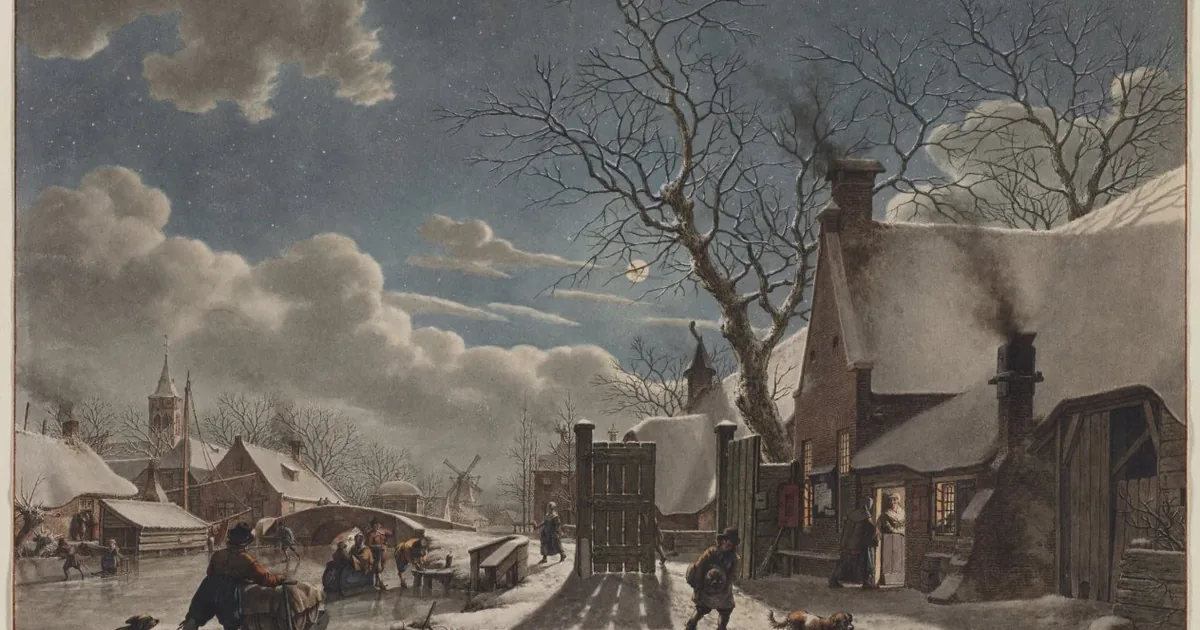
Painting: Jacob Cats, Winter Night in a Dutch Town (1797), The Cleveland Museum of Art, CC0
Review
Watercolor Technique
Most snow in a watercolor is paper you never touched. Learning how to paint snow in watercolor means learning to paint everything around it: the sky, the shadows and the dark shapes that make the white look bright. These nine tips cover how to keep that white clean, which colors to use for shadows, and when masking fluid, salt or opaque white actually help.
In short: Leave the paper white for snow and paint the shadows in diluted French Ultramarine (PB29). Use masking fluid only on dry paper and remove it as soon as the wash is dry. Save opaque white, Titanium White (PW6) or Chinese White (PW4), for small final touches such as falling flakes.
How to paint snow in watercolor (quick answer)
Leave the paper white where the snow lies and paint the shadows, sky and objects around it. Pale blue shadows make bare paper read as snow. Protect small whites with masking fluid, and add falling flakes with spattered opaque white at the end.
Overview
These tips on how to paint snow in watercolor assume transparent paint on cold-press paper, ideally 300 gsm (140 lb) or heavier, so the sheet can take a wet sky. You need a blue, an earth and a red: French Ultramarine (PB29), Burnt Sienna (PBr7) and a cool red such as Quinacridone Rose (PV19). Optional extras are masking fluid, a little table salt and an opaque white.
Historical watercolorists used both of the approaches below. Jacob Cats's Winter Night in a Dutch Town (1797), shown at the top of this page, is catalogued by the Cleveland Museum of Art as watercolor heightened with white gouache. Charles Burchfield's Backyards in Winter (1917), below, leaves most of its snow as bare paper. Both read clearly as snow, for different reasons.
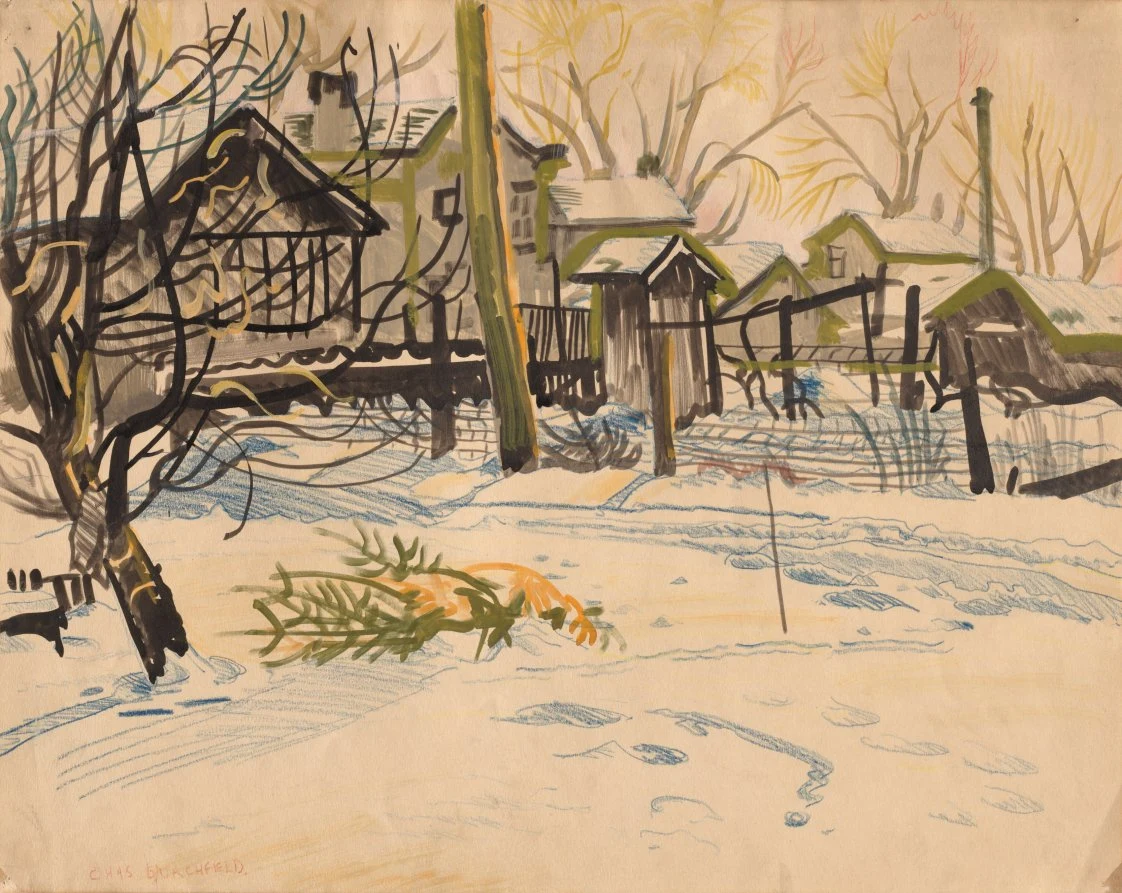 Charles Burchfield, Backyards in Winter (Castoff Christmas Tree), 1917, watercolor, gouache and crayon. The Cleveland Museum of Art, CC0. Most of the snow is untouched paper, shaped by blue strokes and dark sheds.
Step-by-Step: How to Paint Snow in Watercolor With These Tips
Use this short routine on a small practice sheet, a snowy field with a few trees, before you try a full scene. The tips themselves follow, grouped by stage.
1. Plan the whites. Decide where the snow, the brightest highlights and any falling flakes will be, and mark large white areas with a light pencil line. 2. Mask the small whites. Cover snow on branches, fence tops and flakes with masking fluid, and let it dry completely before any paint goes near it. 3. Paint the sky. Lay the sky wet-on-wet, stopping at the snow line so the field stays dry, white paper. 4. Add shadows on the snow. When the sky is dry, paint pale PB29 shadows that follow the ground and fall away from your light source. 5. Paint the dark shapes. Add trees, buildings and fences. Their darkness is what makes the snow look bright. 6. Unmask and finish. Once everything is dry, remove the mask, soften any hard edges, and spatter a little opaque white if you want falling snow.
Before you paint: planning the white
Tip 1: Treat the paper as your snow. In transparent watercolor, nothing is whiter than bare paper. Any white paint you add sits on the surface and looks slightly duller. Treat the snow as an area to protect from the first wash. Pencil in the boundaries of large snow areas before you wet the sheet, because once a wash flows over them you can't get the paper back.
Tip 2: Mask small whites, but read the label. Masking fluid lets you paint freely over snow-laden branches, fence posts and flakes. Winsor & Newton tells painters not to apply its Art Masking Fluid on damp or soft-sized paper, to wash brushes immediately after use, and to remove the fluid as soon as possible. Leaving the mask on for days, or putting it on paper that's still damp, can tear the surface when you peel it off.
While the wash is wet: shadows and texture
Tip 3: Paint snow shadows blue. Snow in shadow reflects the sky, so on a clear day its shadows look blue. Mix French Ultramarine (PB29) very pale and lay it where trees, drifts and buildings block the light. Let the shadow follow the shape of the ground: a shadow that curves over a drift tells the viewer the snow has depth.
Tip 4: Use a granulating blue for texture. Daniel Smith lists French Ultramarine as transparent and granulating, meaning its pigment settles into the grain of the paper as it dries. On cold-press paper that speckle looks like the surface of snow, with no extra effort. Burnt Sienna (PBr7), which Daniel Smith also lists as granulating and non-staining, adds the same texture to grey shadows.
Tip 5: Change the shadow color with the light. Three mixes cover most snow scenes. Pale PB29 alone for a clear day. PB29 with a little PBr7 for an overcast grey. PB29 with a touch of Quinacridone Rose (PV19) for the violet shadows of late afternoon. Keep all three very diluted. A dark shadow makes snow look like slush.
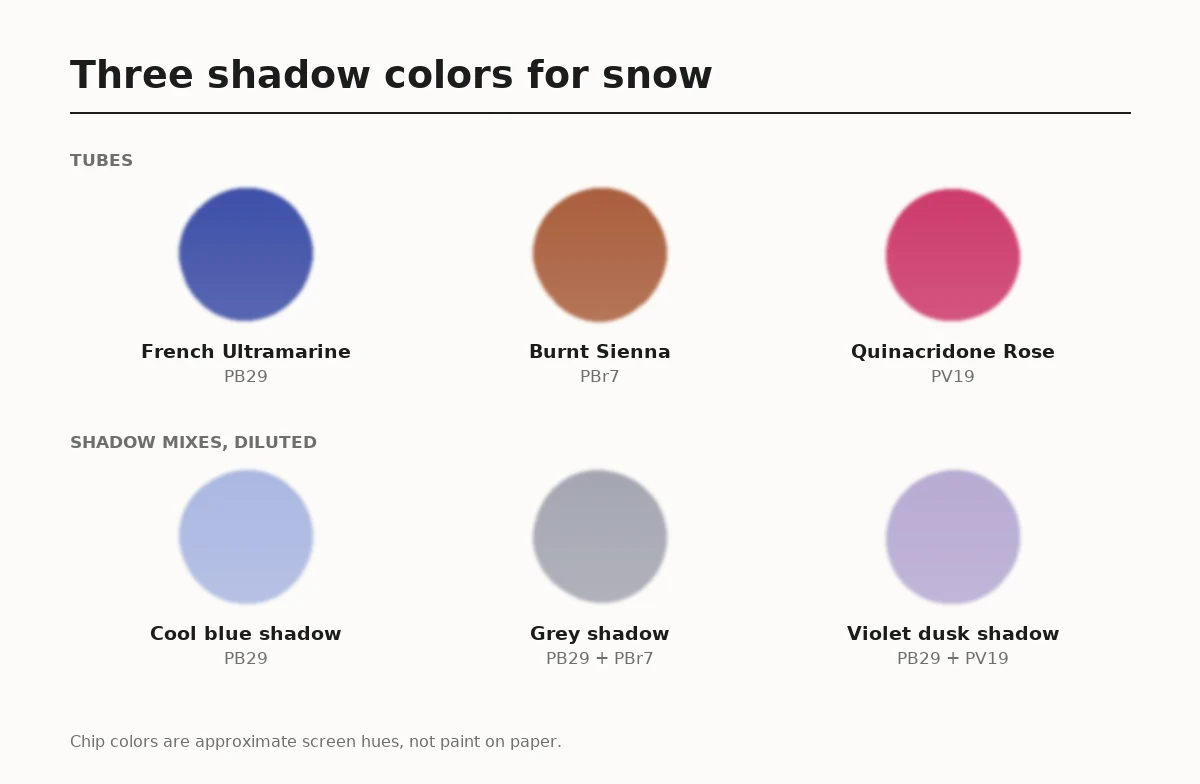 Chart of the three tubes and the diluted shadow mixes from tip 5: blue for clear days, grey for overcast, violet for late light. Chip colors are approximate.
Tip 6: Drop salt into a damp wash for flakes. Sprinkle a few grains of salt into a sky or shadow wash once it has lost its shine but is still damp. The salt draws water and pigment toward it as it dries and leaves pale, star-like marks. Brush the salt off only when the paper is completely dry. The effect changes with paper and timing, so test it on a scrap first.
GODEEPER: The sky in most snow scenes is painted wet-on-wet. This guide explains how wet the paper should be at each stage and how to avoid hard blooms. Wet-on-Wet Watercolor Technique: Complete Beginner Guide →
After it dries: edges and white accents
Tip 7: Soften hard edges where snow meets snow. A drift seen against another drift has no outline, only a gentle change of tone. Once a shadow dries with a hard edge, run a clean damp brush along it and blot with a tissue to lift a little color. Non-staining paints lift more easily than staining ones, which is another reason to keep strong staining greens and blues out of snow shadows.
Tip 8: Save opaque white for small touches. Winsor & Newton describes its Titanium White (PW6) as the whitest and most opaque of its two watercolor whites, and its Chinese White (PW4) as semi-opaque with a blue undertone, often used at the end of a painting for highlights. Use either for snow caught on a twig or a few bright flakes. Over large areas, white paint looks chalky next to bare paper.
Tips
Tip 9: Spatter falling snow last. Load an old toothbrush or a stiff brush with opaque white or white gouache, hold it over the dry painting, and flick the bristles with your thumb. Cover the parts you want clear with a sheet of scrap paper. Jenna Rainey's short winter landscape tutorial shows salt and white gouache snowflakes being added to a sky in real time:
Darken around the snow, not on it. If your snow looks grey or dull, the fix is usually to darken the trees, sky or buildings next to it, so the paper reads brighter by comparison.
Give the paper time. Shadows laid onto a sky that is still damp will bloom into it. The wet-on-dry technique guide covers how to tell when a sheet is truly dry and how long different papers stay wet.
Keep a test strip. Before a full painting, paint your three shadow mixes and a salted patch on a strip of the same paper. It takes five minutes and tells you how dark each mix dries and how your paper takes salt.
Pick a forgiving surface. A firmly sized cotton sheet takes masking fluid and lifting better than a soft, lightly sized one. The cold-press vs hot-press paper guide explains how the three surfaces handle texture, and cold press is the usual choice for snow.
If you want a first project for practicing how to paint snow in watercolor, the watercolor Christmas card ideas include a red barn in the snow and a snowman painted only in shadow.
Frequently Asked Questions
How do you paint snow in watercolor? You mostly don't paint it. Leave the paper white where the snow is and paint the shadows, sky and objects around it. Pale blue or grey shadows make untouched paper read as bright snow, and masking fluid protects small whites such as flakes and branches while you paint over them.
What color are snow shadows in watercolor? Usually a pale blue, because snow in shadow reflects the sky. Diluted French Ultramarine (PB29) is a common choice. Grey it with a little Burnt Sienna (PBr7) on an overcast day, or warm it toward violet with Quinacridone Rose (PV19) for late-afternoon light.
Can you use white paint for snow in watercolor? Yes, for small touches at the end, such as falling flakes or snow on a twig. Winsor & Newton sells Chinese White (PW4), semi-opaque, and Titanium White (PW6), the most opaque. Large areas of white paint over white paper tend to look chalky, so leave big snow areas as paper.
How do you paint falling snow in watercolor? Flick masking fluid off a stiff brush before painting the sky and rub it off afterwards to reveal white specks. Or spatter opaque white over the finished, dry painting. Masking gives crisp paper-white dots, while spattered white sits on top of the paint and looks softer.
Does salt make snow texture in watercolor? It can. Sprinkle a few grains into a wash that is damp but no longer shiny. As it dries, the salt draws water and pigment toward it and leaves pale, star-like marks. Brush it off only when the paper is completely dry, and test first, because results vary with paper and timing.
Related Reading
- Rough Watercolor Paper: Granulation, Dry Brush and 6 Steps: how granulating blues and masking fluid behave on a heavily textured sheet.
- Best Watercolor Paper for Beginners: Why 100% Cotton Matters: why cotton paper holds a wet sky and survives masking.
- Split-Primary Palette Guide: Mix Any Color with 6 Tubes: the warm and cool blues and reds behind clean shadow mixes.
- Watercolor Paper Weight GSM: 190 vs 300 vs 640 Explained: which paper weight stays flat under a big wet sky.
- 10 Easy Winter Watercolor Ideas From a 4-Tube Palette: ten snow scenes to practice these tips on, each with its palette and steps.
References
- Winsor & Newton: Art Masking Fluid
- Winsor & Newton: Why are there two watercolour whites?
- Daniel Smith: French Ultramarine Watercolor
- Daniel Smith: Burnt Sienna Watercolor
- Daniel Smith: Watercolor pigment characteristics chart (PDF)
- The Cleveland Museum of Art: Jacob Cats, Winter Night in a Dutch Town
- The Cleveland Museum of Art: Charles Burchfield, Backyards in Winter (Castoff Christmas Tree)
- Jenna Rainey: Easy Watercolor Winter Landscape (YouTube)
Was this guide helpful?

Written by
Marcus ReedTechnique Editor
Marcus Reed writes Watercolor Daily's step-by-step technique guides: wet-on-wet washes, glazing, dry brush, and the water control underneath them.
NextKeep reading
Guides / 12 min
Masking Fluid Watercolor Guide: 7 Steps and 3 Products
Guides / 12 min
Glazing Watercolor Technique: 6 Steps to Layer Clean Color
Guides / 11 min
Flat Wash Watercolor Technique: Flat and Graded in 5 Steps
Guides / 9 min
Wet-on-Wet Watercolor Technique: Complete Beginner Guide
Guides / 11 min
Dry Brush Watercolor Technique: 8 Tips for Broken Texture
Guides / 10 min
Wet-on-Dry Watercolor Technique: Crisp Edges in 6 Steps

Guides / 11 min
How to Stretch Watercolor Paper: 3 Methods by Weight
Features / 13 min
10 Easy Winter Watercolor Ideas From a 4-Tube Palette
Disclaimer
This article is published for informational purposes and is not professional advice. Product formulations, pigment sources, packaging and store listings change. Check the details that matter to you (price, pigment content, regional availability) with the manufacturer or retailer before you buy.