Loading
Watercolor Daily · Features
Watercolor Paper Weight GSM: 190 vs 300 vs 640 Explained
Watercolor paper weight gsm is the number to trust, because lb labels depend on sheet size. How 190, 300 and 640 gsm behave wet, and when to stretch.
12 min readBy Arthur Sterling
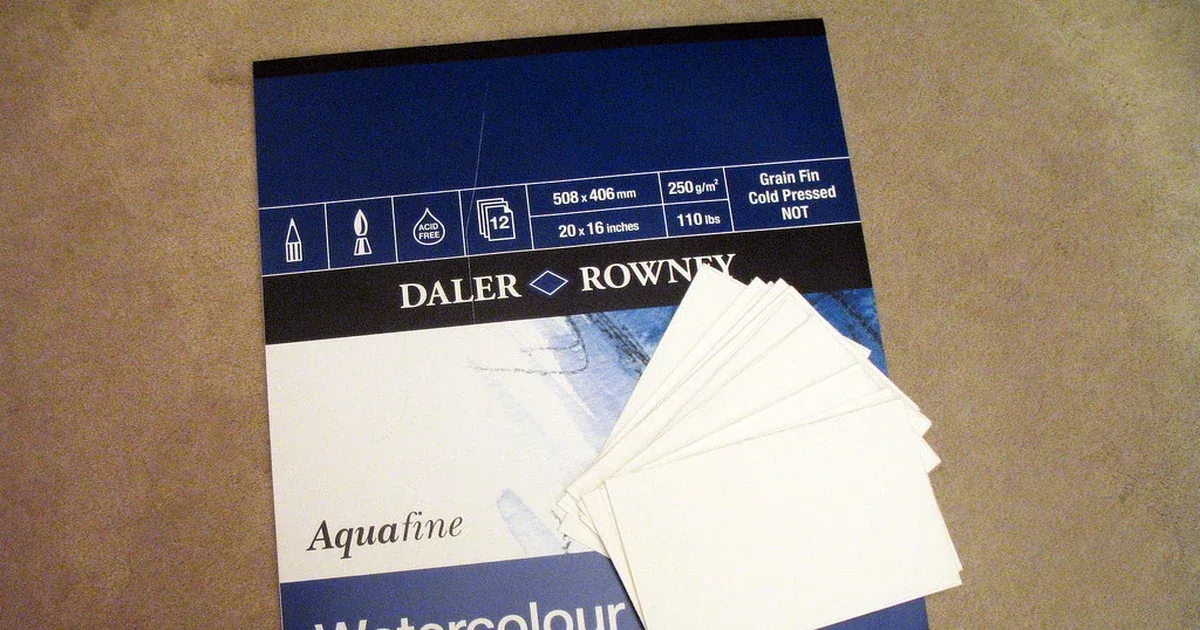
Photo: denn, Flickr, CC BY-SA 2.0
Watercolor paper weight gsm tells you how heavy a sheet is per square meter, and it's the only weight figure you can compare across brands. The pound figure on the same pad depends on what size of sheet was weighed, which is why 140 lb watercolor paper and 140 lb drawing paper are nothing alike.
This guide compares the three weights you'll actually see in shops, roughly 190, 300 and 640 gsm. It covers how the gsm and lb numbers relate, what each weight does under a wet wash, and when a sheet needs stretching, using what Arches, Strathmore and a university materials guide publish.
In short: Use gsm to compare papers. 300 gsm is the standard watercolor weight and equals 140 lb; 640 gsm equals 300 lb and barely cockles; 185 to 190 gsm (90 lb) suits sketching. A UCL Slade guide says sheets under 356 gsm should be stretched for wet work, or bought as blocks glued on all four sides.
What watercolor paper weight gsm should you buy? (quick answer)
Buy 300 gsm (140 lb) for most watercolor painting, ideally as a block glued on four sides so it dries flat. Choose 640 gsm (300 lb) for large, very wet paintings you don't want to stretch. Keep 185 to 190 gsm (90 lb) for sketching and practice.
Key Takeaways
- Compare by gsm: it measures one square meter, so it means the same thing on every label.
- Pounds depend on sheet size: watercolor lb weights describe a ream of 500 sheets at 22 x 30 inches. On that basis, 140 lb is about 298 gsm.
- Labels are rounded: Arches calls its 356 gsm sheet 156 lb, while a UCL Slade guide lists 356 gsm as 260 lb.
- Stretching: UCL's Slade guide says to stretch papers under 356 gsm for wet work.
- Texture changes with weight: Handprint notes heavier sheets from one mill usually have a coarser texture in the same finish.
Overview
Watercolor paper is sold by weight because weight is a decent stand-in for thickness, and thickness decides how a sheet handles water. A thin sheet swells and buckles as it soaks up a wash. A thick one stays flatter and can take more water, more scrubbing and more layers.
Two systems describe that weight. Grams per square meter (gsm, or g/m²) is the weight of one square meter of the paper. Pounds (lb) is the weight of a ream, a stack of sheets at a set size. Arches prints both on its Aquarelle range: 185 gsm (90 lb), 300 gsm (140 lb), 356 gsm (156 lb), 640 gsm (300 lb) and 850 gsm (400 lb).
The three weights in this comparison cover nearly every watercolor pad, block and sheet on sale. The lightest is 185 to 190 gsm, labeled 90 lb. The standard is 300 gsm, or 140 lb. The heavy sheet is 638 to 640 gsm, or 300 lb. Saunders Waterford, for example, is listed by retailers at 300, 425 and 638 gsm, and Blick lists its 300 lb sheet as 638 gsm.
Fiber matters as much as weight. A 300 gsm cotton sheet and a 300 gsm wood-pulp sheet weigh the same and behave differently, so weight is the second thing to check after the fiber.
Watercolor Paper Weight GSM vs Pounds: Why the lb Label Misleads
The gsm figure is consistent because it always measures one square meter. A pound figure measures a ream at a basis size that changes between paper types, so the same pound number can describe very different papers.
Strathmore explains it directly: a pound weight is "determined by weighing 500 sheets (a ream) in the basis size of a particular paper." Drawing paper is weighed at 24 x 36 inches, and Strathmore points out that its Drawing paper and its Aquarius II paper are both listed as 80 lb even though "the master size sheets being weighed are not the same." That's why a 140 lb drawing pad feels nothing like 140 lb watercolor paper.
For watercolor, the basis is a ream of 500 sheets at 22 x 30 inches, the full imperial sheet. The arithmetic is simple enough to check. One sheet of 22 x 30 inches is about 0.426 square meters, so 500 of them cover about 213 square meters, and one pound (454 g) spread over that area is about 2.13 g per square meter. Multiply any watercolor pound weight by 2.13 and you get its gsm:
- 90 lb × 2.13 = about 192 gsm (sold as 185 to 190 gsm)
- 140 lb × 2.13 = about 298 gsm (sold as 300 gsm)
- 300 lb × 2.13 = about 639 gsm (sold as 638 to 640 gsm)
- 400 lb × 2.13 = about 852 gsm (Arches sells 850 gsm)
The 356 gsm weight shows how loose the pound labels can be. Arches labels it 156 lb. A materials guide from UCL's Slade School of Fine Art lists 356 gsm as 260 lb. By the 22 x 30 arithmetic, it's about 167 lb. All three describe the same weight of paper. The pad at the top of this article is another case: Daler-Rowney prints 250 g/m² next to 110 lbs on its Aquafine pad, where the 22 x 30 arithmetic gives about 117 lb. Read the gsm and treat the pounds as a rough label.
GODEEPER: Weight is the second thing to check on a watercolor sheet. Fiber comes first, and the paper guide explains why 100% cotton matters more than any weight. Best Watercolor Paper for Beginners: Why 100% Cotton Matters →
How 190, 300 and 640 GSM Behave Under a Wet Wash
Lighter paper buckles more. A 190 gsm sheet cockles under a wet wash unless it is stretched, 300 gsm takes moderate washes and is usually stretched or used as a block for wet work, and 640 gsm stays nearly flat without stretching.
The UCL Slade guide sets the line at 356 gsm: paper "less than 356 gsm (260 lb) should be stretched before use, otherwise it's likely to warp." That puts both 190 and 300 gsm on the stretch side and 640 gsm above it. It's a cautious rule, and how wet you paint matters as much as the number. A small study with light washes on 300 gsm will survive unstretched. A full-sheet sky laid wet-in-wet won't.
When a sheet cockles, it forms hills and valleys, and a wet wash runs into the valleys and dries there as darker pools. You can't lay a flat wash on a sheet that isn't flat.
There are two easy ways around stretching at 300 gsm. The first is a block: Arches sells its 300 gsm Aquarelle as blocks glued on all four sides, and the glued edges hold the sheet while it dries, so it pulls flat. The second is tape: taping all four edges of a loose sheet to a board gives some of the same hold for lighter washes.
At 640 gsm the sheet is heavy enough to work loose on a table. Some painters still stretch it for very wet work, but it suits large paintings where stretching a full sheet would be a chore.
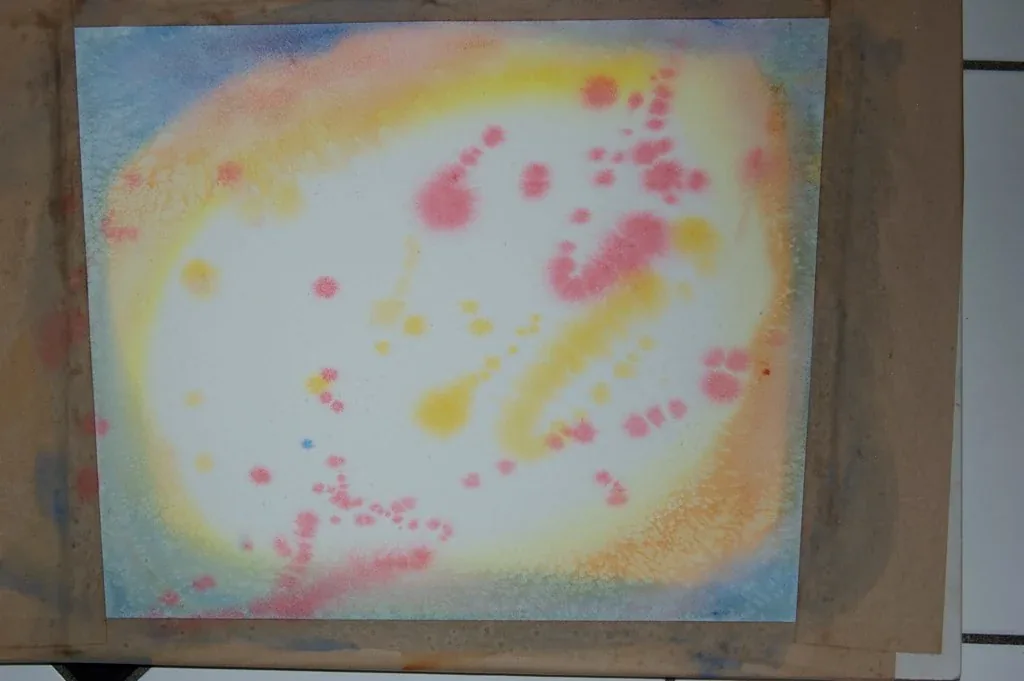 A sheet taped to a board on all four edges and painted wet-in-wet, with the colors spreading into soft blooms. The tape holds the edges while the wash dries. Photo: hurley.k.e, Flickr, CC BY-SA 2.0.
Heavier Paper Changes the Texture Too
Weight affects surface as well as stiffness. Handprint, which tested a large range of watercolor papers, notes that heavier sheets from the same maker usually have a coarser texture within the same nominal finish, comparing Arches cold pressed at 300 and 640 gsm.
So a 640 gsm cold pressed sheet has more tooth than a 300 gsm one as well as more bulk. That suits granulating paints and dry brush and makes fine detail a little harder. If you like how a 300 gsm cold press handles detail, test the heavier sheet before committing a large painting to it.
The surface you can buy also depends on weight. On its Aquarelle page, Arches offers 185 gsm only in cold and hot pressed pads and journals. Rough starts at 300 gsm and runs up to an 850 gsm sheet, which Arches sells only in rough and cold pressed. If you want the deep texture of a rough watercolor paper, you're buying at least 300 gsm.
GODEEPER: Weight and surface work together. The surface comparison explains how mills make hot press, cold press and rough, and what each does under a brush. Hot Press vs Cold Press Watercolor Paper: 3 Surface Types →
Side-by-Side Summary
- Pound label: 190 gsm: 90 lb / 300 gsm: 140 lb / 640 gsm: 300 lb
- Typical formats: 190 gsm: pads, journals, sketchbooks / 300 gsm: blocks, pads, sheets, rolls / 640 gsm: sheets, some blocks
- Under a wet wash: 190 gsm: buckles unless stretched / 300 gsm: cockles in very wet work unless stretched or blocked / 640 gsm: stays close to flat
- Stretch it?: 190 gsm: yes, for wet work / 300 gsm: for loose sheets and wet work / 640 gsm: usually not
- Texture: heavier sheets tend to be coarser in the same finish, per Handprint
- Best for: 190 gsm: sketching, line and wash / 300 gsm: most painting / 640 gsm: large and very wet work
Who Should Buy Which Weight
Buy 185 to 190 gsm if you sketch, paint small studies or work in line and wash. It's light enough for a journal, and many watercolor sketchbooks sit between 200 and 300 gsm. Expect cockling as soon as the washes get wet.
Buy 300 gsm if you're learning or painting anything up to a quarter or half sheet. It's the standard watercolor weight, and in a block glued on four sides it handles wet-on-wet washes without stretching. For loose sheets, stretch them or tape them down.
Buy 640 gsm if you paint large, very wet or heavily layered work and don't want to stretch. It costs more per sheet, and its coarser surface changes how fine detail looks, so try a sheet before switching.
For most painters, the watercolor paper weight gsm decision comes down to 300 gsm in a block for everyday work and an occasional 640 gsm sheet for the big paintings.
Frequently Asked Questions
What gsm watercolor paper should a beginner use? Start with 300 gsm, which is the same weight as 140 lb. It is the standard sheet for watercolor and takes moderate washes. Buy it as a block glued on all four sides, as Arches sells its 300 gsm Aquarelle, and you can paint without stretching it first.
Is 300 gsm the same as 140 lb watercolor paper? Yes. Watercolor pound weights describe a ream of 500 sheets at 22 x 30 inches, and 140 lb on that basis works out to about 298 gsm. Arches labels its 300 gsm Aquarelle as 140 lb, and Blick lists Strathmore Imperial 500 the same way.
Do I need to stretch 300 gsm watercolor paper? Usually, if you paint wet washes on loose sheets. A materials guide from UCL's Slade School of Fine Art says papers under 356 gsm should be stretched or they are likely to warp. A block glued on four sides does the same job, because the glued edges hold the sheet flat.
Is 640 gsm watercolor paper worth it? For large, very wet work, yes. At 640 gsm, or 300 lb, a sheet is more than twice the weight of standard 300 gsm and cockles far less. Handprint also notes that heavier sheets from one mill usually have a coarser texture in the same finish, so the surface changes too.
Why do 140 lb paper and 140 lb drawing paper feel different? Because pound weights are measured on different sheet sizes. Strathmore explains that a pound figure comes from weighing 500 sheets at the basis size of that paper type, and drawing paper uses 24 x 36 inches. The same pound number can mean different gsm.
What is the lightest watercolor paper worth buying? Around 185 to 190 gsm, labeled 90 lb, is the lightest common watercolor weight. Arches sells 185 gsm only in cold and hot pressed pads and journals, not rough. It suits sketching and light washes but buckles under heavy water unless stretched.
Related Reading
- Watercolor for Beginners: Essential Supplies & Buying Guide: where paper weight fits among the first supplies to buy.
- Wet-on-Dry Watercolor Technique: Crisp Edges in 6 Steps: layering on a sheet that has to stay flat between washes.
- Student vs Artist Grade Watercolor: 6 Pigments Compared: the paint side of the same buying decision.
References
- Arches: Arches Aquarelle - Weights in gsm and lb, surfaces per weight, and blocks glued on four sides.
- Strathmore Artist Papers: Paper Weight, What Does It Mean? - Ream weight and basis sizes by paper type.
- UCL Slade School of Fine Art: Watercolour Paper - Standard weights and the 356 gsm stretching threshold.
- Handprint: Watercolor Paper Tests - Texture differences between heavier and lighter sheets of one paper.
- Blick: Saunders Waterford Watercolor Sheet, 300 lb - The 300 lb sheet listed as 638 gsm.

Written by
Arthur SterlingSupplies & Reviews Editor
Arthur Sterling writes Watercolor Daily's supply reviews and brand comparisons: paints, cotton papers, and brushes, compared on published specifications.
NextKeep reading
Guides / 12 min
Rough Watercolor Paper: Granulation, Dry Brush and 6 Steps
Features / 12 min
Best Watercolor Sketchbooks: 4 With 100% Cotton Paper
Features / 11 min
Hot Press vs Cold Press Watercolor Paper: 3 Surface Types

Guides / 11 min
How to Stretch Watercolor Paper: 3 Methods by Weight
Features / 11 min
Watercolor Block vs Pad vs Sheets: Cost per Square Inch
Guides / 9 min
Best Watercolor Paper for Beginners: Why 100% Cotton Matters
Features / 12 min
Ceramic vs Plastic Watercolor Palette: 5 Differences
Features / 10 min
Synthetic vs Kolinsky Sable Brushes: What You Pay For
Disclaimer
This article is published for informational purposes and is not professional advice. Product formulations, pigment sources, packaging and store listings change. Check the details that matter to you (price, pigment content, regional availability) with the manufacturer or retailer before you buy.