Loading
Watercolor Daily · Features
10 Watercolor Birthday Card Ideas From 3 Tubes of Paint
Watercolor birthday card ideas, 10 cards from a rose, a yellow and a blue. Pigment codes, paper, time and three steps for each, sorted by who gets it.
14 min readBy Elena Vance
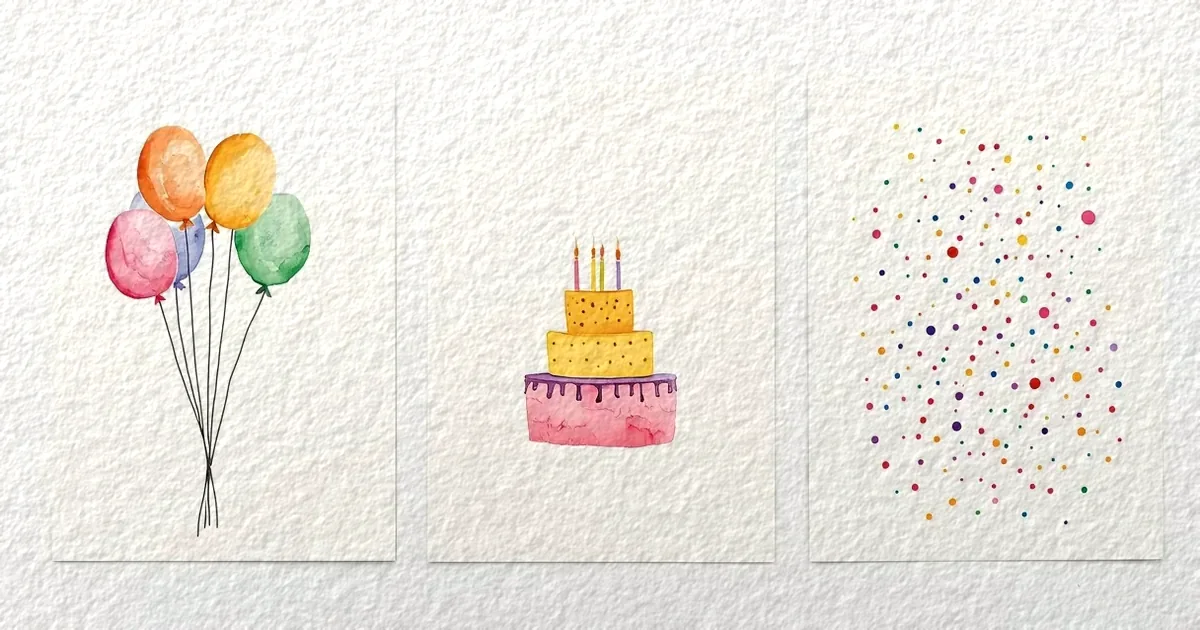
These 10 watercolor birthday card ideas all come from three tubes: a rose, a yellow and a blue. Every orange balloon, green stem and violet ribbon on the list is mixed from those three, so one small palette covers a year of birthdays.
Most card idea lists show you a finished picture and leave you to guess the rest. Each idea below gives you the colors with their pigment codes, the paper, a rough time and the order to paint it in. They are sorted by who the card is for, because a card for a four-year-old and a card for your mother want different things.
In short: Buy three tubes: Quinacridone Rose (PV19), Hansa Yellow Medium (PY97) and Phthalo Blue Green Shade (PB15:3). Cut 300 gsm (140 lb) cold-press paper to 7 by 10 inches and fold it to 5 by 7. Start with the balloons, which take about 15 minutes, and write the greeting with a waterproof pen once everything is dry. Save the layered cake and the wrapped gift for when you have an afternoon.
What are the easiest watercolor birthday card ideas? (quick answer)
Balloons on strings, a single candle and a confetti burst. Each one is a few dabs of color with nothing to draw first, and a wobbly balloon still reads as a balloon. Paint those three first, then move on to the cake and the gift, which need two layers.
Overview
Every card on this list uses the same short supply list.
Paper. Cold-press watercolor paper at 300 gsm (140 lb). Cold press means the sheet has a light texture that holds small dabs of paint well. Cut a 7 by 10 inch piece and fold it to 5 by 7 inches, the size of a standard A7 envelope. Paint the card flat and fold it only when dry. The paper guide for beginners explains why a cotton sheet folds and paints better than a cheap pad.
Brushes. A medium round, around a size 8, for balloons, cake layers and washes. A small round, around a size 4, for strings, candle wicks and dots. A waterproof fineliner for the greeting.
Paint. Three tubes from Daniel Smith's Extra Fine range, each a single pigment rated lightfastness I (Excellent) on the maker's page, so a card kept in a drawer stays bright.
- Rose, Quinacridone Rose (PV19): a cool, transparent pink-red. On its own it is the pink of a birthday balloon. Mixed with yellow it makes orange and coral.
- Yellow, Hansa Yellow Medium (PY97): a clean mid yellow for candle flames, cake icing and the warm side of every mix. Low staining, so it lifts if a dab goes wrong.
- Blue, Phthalo Blue Green Shade (PB15:3): a strong, transparent blue. It's high staining, meaning it won't lift once dry, so start pale. With yellow it makes bright greens, with rose it makes violet.
Four mixes do most of the work. Orange is yellow with a little rose. Leaf green is yellow with a touch of blue. Violet is blue and rose in roughly equal parts. Soft grey is all three together, mostly blue, for shadows under a cake and the string of a balloon. The split-primary palette guide explains why three clean primaries mix brighter than a box of twelve.
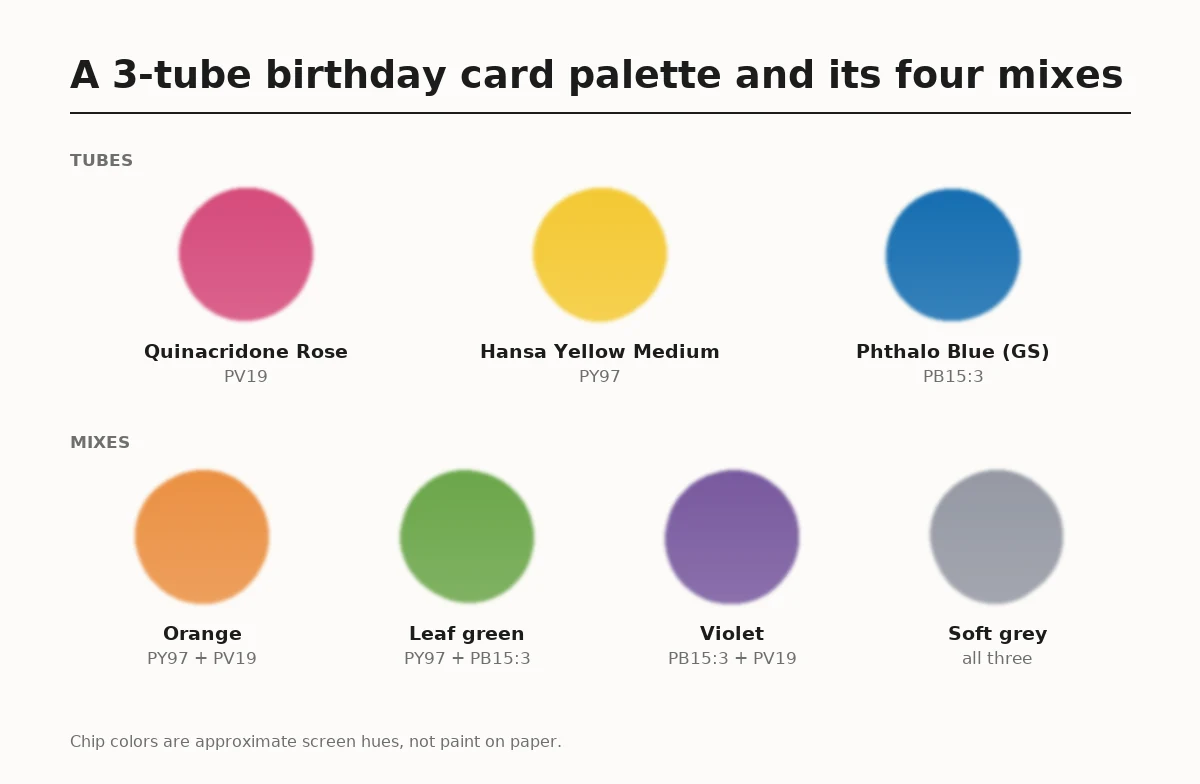 Chart of the three tubes and the four mixes used across the cards. Chip colors are approximate screen hues.
Watercolor Birthday Card Ideas for Kids
These three watercolor birthday card ideas are bright, round and quick. A child will recognise every one of them.
1. Bunch of Balloons
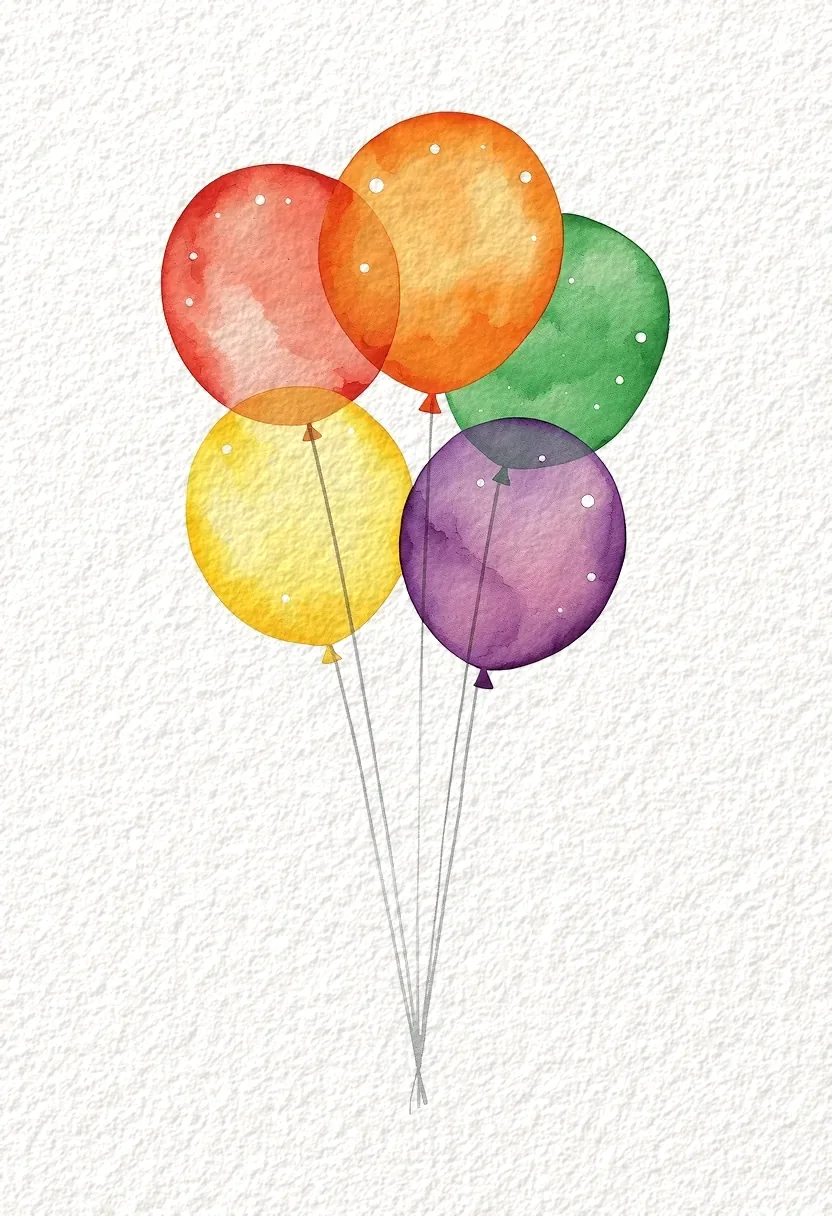 Five round balloons in layered color, the easiest card on this list.
Five round balloons in rose, orange, yellow, green and violet, each on a thin string gathered at the bottom. The easiest card on the list.
- Palette: rose (PV19), yellow (PY97), blue (PB15:3)
- Paper: 300 gsm cold press, 5 x 7 card
- Time: about 15 minutes · Difficulty: easy
1. Dab the balloons. With the medium round, paint five rounded ovals in a loose cluster, one per color, leaving a tiny dot of bare paper near the top of each for shine. 2. Let them dry. Wait until the ovals are matte, about ten minutes, so the strings don't bleed into them. 3. Draw the strings. With the small round and soft grey, pull a thin curving line from each balloon down to one point near the bottom edge.
2. Confetti Burst
 A burst of round dots in one corner leaves the rest of the card empty for a message.
A spray of small dots and dashes in all three colors and their mixes, fanning up from the bottom corner, with the greeting written in the empty space.
- Palette: rose (PV19), yellow (PY97), blue (PB15:3)
- Paper: 300 gsm cold press, 5 x 7 card
- Time: about 15 minutes · Difficulty: easy
1. Dot the big pieces. Paint a dozen small rounded dashes in rose, yellow and blue, spreading out from one corner. 2. Fill with mixes. Add orange, green and violet dashes between them, smaller as they get further from the corner. 3. Leave room. Keep the top half of the card bare for the greeting, and add two or three dots there only once the pen writing is done.
3. Rainbow Arch
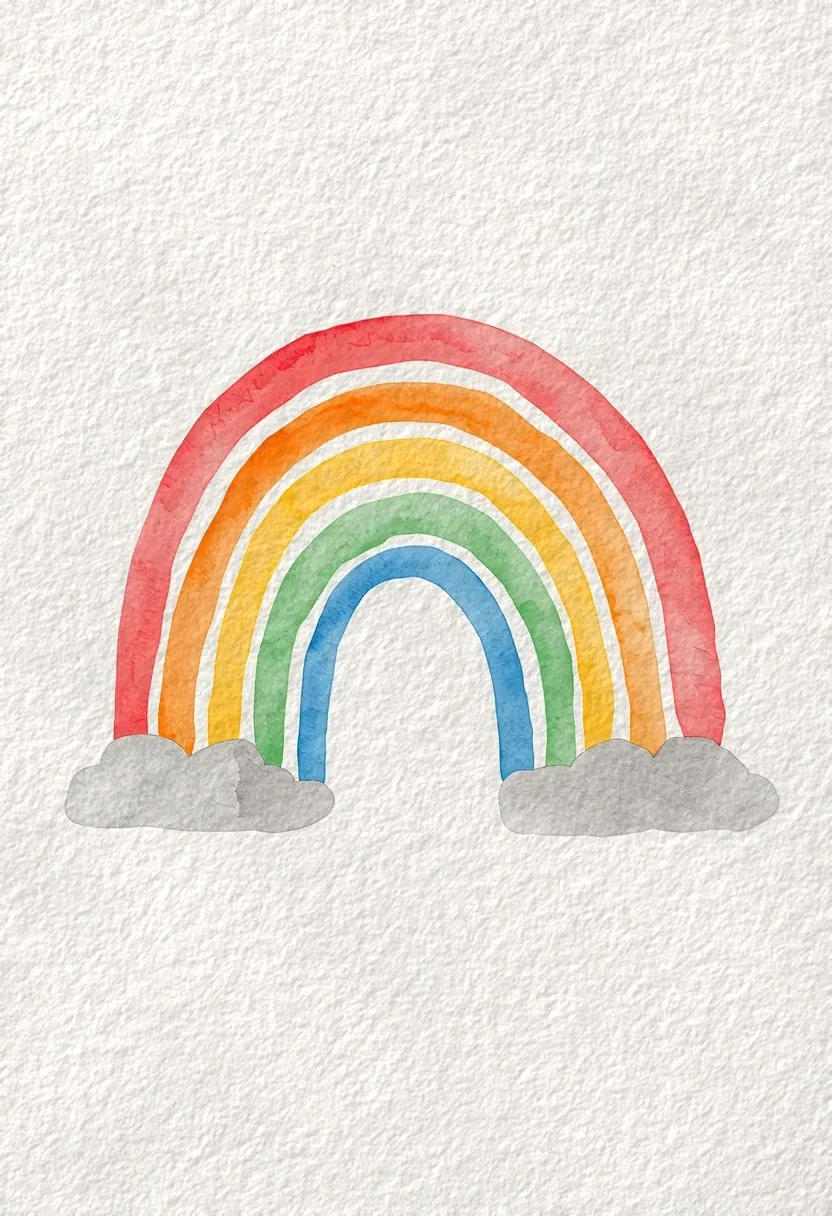 A rainbow of five bands over two grey clouds.
Three or four curved bands of color side by side, from rose through orange and yellow to green and blue, over a small cloud of bare paper at each end.
- Palette: rose (PV19), yellow (PY97), blue (PB15:3)
- Paper: 300 gsm cold press, 5 x 7 card
- Time: about 20 minutes · Difficulty: easy
1. Paint the outer band. With the medium round, pull one curved stroke of rose from the left edge to the right in an arch. 2. Add the inner bands. While the rose is damp, paint orange, then yellow, then green inside it, each stroke touching the last so they blend softly at the edges. 3. Cloud the ends. When dry, paint a pale grey outline of a cloud over each end of the arch, leaving the cloud itself as bare paper.
Watercolor Birthday Card Ideas for Parents and Grandparents
These four cards are calmer: a single flower, a cake, a candle, a cup. They suit a card that will sit on a shelf for a week.
4. Single Stem Flower
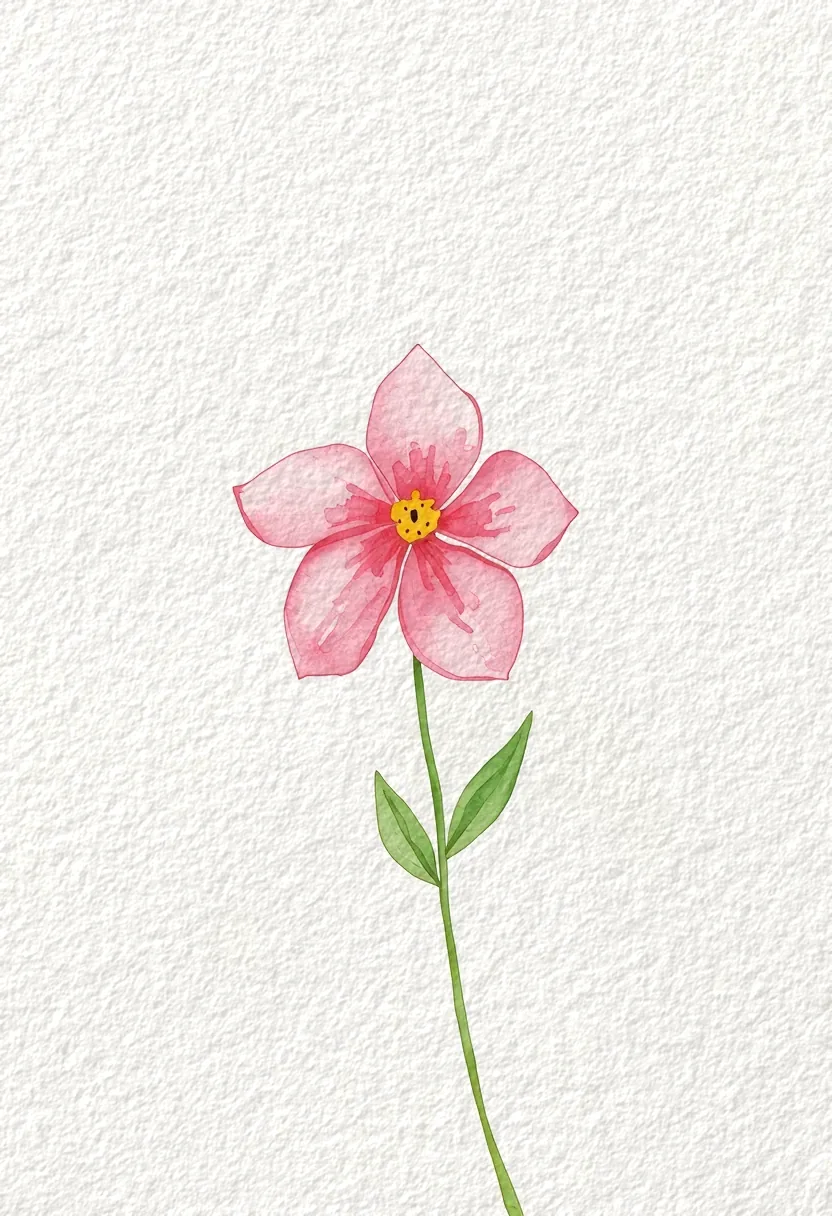 One flower on one stem, with plenty of white space around it.
One loose flower in rose with a yellow center, on a green stem with two leaves, off-center so the greeting fits beside it.
- Palette: rose (PV19), yellow (PY97), blue (PB15:3)
- Paper: 300 gsm cold press, 5 x 7 card
- Time: about 20 minutes · Difficulty: easy
1. Paint the petals. Press the medium round flat to the paper five times around an empty center, one petal per press, in watery rose. 2. Drop in the center. While the petals are damp, touch yellow into the middle so it spreads a little into them. 3. Stem and leaves. When dry, pull a thin leaf green stem downward and add two single-stroke leaves.
5. Layered Cake With Candles
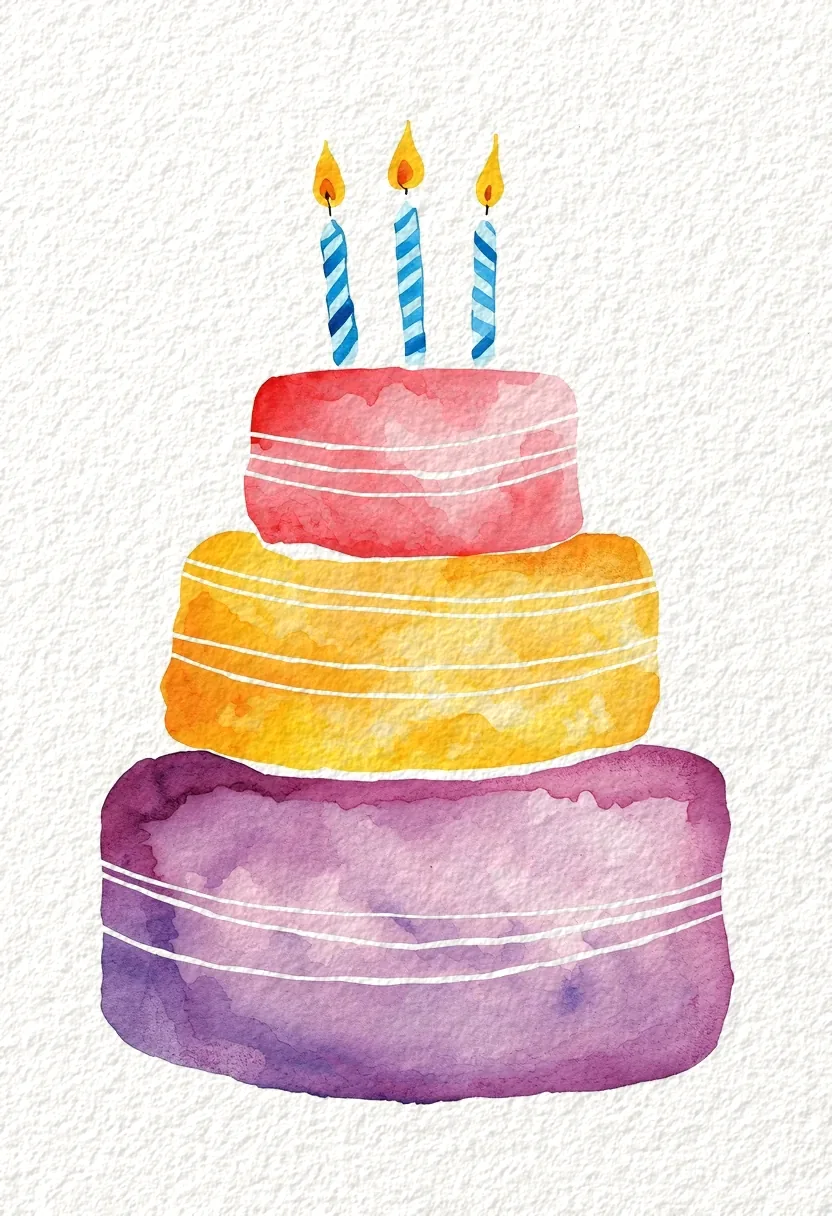 Three tiers with white icing lines and three candles.
A three-tier cake in rose, yellow and violet, with three thin candles and yellow flames on top. Two layers of paint, so it takes a little longer.
- Palette: rose (PV19), yellow (PY97), blue (PB15:3)
- Paper: 300 gsm cold press, 5 x 7 card
- Time: about 30 minutes · Difficulty: easy+
1. Paint the tiers. Paint three stacked rectangles, wide at the bottom and narrow at the top, in rose, yellow and violet, leaving a thin white gap between each for icing. 2. Let them dry. Wait until matte, then paint a wavy line of a darker version of each color along the bottom edge of each tier. 3. Add candles. With the small round, paint three thin blue candles on the top tier and a small yellow flame above each.
6. Birthday Candle in the Dark
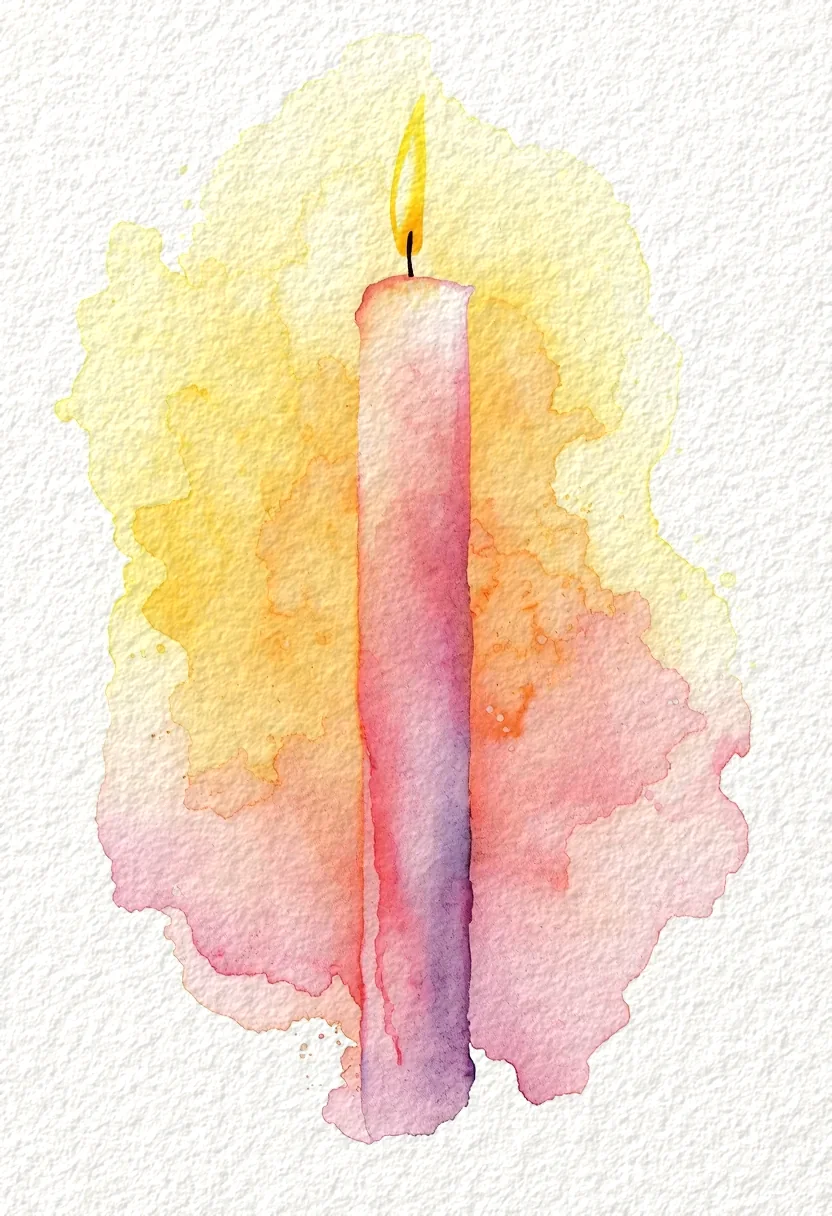 A single candle with a wet-on-wet glow around it.
One tall candle with a yellow flame, surrounded by a soft violet glow that fades to bare paper at the edges. A wet-on-wet card.
- Palette: yellow (PY97), rose (PV19), blue (PB15:3)
- Paper: 300 gsm cold press, 5 x 7 card
- Time: about 25 minutes · Difficulty: easy+
1. Wet the glow. Brush clean water in a rough circle around the middle of the card, leaving a candle-shaped strip dry in the center. 2. Drop in the colors. Touch yellow into the damp paper nearest the candle and violet toward the outer edge, and let them blend. 3. Paint the candle. When dry, fill the dry strip with pale rose, add a short grey wick and a teardrop of yellow for the flame.
7. Cup of Tea With Steam
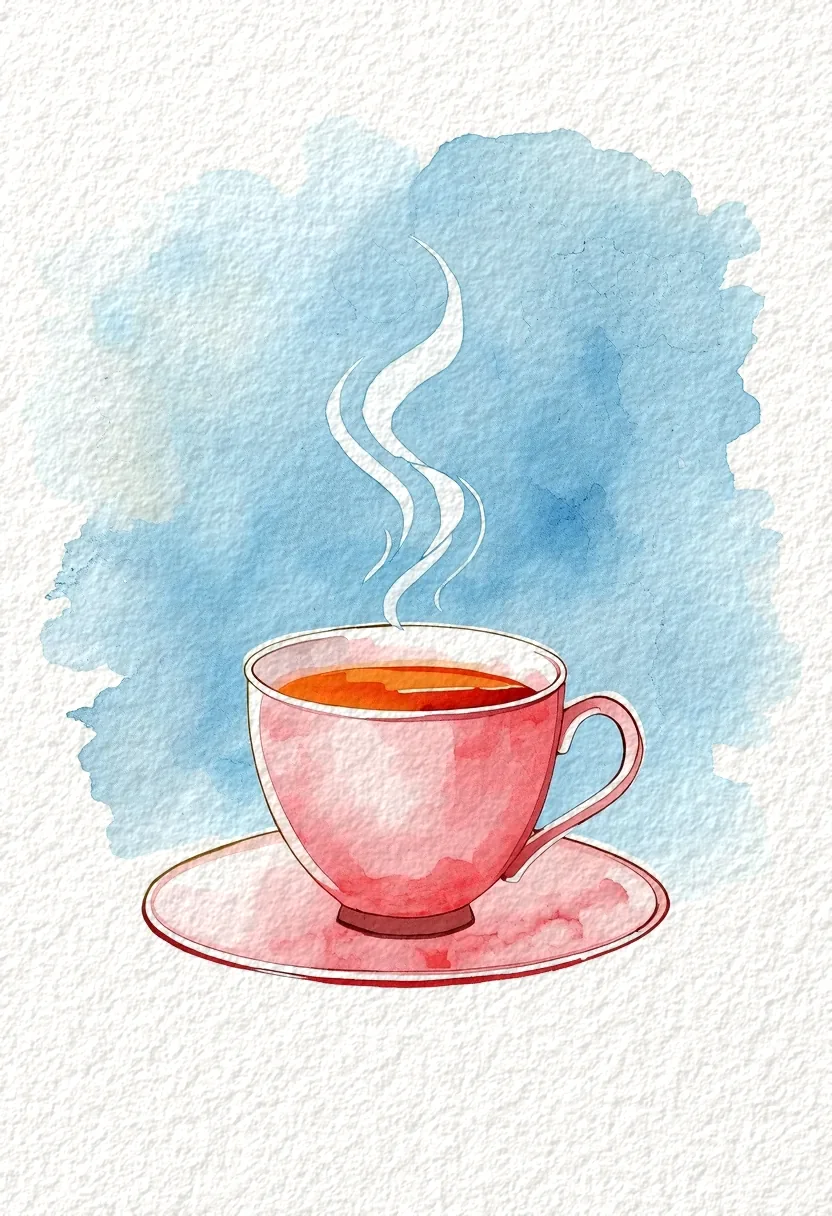 A rose-colored cup, with the steam left as bare paper.
A rose-colored cup on a saucer, with two wisps of steam left as bare paper inside a pale blue background. The quiet card.
- Palette: rose (PV19), blue (PB15:3), yellow (PY97)
- Paper: 300 gsm cold press, 5 x 7 card
- Time: about 25 minutes · Difficulty: easy+
1. Paint the cup. Paint a cup shape in rose with a thin white strip down one side for shine, and a flat saucer below it. 2. Fill the tea. When dry, paint the top oval in orange, leaving a thin crescent of bare paper for the rim. 3. Leave the steam. Wash very pale blue around the cup and leave two curvy wisps of bare paper rising from it.
GODEEPER: The candle card and the glow behind it depend on paint spreading into damp paper. The wet-on-wet guide shows how wet the sheet should be for a soft halo. Wet-on-Wet Watercolor Technique: Complete Beginner Guide →
Watercolor Birthday Card Ideas for Friends
These three watercolor birthday card ideas are bolder and a little more graphic. They work well with the greeting as part of the design.
8. Wrapped Gift With a Bow
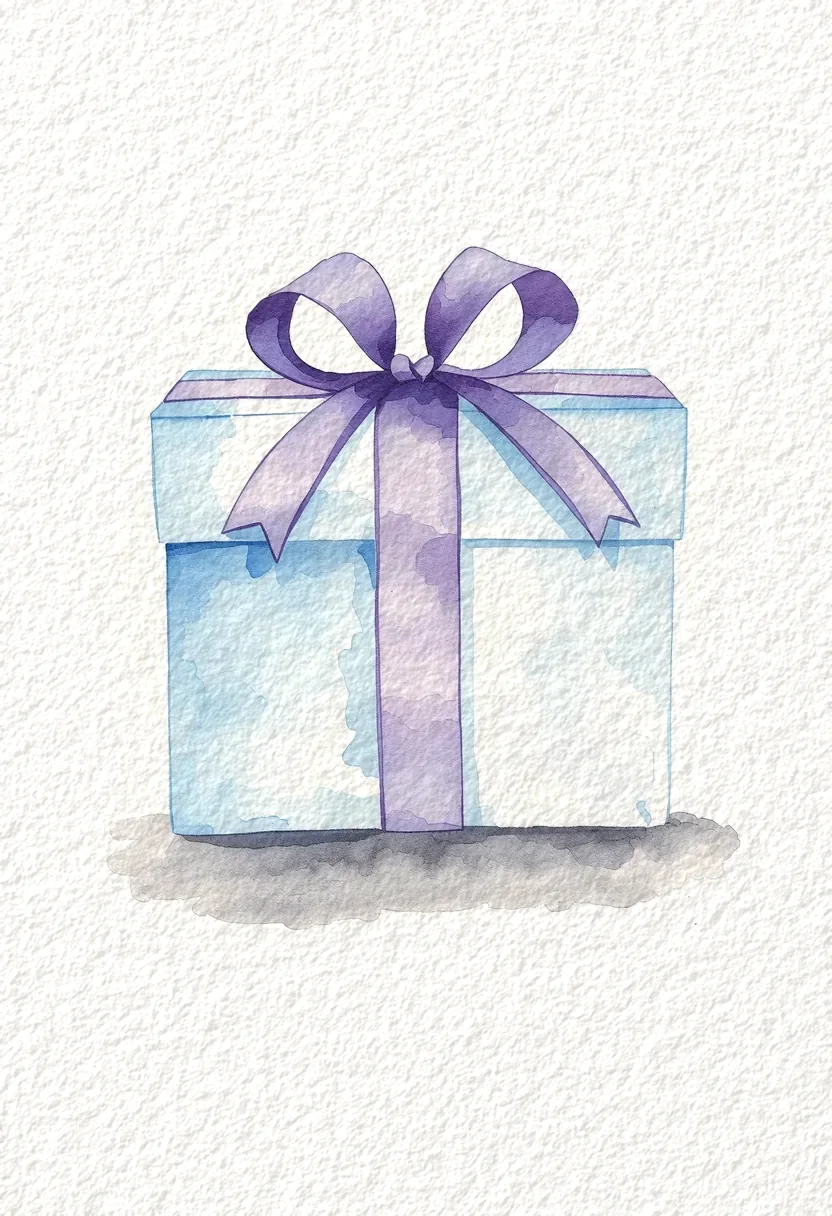 A wrapped gift in pale blue with a violet bow.
A square gift box in blue with a violet ribbon and a bow on top. Two layers, crisp edges.
- Palette: blue (PB15:3), rose (PV19), yellow (PY97)
- Paper: 300 gsm cold press, 5 x 7 card
- Time: about 30 minutes · Difficulty: easy+
1. Paint the box. Paint a square in pale blue, leaving two thin white strips crossing it where the ribbon will go. 2. Ribbon and bow. When dry, fill the white strips with violet and paint a bow of two loops and two tails on top. 3. Shadow it. Add a soft grey shadow along the bottom edge so the box sits on the card.
9. Number Card
 A number card, blended from pink to yellow, with a few confetti dots.
The person's age painted as one large number in a bright wash, filled with a wet-on-wet blend of two colors, with a few confetti dots around it.
- Palette: rose (PV19), yellow (PY97), blue (PB15:3)
- Paper: 300 gsm cold press, 5 x 7 card
- Time: about 20 minutes · Difficulty: easy
1. Pencil the number. Lightly draw the digit or digits large in the center of the card. 2. Fill it wet. Wet the inside of the number with clean water, then touch rose at the top and yellow at the bottom and let them meet in the middle. 3. Add confetti. When dry, dot a few small marks of blue and violet around the number.
10. Stacked Macarons
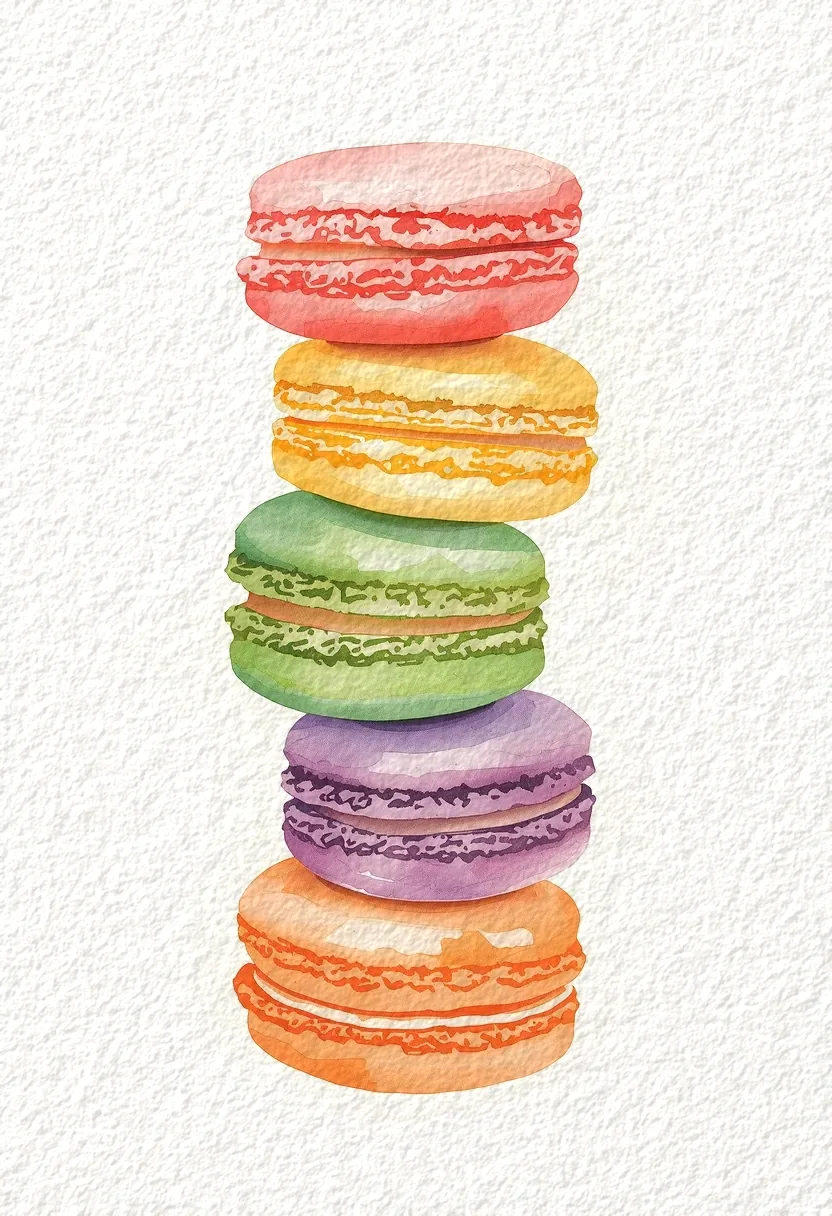 Five macarons stacked in rainbow order.
A tower of five round macarons in rose, yellow, green, violet and orange, each with a thin white filling line. Mostly a color exercise.
- Palette: rose (PV19), yellow (PY97), blue (PB15:3)
- Paper: 300 gsm cold press, 5 x 7 card
- Time: about 25 minutes · Difficulty: easy+
1. Paint the shells. Paint five pairs of flattened ovals stacked up the card, one color per pair, leaving a thin white line between the two halves of each. 2. Deepen one side. While each pair is damp, touch a stronger dab of its color on the left so it looks round. 3. Fill the lines. When dry, run a thin line of a contrasting mix through each white gap for the filling.
GODEEPER: Our Christmas card list uses the same card size and the same three steps per design, with a five-tube palette instead of three. 12 Easy Watercolor Christmas Card Ideas for Beginners →
Analysis: Which Birthday Card to Paint First
Work through these watercolor birthday card ideas in an order that adds one skill at a time. The balloons (idea 1) teach a single dab with a dot of paper left white. The confetti (idea 2) repeats that at speed, and the rainbow (idea 3) adds strokes that touch while damp.
The flower (idea 4) is your first pressed-brush petal, and the cake (idea 5) is your first second layer on dry paint. Those two moves carry the rest of the list. The candle (idea 6) and the number (idea 9) are both wet-on-wet, a halo and a fill, and the cup (idea 7) and the gift (idea 8) are about leaving paper white for shine and ribbon.
Because all ten cards share three tubes, you can paint them in batches. Mix one pool of orange and one of violet, and ideas 1, 2, 5 and 10 are mostly done from those pools. Painting six cards side by side uses the drying time well, since each one dries while you work on the next. A card that goes wrong costs one small piece of paper, which is the best reason to make birthday cards your practice sheets.
Frequently Asked Questions
What is the easiest watercolor birthday card to paint? A bunch of balloons. Each balloon is one round dab of color with a dot of bare paper left for the shine, and the strings are three thin lines drawn once the paint is dry. There is no drawing and no blending. A first card takes about 15 minutes, most of it waiting for the balloons to dry.
What colors do I need for watercolor birthday cards? Three tubes cover all ten cards: Quinacridone Rose (PV19), Hansa Yellow Medium (PY97) and Phthalo Blue Green Shade (PB15:3). Rose and yellow make orange, yellow and blue make green, blue and rose make violet. All three are rated lightfastness I by Daniel Smith, so the card won't fade on a shelf.
What paper should I use for a watercolor birthday card? Cold-press watercolor paper at 300 gsm (140 lb), cut to 7 by 10 inches and folded to 5 by 7 inches, which fits a standard A7 envelope. That weight folds cleanly without cracking and takes a wet wash without buckling much. Paint the card flat before you fold it, and let it dry fully first.
How long does a watercolor birthday card take? Most cards here take 15 to 30 minutes, and roughly half of that is drying time between the paint and the pen lines. The balloons, the candle and the confetti are the quickest. The cake and the wrapped gift take longer because each colored layer has to dry before the next one goes on.
Can I write on a watercolor birthday card with a pen? Yes, once the paint is bone dry. A waterproof fineliner, such as a pigment ink pen, writes cleanly over dried watercolor and won't bleed if the card gets damp later. Write the greeting last, after any paint has dried for at least 20 minutes, and test the pen on an offcut of the same paper first.
Related Reading
- 12 Easy Watercolor Ideas for Beginners From 3 Tubes: the same three-tube idea, with twelve non-card subjects.
- Wet-on-Dry Watercolor Technique: Crisp Edges in 6 Steps: the crisp cake tiers and gift ribbon are wet-on-dry layers.
- Best Watercolor Brushes for Beginners: 3 Shapes to Buy: the round brushes that handle both balloons and strings.
- Watercolor Block vs Pad vs Sheets: Cost per Square Inch: a full sheet cuts into nine card blanks for the price of one block page.
References

Written by
Elena VancePigments & Color Editor
Elena Vance writes Watercolor Daily's pigment and color coverage: Colour Index codes, lightfastness ratings, transparency, and palette building.
NextKeep reading
Features / 14 min
12 Easy Watercolor Flower Ideas Sorted by Brush Stroke
Features / 14 min
11 Christmas Watercolor Ideas to Paint With 5 Tubes
Features / 14 min
12 Easy Watercolor Ideas for Beginners From 3 Tubes
Features / 13 min
10 Easy Winter Watercolor Ideas From a 4-Tube Palette
Features / 15 min
12 Easy Watercolor Christmas Card Ideas for Beginners
Guides / 11 min
Dry Brush Watercolor Technique: 8 Tips for Broken Texture
Guides / 14 min
How to Clean Watercolor Brushes: 7 Steps, 3 Ways to Dry
Guides / 11 min
Flat Wash Watercolor Technique: Flat and Graded in 5 Steps
Disclaimer
This article is published for informational purposes and is not professional advice. Product formulations, pigment sources, packaging and store listings change. Check the details that matter to you (price, pigment content, regional availability) with the manufacturer or retailer before you buy.