Loading
Watercolor Daily · Guides
Watercolor Pans vs Tubes: What to Buy First, Priced per ml
12 min readBy Marcus Reed
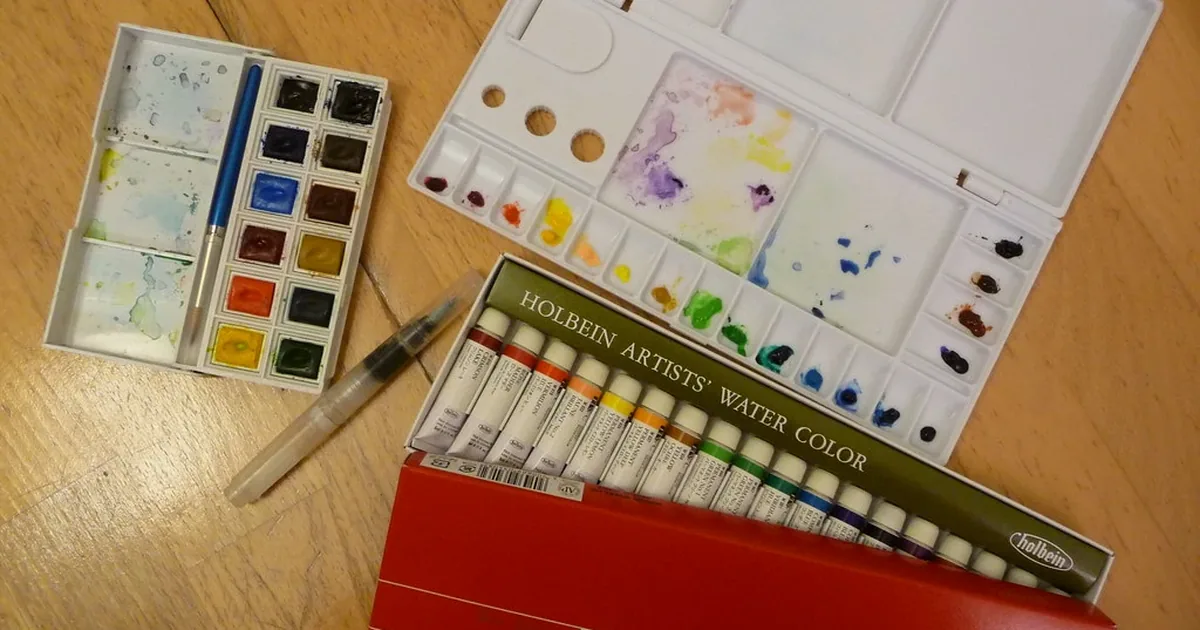
Photo: denn, Flickr, CC BY-SA 2.0
Review
Watercolor Paint Formats
Watercolor pans vs tubes is mostly a format decision, and the paint inside is often identical. Schmincke says its Horadam pans and tubes share one formulation, and Winsor & Newton sells its Professional range in both. The two differ in how fast color comes off the brush, what each milliliter costs, and how much paint ends up dried on the palette. This guide prices four Winsor & Newton formats per milliliter and shows how to fill your own pans from tubes.
In short: Start with pans if you paint small or outdoors, and buy tubes for large washes and for refilling. Winsor & Newton's US store lists Professional Cobalt Blue at $17.29 for 5 ml, $33.99 for 14 ml and $60.19 for 37 ml, so the biggest tube costs less than half as much per ml as the smallest. A half pan costs about the same as a 5 ml tube, and Winsor & Newton does not publish how much paint it holds.
Watercolor pans vs tubes: which should you buy first? (quick answer)
Buy pans first if you are learning, painting small, or carrying a kit outdoors. Buy tubes first if you paint large washes at a desk or already know your six to twelve colors. The cheapest long-term setup is tubes squeezed into empty pans.
Key Takeaways
- Pans hold dry paint you re-wet with a brush. Tubes hold wet paint that releases a lot of color at once.
- Schmincke states that its Horadam pans and tubes use the same formulation.
- Price per ml falls as the tube gets bigger: about $3.46 for a 5 ml Winsor & Newton Professional tube, $1.63 for a 37 ml tube.
- Winsor & Newton does not publish the volume of a half pan, so its price per ml can't be compared directly.
- Honey-based paints such as M. Graham resist hardening, which makes them a poor choice for filling pans.
Overview
These tips are for painters weighing watercolor pans vs tubes for a first palette, or deciding whether to switch formats. They assume artist or student watercolor from an established maker, a palette with removable half-pan slots or a mixing tray, and paper that can take a wash. Winsor & Newton prices are from its US online store on October 17, 2026. They change, so treat them as a snapshot for comparing formats, not a shopping list.
Winsor & Newton's own product page sums up the trade-off in two sentences:
"Pans are portable and air dry, very useful when working outside or when needing to work quickly. Tubes are wet paint, perfect for working at a large scale with a quicker release and particularly helpful with a restricted palette."
That "quicker release" is what you notice first. Wet tube paint gives up a lot of color the moment the brush touches it, while a dry pan needs a few seconds of scrubbing with a wet brush before it gives up the same strength.
Watercolor Pans vs Tubes: What Each Format Costs per ml
Larger tubes are much cheaper per milliliter, and the half pan is the hardest format to compare. At Winsor & Newton's US store, the 37 ml tube of Professional Cobalt Blue costs less than half as much per ml as the 5 ml tube. The half pan sells for about the price of a 5 ml tube, but its volume isn't stated.
Here are the four formats of one color, Professional Cobalt Blue, a Series 4 color, as listed on October 17, 2026:
| Format | Price | Price per ml |
|---|---|---|
| 5 ml tube | $17.29 | $3.46 |
| Half pan | $17.89 | not published |
| 14 ml tube | $33.99 | $2.43 |
| 37 ml tube | $60.19 | $1.63 |
Winsor & Newton lists the half pan next to the tubes but gives no milliliter figure for it, so any per-ml price for a pan would be a guess. What you can say is that a half pan costs 60 cents more than a 5 ml tube. And according to Daniel Smith's tutorial on filling pans, a 5 ml tube fills roughly two to three half pans. So the cheapest route takes a few days of patience: buy tubes, fill your own pans, and keep the rest of the tube for refills.
Price per ml also depends on the series. Professional colors are priced in series from 1 to 4, so an earth color costs much less than this cobalt in every format. The pattern holds across series, though: the bigger the tube, the lower the cost per ml. The student Cotman range follows the same logic with different sizes: 8 ml and 21 ml tubes, plus half pans.
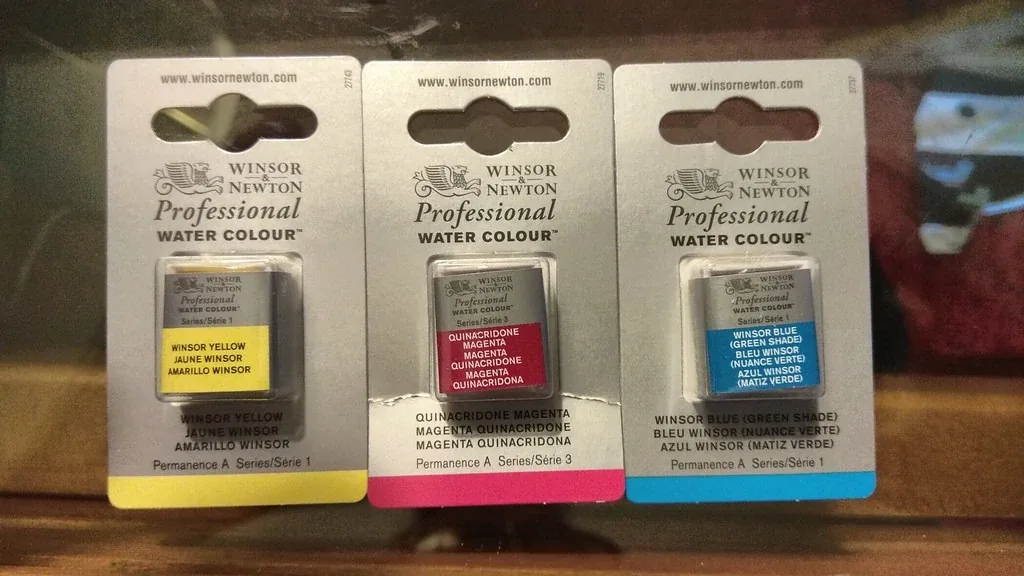 Three Professional half pans as sold on cards. The series number printed on each card (Series 1 for the yellow and blue, Series 3 for the magenta) sets the price. Photo: inktorius, Flickr, CC BY 2.0.
GODEEPER: Price is only half the story. Student and artist lines also differ in pigment, and some student colors are hues made from cheaper pigments. Student vs Artist Grade Watercolor: 6 Pigments Compared →
When Pans Win, and When Tubes Win
Pans win for small work, travel and learning. Tubes win for big washes and for refilling. In the watercolor pans vs tubes choice, the reasons come down to how each format handles water.
Tips for choosing pans
1. Choose pans if you paint small or on location. A closed pan box doesn't leak once the paint has dried, and you can be painting within seconds of opening it. That is the convenience Winsor & Newton describes when it calls pans "very useful when working outside."
2. Choose pans if you waste paint. Tube paint squeezed onto a palette sits there drying, and beginners often squeeze out more than they use. A pan only loses what the brush picks up.
3. Wet your pans before you start. Put a drop of clean water on each pan you plan to use a minute before painting. The surface softens, and the first brushload comes up stronger, which narrows the gap with tube paint.
Tips for choosing tubes
4. Choose tubes for large washes. A sky across a half sheet needs a puddle of mixed color ready before you start, and scrubbing a half pan for that much paint is slow and wears down your brush. Squeeze tube paint into a well, add water, and the wash is mixed in seconds.
5. Choose tubes for a short, fixed palette. If you use the same six colors every time, a 14 ml tube of each is cheaper per ml than any small format, and you can refill pans from it for years.
6. Recap tubes cleanly. Wipe the thread before closing the cap. Dried paint in the thread glues the cap shut and lets air in, and air is what turns the paint left in the tube hard.
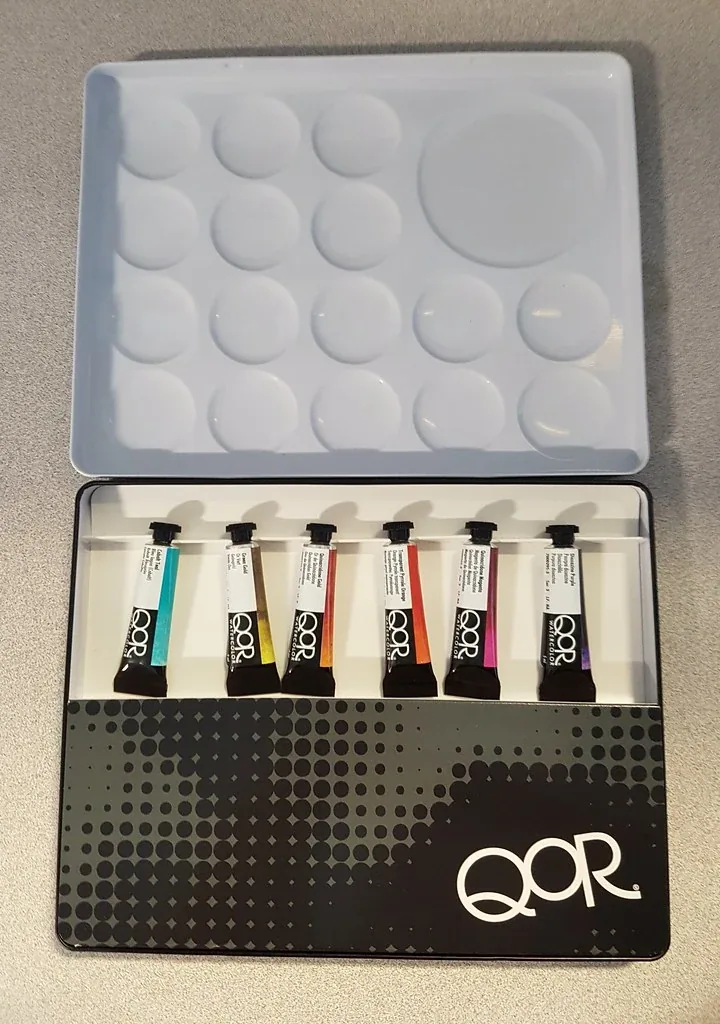 A QoR tin of six 5 ml tubes. The lid doubles as a palette: tube paint is squeezed into the round wells and either used wet or left to dry. Photo: CharmaineZoe's Marvelous Melange, Flickr, CC BY 2.0.
Step-by-Step: How to Fill Half Pans from Tubes
1. Check that the paint will set. Most gum arabic watercolors dry hard in a pan. Honey-based paints are the exception: M. Graham says its watercolors "resist hardening on the palette or in the tube," and painters report that pans filled with them stay tacky. Fill pans with those only if your palette always lies flat.
2. Squeeze the first layer to about half full. Put the empty half pan on a flat surface and squeeze tube paint in from one corner, working across the pan. Stop at about half full, because watercolor shrinks as the water evaporates.
3. Spread the paint and remove air bubbles. Use a toothpick or a palette knife to push the paint into the corners and smooth the top. Tap the pan gently on the table to bring trapped air to the surface. Air pockets become holes and cracks once the paint dries.
4. Let it dry uncovered. Leave the pan open somewhere free of dust. Daniel Smith suggests about 24 to 48 hours before adding the next layer. In humid weather, give it longer.
5. Top up in a second or third layer. Squeeze in more paint, spread it, and let it dry again. Daniel Smith's tutorial recommends building pans in layers, and factory pans are made the same way: Schmincke says it pours its Horadam pans four times, with several weeks of drying in between.
6. Label the pan. Write the color name and pigment code on the side or bottom of the pan with a fine permanent marker. When the pan runs low, you'll know exactly which tube to buy.
GODEEPER: Once your pans are filled, the next decision is which colors go in them. Six well-chosen pigments can carry a whole palette. Split-Primary Palette Guide: Mix Any Color with 6 Tubes →
Tips for Mixing Pans and Tubes in One Kit
Plenty of painters settle watercolor pans vs tubes by keeping both, and it's a sensible setup. A pan box for sketching and a few large tubes for washes and refills cover almost every situation.
- Keep one tube of your most-used color. Whichever pan empties first in your palette, buy that color as a 14 ml tube. If a 5 ml tube fills two to three half pans, a 14 ml tube refills its pan many times over.
- Expect home-filled pans to crack. A pan filled in a day or two dries faster than a factory pan that was poured and dried over weeks, so small cracks are common. They don't change the paint. A drop of water before painting usually stops cracked pieces from lifting out.
- Don't fill pans from very old tubes. If the paint comes out stiff or separated, with clear binder running ahead of the color, knead the tube first. A stiff tube that won't flow may not set evenly in a pan.
- Match the paper to the format. Big tube washes need paper that can take a lot of water without buckling. A 300 gsm (140 lb) cotton sheet is the usual minimum for wash-heavy work.
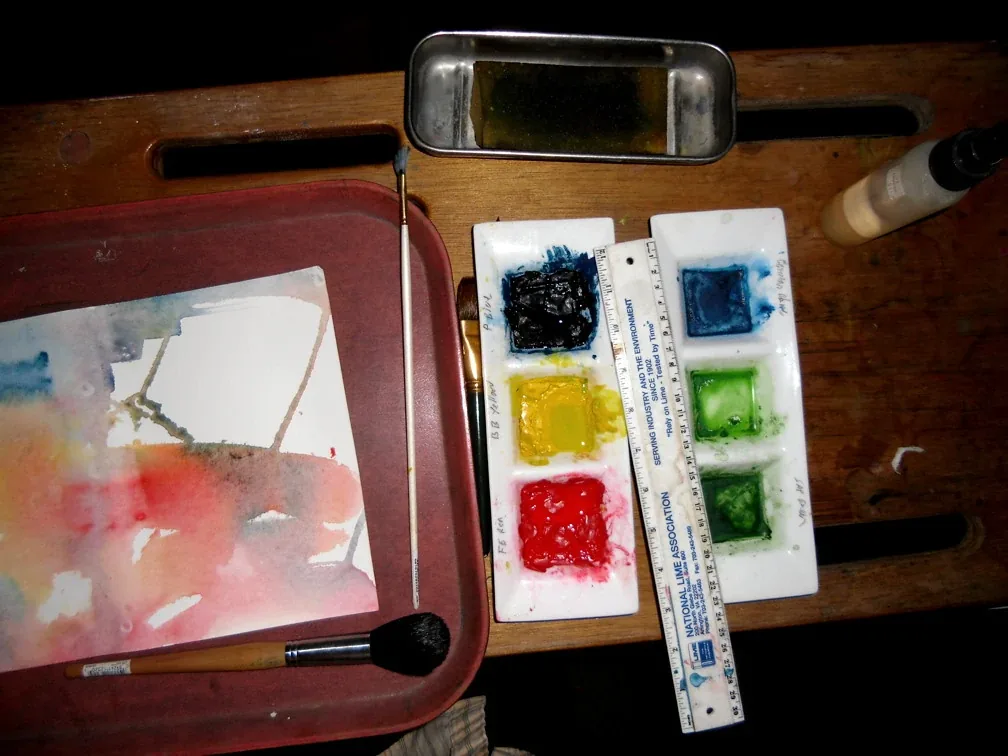 One painter's answer to pans that are too small for big brushes: cheap white condiment trays filled with tube paint. The photographer describes a standard pan as about 2 cm across, awkward to load a large brush from. Photo: jimoneilalaska, Flickr, CC BY 2.0.
Frequently Asked Questions
Is it better to buy watercolor pans or tubes? For a first palette, pans are usually easier: they are ready to paint, travel without leaking and waste little paint. Tubes win when you paint large washes, because wet paint releases a lot of color quickly. Many painters end up using both, buying tubes and filling their own pans.
Are watercolor tubes and pans the same paint? Often, but check the brand. Schmincke states that its Horadam pans and tubes use the same formulation. Not every maker says this, and honey-based paints such as M. Graham resist hardening, which makes them awkward to dry into pans.
Which is cheaper, watercolor pans or tubes? Larger tubes are cheapest per milliliter. Winsor & Newton's US store lists Professional Cobalt Blue at $17.29 for 5 ml and $60.19 for 37 ml, so the price per ml falls by more than half. A half pan costs about the same as a 5 ml tube, but its volume is not published.
Can you put tube watercolor into half pans? Yes. Squeeze the tube paint into an empty half pan, spread it to remove air bubbles, and let it dry uncovered before adding another layer. Daniel Smith's own tutorial suggests building the pan in layers and estimates that a 5 ml tube fills two to three half pans.
How long does tube paint take to dry in a pan? Plan on at least a day per layer, and longer in humid weather. Daniel Smith suggests about 24 to 48 hours uncovered before topping up a pan. Schmincke fills its factory pans in four pours with several weeks of drying, which is why a home-filled pan may shrink or crack more.
Do watercolor pans dry out or go bad? Pans are meant to dry. Dry watercolor is re-wetted with a damp brush, and Schmincke describes its Horadam pans as easily re-wettable and re-usable after drying. A pan only becomes a problem if it cracks badly or falls out of its slot, which a drop of water usually fixes.
Related Reading
- Watercolor for Beginners: Essential Supplies and Buying Guide: the full starter kit, from paper to palette.
- Best Watercolor Brushes for Beginners: 3 Shapes to Buy: which brushes lift paint cleanly from a pan and carry a wash.
- Best Watercolor Paper for Beginners: Why 100% Cotton Matters: paper that can take a tube-sized wash without buckling.
References
- Winsor & Newton: Professional Watercolour Cobalt Blue - Formats, US prices and the pans vs tubes description.
- Winsor & Newton: Cotman Watercolour range - Student range formats, including 8 ml and 21 ml tubes and half pans.
- Schmincke: Horadam Aquarell - Pan and tube sizes, four-pour pan filling and shared formulation.
- M. Graham: Watercolors - Honey binder and resistance to hardening.
- Daniel Smith: Fill Your Own Half Pans - Layered filling and drying times for home-filled pans.
Was this guide helpful?

Written by
Marcus ReedTechnique Editor
Marcus Reed writes Watercolor Daily's step-by-step technique guides: wet-on-wet washes, glazing, dry brush, and the water control underneath them.
NextKeep reading
Features / 10 min
Student vs Artist Grade Watercolor: 6 Pigments Compared
Features / 12 min
Ceramic vs Plastic Watercolor Palette: 5 Differences
Features / 11 min
Best Travel Watercolor Sets: 5 Pocket Boxes Compared
Guides / 9 min
Watercolor for Beginners: Essential Supplies & Buying Guide
Features / 13 min
Best Watercolor Paints for Beginners: 5 Sets Compared
Guides / 16 min
Best Watercolor Brushes for Beginners: 3 Shapes to Buy
Features / 11 min
Watercolor Block vs Pad vs Sheets: Cost per Square Inch
Guides / 11 min
Dry Brush Watercolor Technique: 8 Tips for Broken Texture
Disclaimer
This article is published for informational purposes and is not professional advice. Product formulations, pigment sources, packaging and store listings change. Check the details that matter to you (price, pigment content, regional availability) with the manufacturer or retailer before you buy.
Brands in this article
Winsor & Newton