Loading
Watercolor Daily · Reviews
Canson XL Watercolor Paper Review: 6 Pads and Prices Checked
Canson XL watercolor paper review, a fair practice paper but weak for wet-in-wet. Six pads priced per square inch, the fiber, and when to step up to cotton.
9 min readBy Arthur Sterling
Painting: Maurice Prendergast, May Day, Central Park, 1901, Cleveland Museum of Art, CC0
Review
Canson XL Watercolor
Canson · France
6.8
Score / 10
- Grade
- Student Grade
- Format reviewed
- 140 lb (300 gsm) cold press pads, 30 sheets
For
- About 0.26 to 0.46 cents per square inch at Blick, a third of Canson's own Montval
- 30 sheets per pad in every size Blick sells, from 7 x 10 to 18 x 24 inches
- 140 lb (300 gsm), acid-free and FSC certified, per Canson
- Takes pen, ink and watercolor pencil well, by painter reports
Against
- Cellulose (wood pulp), not cotton, so washes are hard to blend wet-in-wet
- Canson does not publish the sizing it uses
- The surface pills after several layers or heavy scrubbing, by painter reports
- Cold press only, and the texture is finer than most cold press sheets
Verdict
Canson XL is a cheap, consistent practice paper for studies and mixed media, but cotton paper is the better buy for wet-in-wet work and finished paintings.
This Canson XL watercolor paper review starts with the fiber, because it explains most of how the paper behaves. Canson XL is cellulose, which means wood pulp, and it has no cotton in it. Canson sells it as a student paper, 140 lb (300 gsm), in pads of 30 sheets. We checked Canson's product pages, Blick's six pad sizes and prices on 2026-11-18, and what painters report after using it. We didn't run our own paint tests, so nothing here is a drying time or a lifting count.
We score Canson XL 6.8/10. It's cheap, consistent and good for practice. For soft wet-in-wet blends it's the wrong paper.
Key Takeaways
- What it is. A cold press watercolor paper from Canson, 140 lb (300 gsm), acid-free, FSC certified.
- Fiber. Cellulose (wood pulp), not cotton, per Blick's product specialists. Canson does not publish the sizing.
- Formats. Six pads at Blick, all 30 sheets, from 7 x 10 to 18 x 24 inches. Canson also sells sheets and sketchbooks.
- Price. $11.11 for a 9 x 12 inch fold over pad at Blick, about 37 cents a sheet.
- Who it suits. Beginners practicing strokes, sketchers, and mixed media with pen or watercolor pencil.
- Main limit. Colors don't blend softly into a wet wash, and the surface pills after several layers.
A painter paints wildflowers on one Canson XL sheet and talks through what he likes and doesn't like about non-cotton paper (The Art of Michael David Sorensen, 8 minutes, 2026).
Overview: What This Canson XL Watercolor Paper Review Covers
Canson is a French paper maker. It makes papers at every level, from school pads to cotton sheets. XL is its value line. There are XL pads for drawing, markers, mixed media and watercolor.
Canson describes XL Watercolour plainly. It "was specially designed for wet techniques including watercolour." The same page says it is "perfect for students, as the paper is very easy to correct and it can be washed with a sponge or a brush." The US page adds that "the durable surface withstands repeated washes."
The specification Canson publishes is short:
| Spec | What Canson and Blick list |
|---|---|
| Weight | 140 lb (300 gsm); a lighter 90 lb (185 gsm) version is also sold in the US |
| Surface | Cold press only |
| Fiber | Cellulose pulp, no cotton (Blick product specialists) |
| Sizing | Not published |
| Treatment | Acid-free, mould-resistant, FSC certified |
| Formats | Pads, sketchbooks and loose sheets |
Weight tells you how thick a sheet is. 300 gsm and 140 lb are the same paper, one metric and one imperial. Our guide to watercolor paper weight explains why 140 lb is the usual minimum for washes. Check the cover before you buy, because the 90 lb pad looks almost the same on a shelf.
Blick says XL pads "contain more sheets at a comparable or better price than other value pads." Sheet count for the money is the main reason to buy it.
Performance: How a Cellulose Sheet Handles Watercolor
The short answer is that Canson XL handles direct painting well and soft blending poorly. Paint put down in one pass and left alone dries clean. Paint dropped into a wet wash stays put instead of spreading. Layers work for two or three passes, then the surface starts to rough up.
Why the fiber matters
Cotton fibers are long and soak up water slowly. That gives you time to work into a wet wash. Cellulose from wood pulp has shorter fibers. Water sinks in faster, so the wet window is shorter.
Sizing also matters. Sizing is a glue in or on the paper that controls how fast water soaks in. Our Arches paper review covers a paper whose maker publishes its gelatin sizing. Canson publishes no sizing details for XL. So how the sheet holds water can only be judged from painters' reports.
What painters report
Teoh Yi Chie of Parka Blogs reviewed the 300 gsm paper on his blog. He found the cold press texture closer to a "fine grain cartridge paper" than to true cold press. He also found that strokes painted into a wet wash "did not diffuse," where cotton paper lets them spread softly. His advice was to "paint fast," and he noted the paper doesn't dull colors.
Comments under that review add two points. One painter says the paper "can only take so many layers before it begins to pill." Pilling means the surface fibers lift into small balls. Another calls it a favorite for watercolor pencils, because the fine texture suits them.
A Blick reviewer who uses it for card fronts likes that it is "whiter than some other watercolor paper." The same reviewer says it "buckles a bit when making a larger painting, even when taped down." Buckling is the sheet rippling as it gets wet. Our guide to watercolor paper buckling explains how to limit it.
What suits it and what fights it
Good uses:
- Brush stroke and color mixing practice
- Small studies painted in one or two passes
- Pen and ink with a light wash
- Watercolor pencil, wet or dry
- Practice cards and swatch charts
Poor uses:
- Wet-in-wet skies and soft blends
- Many glazes over one area
- Heavy scrubbing and repeated lifting
- Paintings you plan to frame or sell
Canson says the paper is "very easy to correct" with a sponge. That suits gentle lifting of a still-damp area. Hard scrubbing on a dry area is where pilling starts.
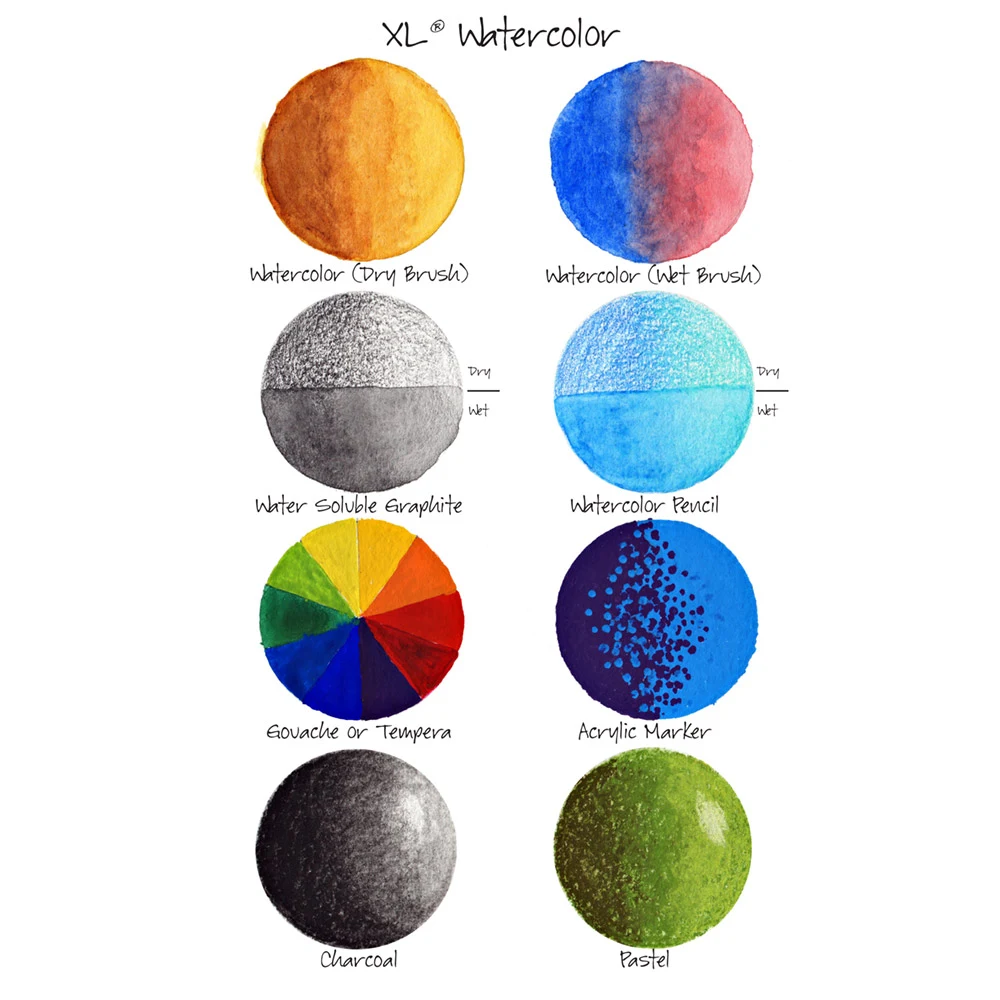 Canson's own sample sheet for XL Watercolor, showing the media it markets the paper for. Image: Canson.
Price: Which Canson XL Pad Is the Best Buy?
The largest fold over pad is the cheapest per square inch, and the small wirebound pads are the most expensive. Every pad has 30 sheets, so the gap comes from sheet size and binding. All prices below are from Blick on 2026-11-18.
| Canson XL pad at Blick | Price | Per sheet | Per square inch |
|---|---|---|---|
| Fold over, 18 x 24 in | $34.06 | $1.14 | 0.26 cents |
| Fold over, 11 x 15 in | $14.35 | $0.48 | 0.29 cents |
| Fold over, 12 x 18 in | $18.91 | $0.63 | 0.29 cents |
| Fold over, 9 x 12 in | $11.11 | $0.37 | 0.34 cents |
| Wirebound, 9 x 12 in | $13.78 | $0.46 | 0.42 cents |
| Wirebound, 7 x 10 in | $9.72 | $0.32 | 0.46 cents |
The 11 x 15 inch pad is the sweet spot. It costs almost the same per inch as the biggest pad and fits a normal desk. Wire binding on the 9 x 12 size costs about 24% more per inch, which is a lot to pay for a spiral on practice paper.
For context, Canson's own step-up pad, Montval, cost $11.43 for 12 sheets of 9 x 12 inch at Blick. That is about 95 cents a sheet, about two and a half times the XL price. Montval is also cellulose, with no cotton, per Blick. In our Arches review, cotton Arches cost 1.48 cents per square inch as a full sheet and 2.27 cents in a block (Blick, 2026-11-14). That is five to nine times the price of a large XL pad.
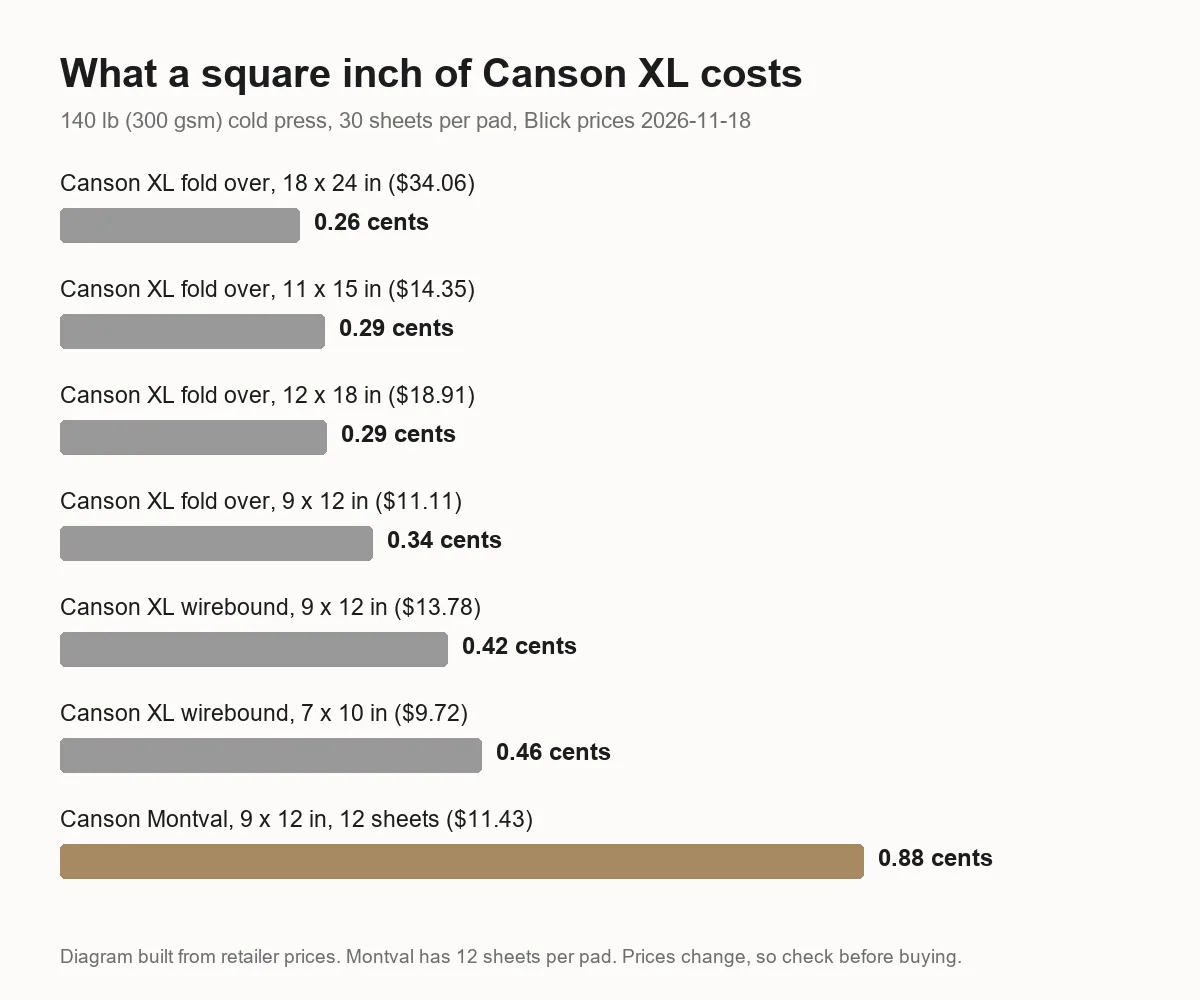 Our diagram of the Blick prices above. The large fold over pads give the most paper for the money.
Rubric Assessment
Paper Quality: 5/10
The weight is a full 140 lb, the paper is acid-free and the pads are consistent. The fiber is cellulose, and Canson does not publish the sizing. Painters report pilling after a few layers.
Permanence: 6/10
Acid-free paper resists yellowing. Canson does not publish a lifespan. Blick's product specialist says paper of this quality "can typically last up to 100 years" with proper care. That is a retailer's estimate, not a test result.
Handling: 6/10
Direct painting, pen work and watercolor pencil go well, by painter reports. Wet-in-wet blending and heavy glazing do not. The fine texture also leaves little tooth (the grain that catches paint) for dry brush work.
Range and Formats: 8/10
Six pad sizes at Blick, plus sketchbooks and sheets from Canson. Two bindings. The only gap is texture: cold press is the only surface sold.
Value: 9/10
At 0.26 to 0.46 cents per square inch, it is the cheapest true 140 lb paper we have priced. Thirty sheets per pad means you can practice without worrying about waste.
Verdict: Our Canson XL Watercolor Paper Review Score
Score: 6.8/10
This Canson XL watercolor paper review lands on 6.8 because the paper does its main job, cheap practice, very well. It loses points where cotton is better, in soft blends, layering and long life.
The Good
- About 0.26 to 0.46 cents per square inch at Blick
- 30 sheets in every pad size
- 140 lb (300 gsm), acid-free and FSC certified
- Good with pen, ink and watercolor pencil, by painter reports
- Bright white surface, by one Blick reviewer
The Cons
- Cellulose, not cotton, so colors spread poorly in a wet wash
- No published sizing details
- Pills after several layers or hard scrubbing
- Texture is finer than most cold press, and only cold press is sold
Buy the 11 x 15 inch fold over pad for practice and studies. Keep a few sheets of cotton paper, such as the picks in our best watercolor paper for beginners guide, for the paintings you want to keep. A published sizing specification would raise the score.
Frequently Asked Questions
Is Canson XL watercolor paper good? It is good for practice, studies and mixed media, and weak for wet-in-wet painting. It is 140 lb (300 gsm), acid-free and costs about 37 cents a sheet in the 9 x 12 inch pad at Blick. Because it is cellulose, not cotton, colors dropped into a wet wash spread less and layers pill sooner.
What is Canson XL watercolor paper made of? Cellulose, which means wood pulp. Blick's product specialists confirm the pads are made from cellulose pulp and contain no cotton. Canson's own page lists the weight, cold press texture, acid-free paper, a mould-resistant treatment and FSC certification, but does not name the fiber or the sizing.
Is Canson XL watercolor paper 100% cotton? No. Canson XL contains no cotton at all. It is a cellulose paper made from wood pulp. If you want a cotton sheet, look for a paper that states 100% cotton on the pad, such as Arches. Canson's own Montval is also cellulose, so it is not a cotton step up either.
Is Canson XL watercolor paper acid free and archival? It is acid-free, by Canson's product page, which slows yellowing. Canson does not give a lifespan figure. Blick's product specialist says paper of this quality can typically last up to 100 years with proper care. Treat that as the retailer's estimate, not a tested rating, and frame finished work behind UV glass.
Do you need to stretch Canson XL paper? Usually not for small work. At 140 lb (300 gsm), Blick says the sheets are thick enough that they do not have to be stretched. Large, very wet paintings still buckle, as one Blick reviewer reports even with the sheet taped down. For full-page washes, stretch the paper first.
Is Canson XL better than Strathmore 400 watercolor paper? We have no side-by-side data for these two, so we won't rank them. Both are cellulose student papers. Compare the price per sheet at your store and check the fiber on the cover. For wet-in-wet work, the step that changes results is moving to cotton, not switching between two cellulose pads.
References
- Canson: XL Watercolour - Weight, cold press surface, acid-free, mould-resistant treatment, FSC certification and Canson's description.
- Canson: XL Watercolor (US) - 90 lb and 140 lb weights, pads, sketchbooks and sheets.
- Blick: Canson XL Watercolor Pads - Pad sizes and prices checked 2026-11-18, fiber and stretching answers from product specialists, buyer reviews.
- Blick: Canson Montval Tape Bound Watercolor Pads - Montval price, sheet count and fiber.
- Parka Blogs: Review of Canson XL Watercolour Paper (300gsm) - Texture, wet-in-wet and layering observations, and reader comments.
- The Art of Michael David Sorensen: Canson XL Watercolor Paper Review (YouTube) - Painting demo on one sheet with commentary.

Written by
Arthur SterlingSupplies & Reviews Editor
Arthur Sterling writes Watercolor Daily's supply reviews and brand comparisons: paints, cotton papers, and brushes, compared on published specifications.
NextKeep reading
Reviews / 9 min
Van Gogh Watercolor Review: 72 Colors and Pigments Checked
Reviews / 9 min
Baohong Watercolor Paper Review: 3 Ranges, Priced vs Arches
Reviews / 8 min
Arches Watercolor Paper Review: Is It Worth the Price?
Reviews / 9 min
Winsor & Newton Cotman Watercolor Review: 48 Colors Decoded
Features / 9 min
Best Watercolor Paper for Card Making: 7 Picks Ranked
Guides / 10 min
Watercolor Paper Buckling: Why It Happens and 6 Fixes
Guides / 10 min
Masking Tape for Watercolor Paper: 6 Tips to Stop Tearing
Features / 11 min
Watercolor Block vs Pad vs Sheets: Cost per Square Inch
Disclaimer
This article is published for informational purposes and is not professional advice. Product formulations, pigment sources, packaging and store listings change. Check the details that matter to you (price, pigment content, regional availability) with the manufacturer or retailer before you buy.