Loading
Watercolor Daily · Reviews
Arches Watercolor Paper Review: Is It Worth the Price?
Arches watercolor paper review, worth the price for finished work but costly for practice. Cotton, gelatin sizing, 5 weights and the cheapest way to buy it.
8 min readBy Elena Vance
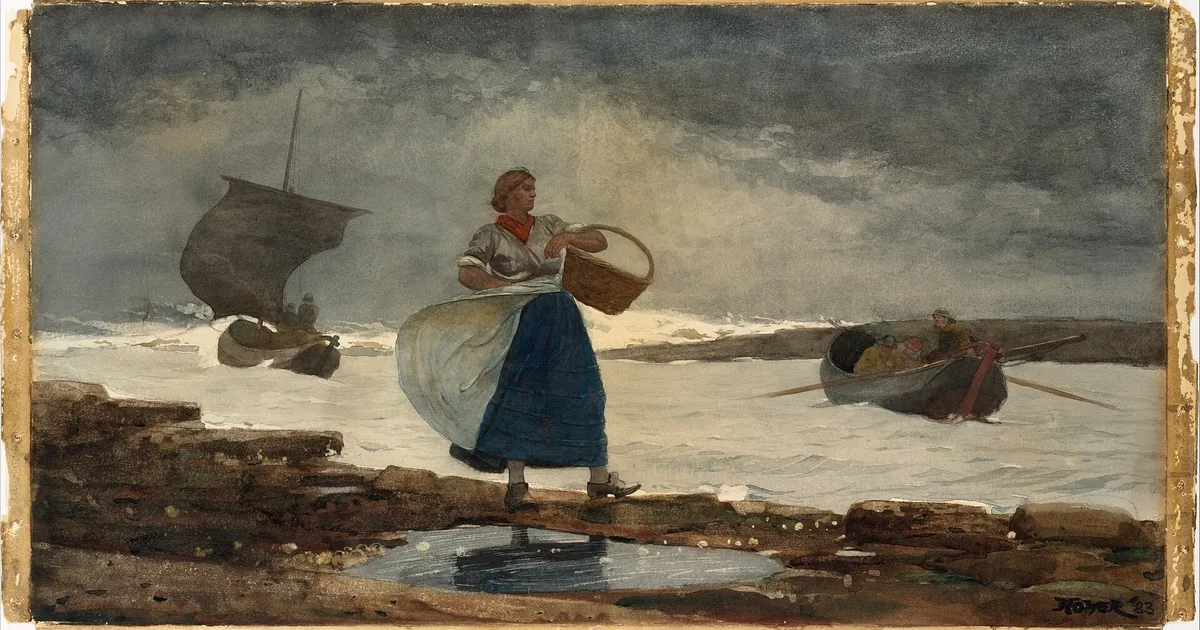
Painting: Winslow Homer, Inside the Bar (1883), The Metropolitan Museum of Art, CC0
Review
Arches Aquarelle Watercolour Paper
Arches · Vosges, France
9.2
Score / 10
- Grade
- 100% Cotton
- Format reviewed
- 300 gsm (140 lb) cold pressed, blocks and 22 x 30 inch sheets
For
- 100% cotton fiber, made on a cylinder mould
- Sized with natural gelatin all the way through the sheet, by the mill's description
- Five weights from 185 gsm to 850 gsm and three surfaces
- Acid free, with no optical brightening agents, to the ISO 9706 permanence standard
Against
- A 9 x 12 inch block of 20 sheets costs $48.93 at Blick, about $2.45 a sheet
- Gelatin is an animal product, so the paper is not vegan
- Blocks cost about half as much again per square inch as full sheets
Verdict
Arches Aquarelle is the reference cotton paper and earns its price on finished paintings, but full sheets torn down are the sensible way to afford it.
This Arches watercolor paper review answers the question on the price tag. A block of 20 small sheets costs close to $50, while a student pad costs about $11. So what does the extra money buy? We worked from the mill's own specification and today's prices at Blick, not from painted tests of our own. The paper earns its price on finished work, and there's a much cheaper way to buy it than a block.
Key Takeaways
- What it is. Arches Aquarelle, a 100% cotton watercolor paper made in the Vosges region of France.
- Standout property. It is sized with natural gelatin through the whole sheet, a process the mill says is exclusive to Arches.
- Range. Five weights (185, 300, 356, 640 and 850 gsm) and three surfaces.
- Price. $48.93 for a 9 x 12 inch block of 20 sheets at Blick on 2026-11-14. A full 22 x 30 inch sheet is $9.74.
- Main drawback. Cost, plus gelatin sizing that is not vegan.
- Who should buy it. Painters making work to keep, sell or frame.
Overview: What This Arches Watercolor Paper Review Covers
Arches is one of the oldest paper mills still working. By the mill's own history, it was set up in the Vosges region of France at about the time Columbus reached America. Since March 2020 it has belonged to the Italian group F.I.L.A.
The watercolor paper is called Arches Aquarelle. The mill publishes four facts about how it is made.
The mill's own film, under four minutes long, shows the process.
It is 100% cotton. Arches describes "100 % long cotton fibre composition." Cheaper papers use wood pulp, often labeled cellulose. Cotton fibers are longer and stronger, so the sheet takes more water and more handling.
It is made on a cylinder mould. This is a slow, traditional machine. Arches says the slow turn of the cylinder spreads the fibers evenly in all directions, so the wet paper stretches evenly too.
It is gelatin sized to the core. Sizing is a treatment that controls how fast water soaks in. Without it, paper soaks up paint like a blotter. Arches says it is "the only paper mill in the world to gelatin size its watercolour paper to the core."
It is built to last. The paper is acid free, has no optical brightening agents (chemicals that make paper look whiter but can fade), and is treated against mould. Arches rates it permanent under the ISO 9706 standard.
That gelatin choice is old. The mill's history says that from 1826 most papermakers moved to cheaper rosin sizing. Arches kept gelatin. Book collectors later found that rosin-sized paper broke down with age.
Performance: What the Specification Means on Paper
Each property above shows up on the page in a way painters can see.
Washes stay workable. Arches says the paper "can absorb a large amount of water with limited deformation." A sheet that holds water gives you more time before a wash dries. You need that time for wet-on-wet painting, where color is dropped into damp paper.
Layers sit on top. The mill says gelatin sizing stops paint from sinking deep into the sheet and allows "superposing of washes." Painters call this glazing: thin layers of color laid over dry ones.
Paint lifts off. According to Arches, the sizing lets paint be removed "either wet or dry, easily revealing the whiteness of the paper." It also says the sheet resists scratching and erasing "without tearing or linting." Linting means the surface breaking into fluff. This matters if you fix mistakes by lifting color back off the paper.
It still buckles at lighter weights. No 300 gsm paper stays flat under a very wet wash unless it is held down. Arches sells blocks glued on all four sides for this reason. Our guide to watercolor paper buckling explains the fixes.
What frustrates painters? Two things come up often on r/watercolor. One is the price. The other is a faint smell when the sheet is wet, which painters put down to the gelatin. Arches doesn't comment on the smell, so treat it as painter experience.
Hard, heavy sizing also has a learning curve. Paint moves differently on a well-sized cotton sheet than on a student pad. Painters moving up often report that washes spread further than they expect at first.
Weights and Surfaces: Which Arches Paper to Buy
Any Arches watercolor paper review has to deal with the range, because Arches lists five weights. Weight is given in gsm (grams per square meter) and in pounds.
| Weight | Also labeled | Good for |
|---|---|---|
| 185 gsm | 90 lb | Sketches and light washes |
| 300 gsm | 140 lb | The standard. Most painting |
| 356 gsm | 156 lb | Large sheets, 25.75 x 40 inches |
| 640 gsm | 300 lb | Heavy washes with no stretching |
| 850 gsm | 400 lb | Very large, very wet work |
The mill says only Arches offers the 850 gsm weight. Most painters will never need it. Our guide on how to choose watercolor paper weight covers the trade-offs.
There are three surfaces. Hot pressed is smooth. Cold pressed has a medium grain and is the usual first choice. Rough has the deepest texture. The differences are set out in our hot press vs cold press comparison.
The paper comes in two whites, natural white and bright white. It is sold as sheets with four deckle edges (the soft, feathered edge left by the mould), rolls, pads glued on the short side, and blocks glued on four sides.
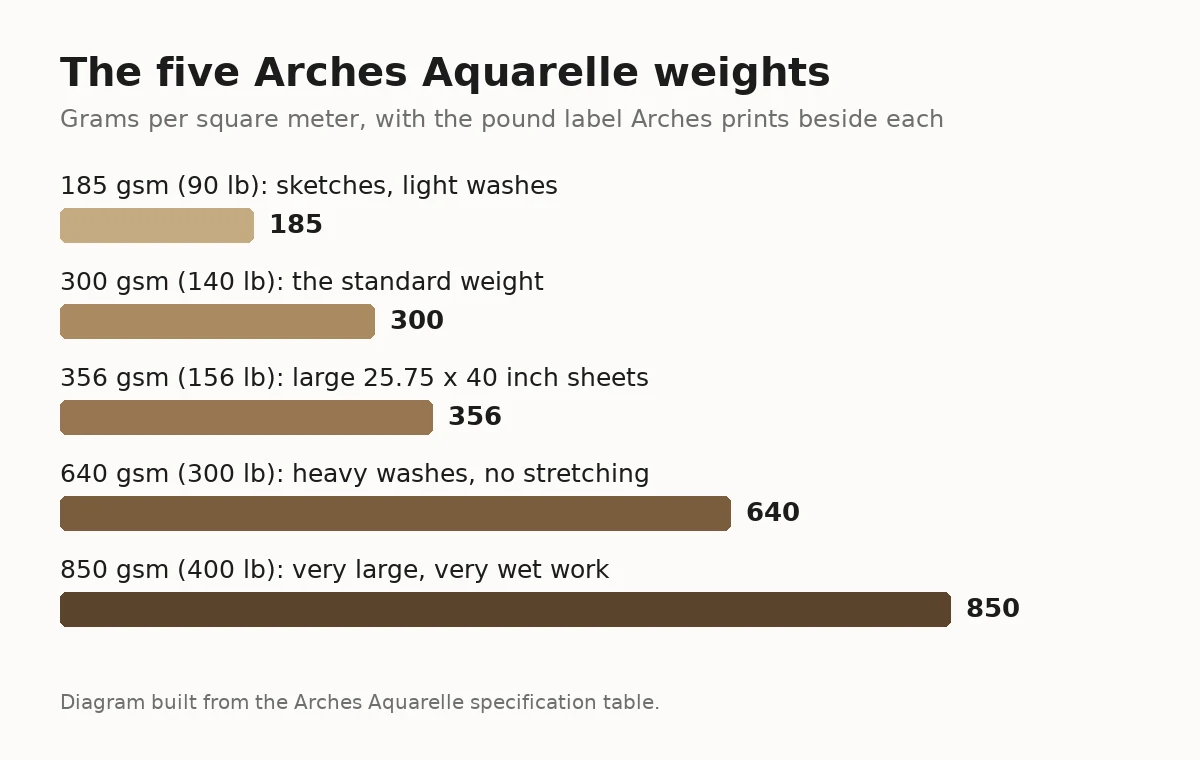 A diagram of the five weights in the mill's specification table. Most painters only ever need the second bar.
Price: The Cheapest Way to Buy Arches
Prices below are from Blick on 2026-11-14, all for 300 gsm cold pressed unless noted.
| Product | Price | Per sheet | Per square inch |
|---|---|---|---|
| Arches block, 9 x 12 in, 20 sheets | $48.93 | $2.45 | 2.27 cents |
| Arches full sheet, 22 x 30 in | $9.74 | $9.74 | 1.48 cents |
| Canson XL pad, 9 x 12 in, 30 sheets (wood pulp) | $11.11 | $0.37 | 0.34 cents |
Arches costs more than six times as much per square inch as a student pad. That gap is what cotton and gelatin cost.
The block is also the expensive way to buy it. Per square inch, the full sheet costs about a third less. Tear one full sheet into four quarter sheets of 11 x 15 inches. Each costs about $2.44. That is the same price as one 9 x 12 inch block sheet, for about half as much paper again.
The block does earn its extra cost in one way: it keeps the sheet flat with no tape or board. If you buy loose sheets, read our guide on how to stretch watercolor paper first.
Other weights at Blick on the same day, for a 22 x 30 inch cold pressed sheet: $6.60 at 90 lb and $20.44 at 300 lb.
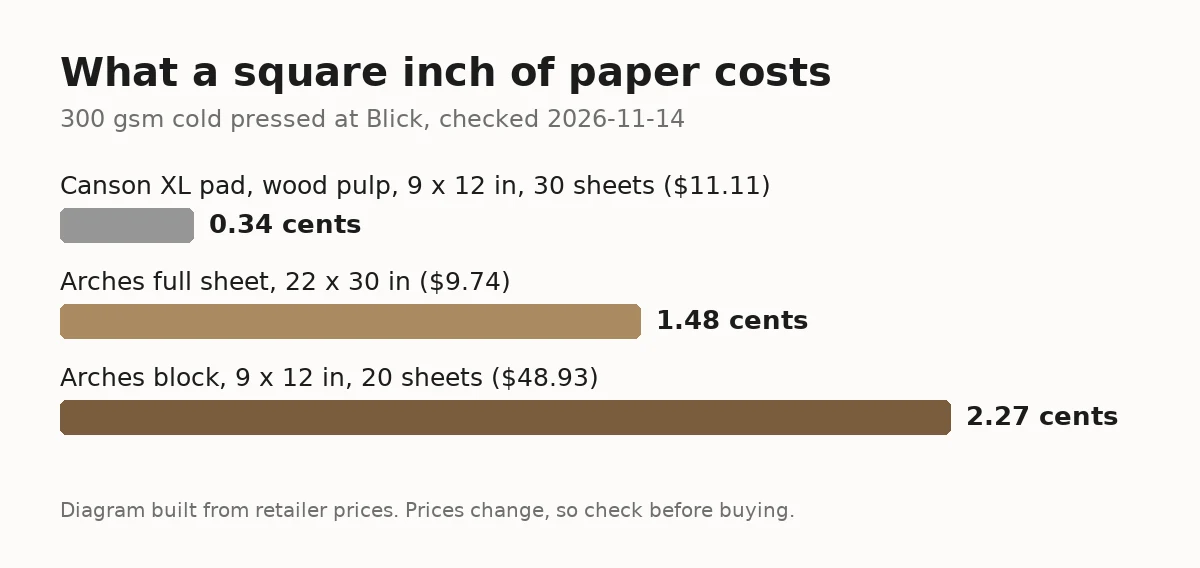 A diagram of the Blick prices above. Buying full sheets cuts about a third off the cost of painting on Arches.
Verdict: Arches Watercolor Paper Review Score
Score: 9.2/10. The reference cotton paper, with a specification few mills publish in this detail. The price is the only real mark against it.
The Good
- 100% long cotton fiber, made on a cylinder mould
- Natural gelatin sizing through the whole sheet
- Five weights, three surfaces and two whites
- Acid free, no optical brighteners, rated permanent to ISO 9706
- Full sheets bring the cost down to about $2.44 a quarter sheet
The Cons
- $48.93 for a 20-sheet 9 x 12 inch block at Blick
- Gelatin sizing rules it out for vegan painters
- Painters report a faint smell when the paper is wet
- Too costly for everyday drills and swatches
Arches suits anyone painting work they mean to keep. It also suits a learner who wants to find out whether their paper has been holding them back. One full sheet is a cheap way to test that. For drills, color charts and warm-ups, I'd use a cheaper sheet. Our best watercolor paper for beginners guide lists mid-priced cotton options.
Frequently Asked Questions
Is Arches the best watercolor paper? It is the paper most others are measured against. Arches Aquarelle is 100% cotton, made on a cylinder mould and sized with gelatin through the whole sheet. Other cotton papers share some of those features. Whether it is the best for you depends on surface taste and budget.
Is Arches watercolor paper worth the price? For finished paintings, yes. For daily practice, it is expensive. At Blick on 2026-11-14 a 22 x 30 inch sheet of 300 gsm cold pressed cost $9.74. Torn into four quarter sheets, that is about $2.44 each, which is the cheapest way to paint on Arches.
Is Arches watercolor paper 100% cotton? Yes. Arches states that Aquarelle is made from 100% long cotton fibers. Cotton fibers are longer and stronger than wood pulp fibers, so the sheet holds more water and stands up to scrubbing and lifting better than student paper.
Is Arches watercolor paper vegan? No. Arches sizes Aquarelle with natural gelatin, which is an animal product. Sizing is the treatment that controls how fast water soaks into the paper. Painters who avoid animal products should look for cotton papers with synthetic or plant-based sizing instead.
Which Arches paper should a beginner buy? Start with 300 gsm (140 lb) cold pressed in natural white. It is the standard weight and the middle surface. Buy one 22 x 30 inch sheet and tear it into quarters, or choose a small block if you want sheets that stay flat without taping.
What is the difference between an Arches block and a pad? A block is glued on all four sides, so each sheet stays flat while you paint and is cut free when dry. An Arches pad is glued on the short side only, so sheets come out easily but can buckle unless you tape them down.
References
- Arches: Aquarelle watercolour paper - Fiber, cylinder mould, gelatin sizing, weights, surfaces, formats and ISO 9706 permanence. Checked 2026-11-14.
- Arches: history of the mill - Founding, the 1826 decision to keep gelatin sizing, and the 2020 move to F.I.L.A.
- Blick: Arches Watercolor Blocks - Block sizes and prices on 2026-11-14.
- Blick: Arches Natural White Watercolor Paper sheets - Sheet prices by weight on 2026-11-14.
- Arches Papers on YouTube: Arches Aquarelle, an inimitable paper - The mill's own video on how the paper is made.

Written by
Elena VancePigments & Color Editor
Elena Vance writes Watercolor Daily's pigment and color coverage: Colour Index codes, lightfastness ratings, transparency, and palette building.
NextKeep reading
Reviews / 9 min
Baohong Watercolor Paper Review: 3 Ranges, Priced vs Arches
Guides / 9 min
Best Watercolor Paper for Beginners: Why 100% Cotton Matters
Reviews / 9 min
Canson XL Watercolor Paper Review: 6 Pads and Prices Checked
Features / 11 min
Watercolor Block vs Pad vs Sheets: Cost per Square Inch
Features / 14 min
Watercolor Paper Weight Comparison Chart: GSM vs lb Guide
Guides / 12 min
Rough Watercolor Paper: Granulation, Dry Brush and 6 Steps
Features / 12 min
Best Watercolor Sketchbooks: 4 With 100% Cotton Paper
Features / 11 min
Hot Press vs Cold Press Watercolor Paper: 3 Surface Types
Disclaimer
This article is published for informational purposes and is not professional advice. Product formulations, pigment sources, packaging and store listings change. Check the details that matter to you (price, pigment content, regional availability) with the manufacturer or retailer before you buy.
Brands in this article
Arches