Loading
Watercolor Daily · Features
11 Easy Watercolor Landscape Ideas With Museum Examples
Easy watercolor landscape ideas, 11 scenes from 4 tubes with no green paint. Each has a museum painting to study, pigment codes, paper, time and steps.
19 min readBy Marcus Reed
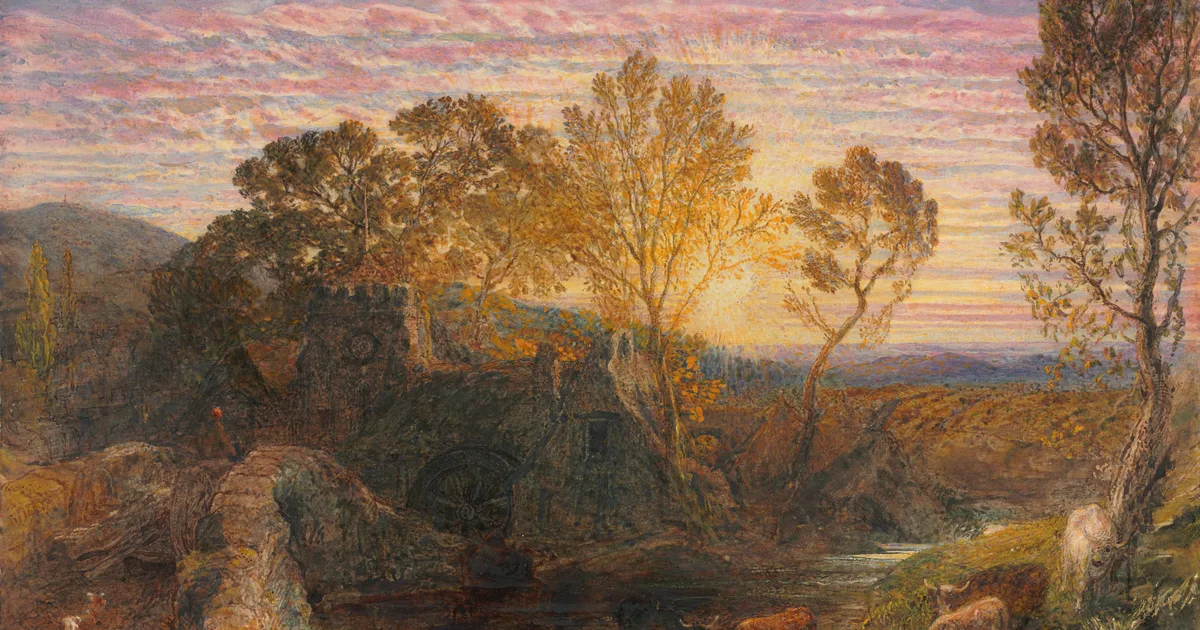
Painting: Samuel Palmer, The Golden Hour (1865), The Cleveland Museum of Art, CC0
Each of these 11 easy watercolor landscape ideas comes with a museum painting that solves the same scene in a handful of washes. You see how a working painter kept it simple, then you paint your own version from four tubes.
Most landscape idea lists show a picture and stop there. Every idea below also gives you the colors with their pigment codes, the paper, a rough time and the order to paint it in. None of them needs a pencil drawing or a green tube.
The painting at the top, Samuel Palmer's The Golden Hour, is not on the list. It shows where these simple washes can lead after some practice.
In short: Buy four tubes: Ultramarine (PB29), Burnt Sienna (PR101), Yellow Ochre (PY42) and Permanent Rose (PV19). Paint on 300 gsm (140 lb) cold-press paper. Start with the far shore across a still lake, which takes about 15 minutes and is mostly bare paper. These easy watercolor landscape ideas are grouped by what fills the sheet: sky, water or land.
Which easy watercolor landscape ideas should you paint first? (quick answer)
Start with the far shore across a still lake (idea 5), the sunrise sky (idea 1) and the storm clearing over far hills (idea 2). Each one is a few flat or soft washes with no detail, so there is little to mix and almost nothing to fix. Paint those three, then try the mountains.
If you would like to watch a landscape come together before you start, this 12-minute beginner lesson from the Lets Paint Watercolors channel uses wet washes and three colors.
Overview
Every idea on this list uses the same short supply list.
Paper. Cold-press watercolor paper at 300 gsm (140 lb). Cold press means the sheet has a light grain that holds paint well. Cotton paper stays wet longer, which gives you more time in a sky. Our guide to the best watercolor paper for beginners explains why. Tape the sheet down on all four sides, because big wet washes are what cause watercolor paper buckling.
Brushes. A large round (around a size 10 or 12) for skies and water, and a small round (around a size 4) for tree lines and sails. The guide to the best watercolor brushes for beginners covers both.
Paint. Four tubes from Winsor & Newton's Cotman range, the student line covered in our Cotman watercolor review. Each of the four is a single pigment on the maker's composition table. An 8 ml tube of Cotman Ultramarine was $4.25 at Blick on 14 November 2026.
- Blue, Ultramarine (PB29): a warm, transparent blue. The maker lists it as granulating, which means the pigment settles into the paper's grain and leaves a soft speckle. Our guide to granulating watercolors shows the effect. In a sky or a mountain, that speckle looks like haze.
- Red-brown, Burnt Sienna (PR101): a transparent earth color. Mixed with the blue, it makes every grey on this list.
- Earth yellow, Yellow Ochre (PY42): a soft, dull yellow that the maker lists as opaque. It's the color of sand, dry grass and low evening light.
- Rose, Permanent Rose (PV19): a cool pink for sunsets and violet shadows. The maker lists it as staining, so it is hard to wash out once dry. Put it down only where you want it.
The first three carry the highest lightfastness rating on the table (ASTM I), which means they resist fading in light. The rose is rated one step lower (ASTM II).
Four mixes do most of the work. Storm grey is blue with a little red-brown. Field green is blue with earth yellow, and it comes out as a quiet olive. Sunset peach is rose with earth yellow. Dusk violet is blue with rose.
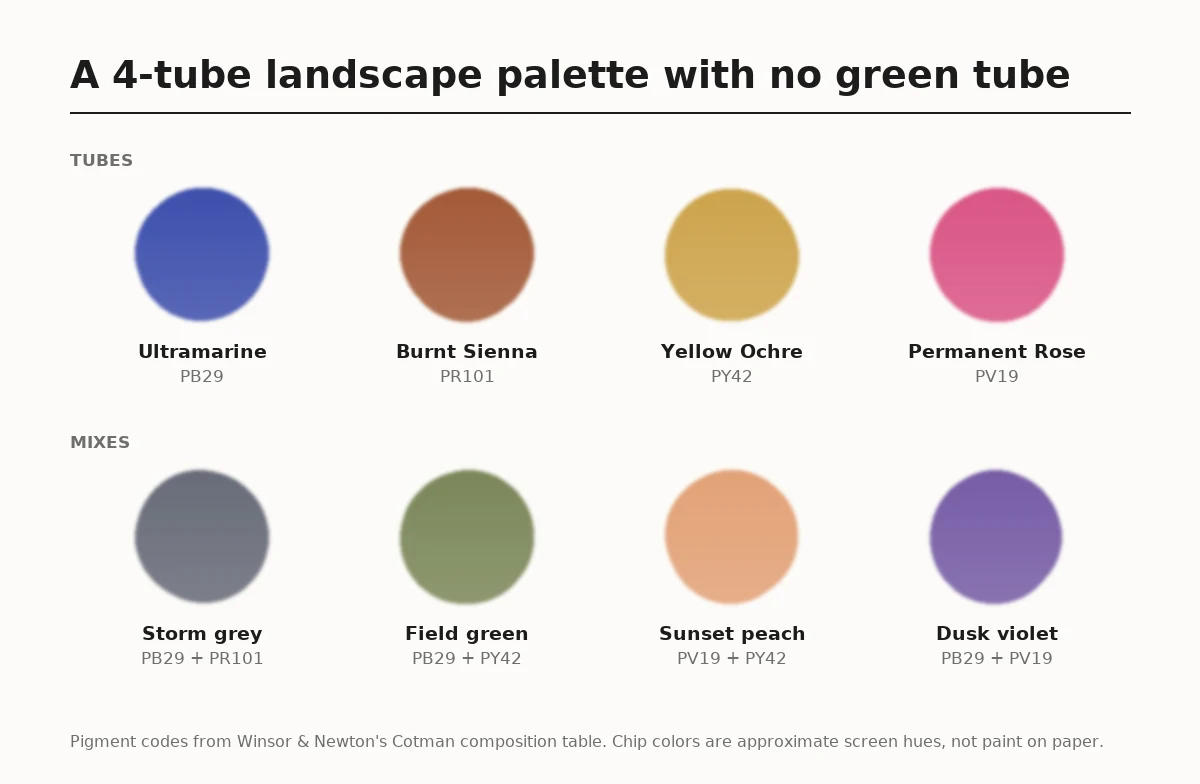 Chart of the four tubes and the four mixes used across the ideas. Chip colors are approximate screen hues, not paint on paper.
The museum paintings are examples to study. None of them was painted with these steps or these tubes, and several also use pencil or opaque white paint, called gouache. The steps below use transparent paint only, and bare paper for white.
Easy Watercolor Landscape Ideas That Are Mostly Sky
These four easy watercolor landscape ideas put the horizon low. The sky does the work, and the land is a strip at the bottom.
1. Sunrise Sky in Three Bands
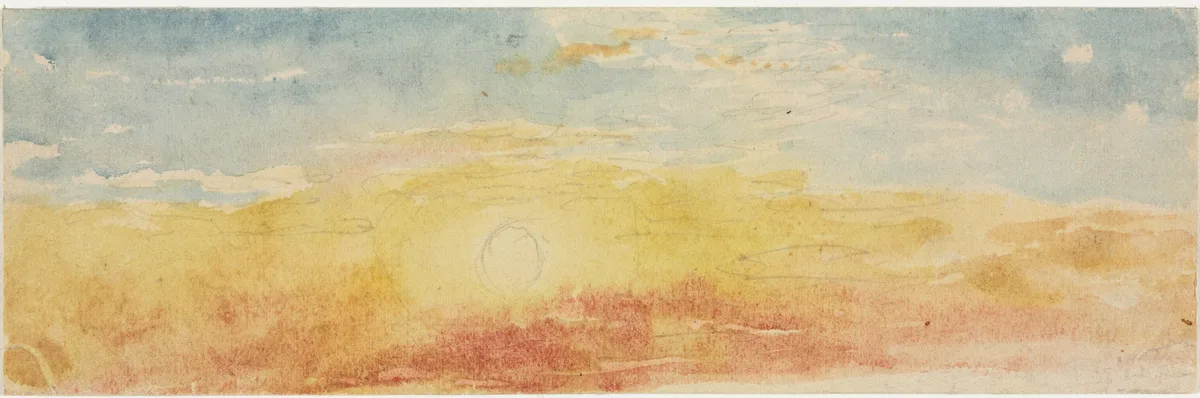 Cloud Study, anonymous, 1800s, watercolor. The Cleveland Museum of Art, CC0. Three bands only: blue-grey on top, yellow in the middle, red streaks at the bottom.
A sky with no land at all. The whole painting is three soft bands of color that melt into each other.
- Palette: earth yellow (PY42), rose (PV19), blue (PB29)
- Paper: 300 gsm cold press
- Time: about 15 to 20 minutes · Difficulty: easy
1. Wet the paper. Brush clean water over the whole sheet until it shines evenly. This is the start of every wet-on-wet wash.
2. Lay the yellow. Paint a wide band of watery earth yellow across the middle.
3. Add rose below and blue above. Streak sunset peach along the bottom third and pale blue across the top. Leave a thin gap of yellow between the blue and the peach so they don't mix into green-grey.
4. Lift the sun. While the yellow is still wet, press a twist of tissue into it once to leave a pale disc.
2. Storm Clearing Over Far Hills
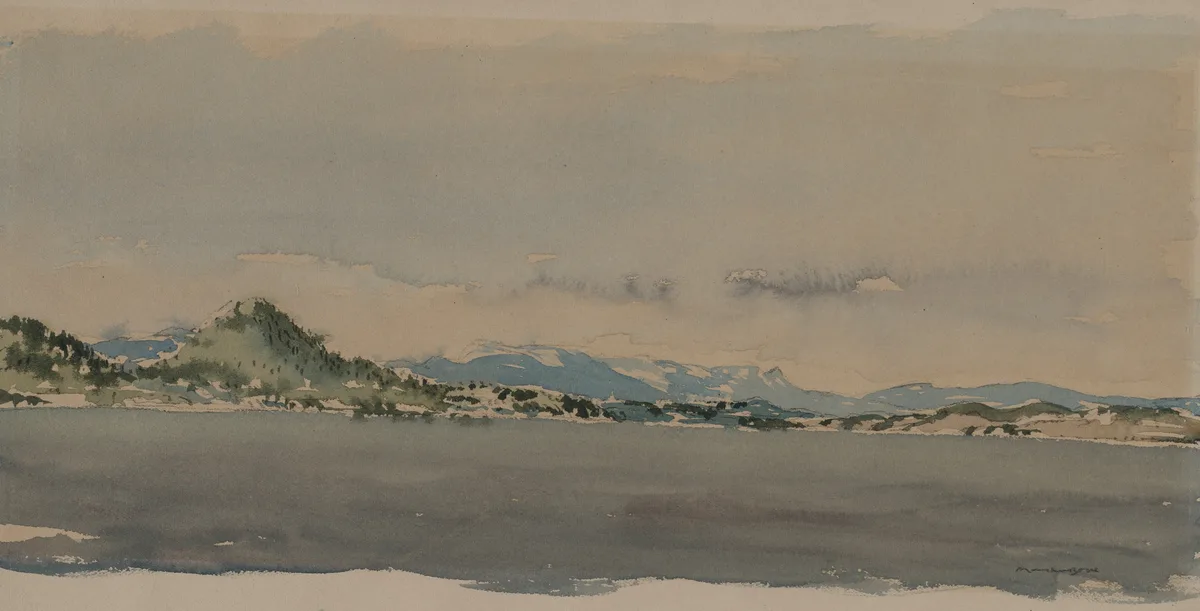 Muirhead Bone, Storm Ending, Norwegian Fijord, undated, watercolor and graphite. The Cleveland Museum of Art, CC0. One grey for the sky, a darker grey for the water, and a thin strip of hills between them.
A flat grey sky, a thin line of hills and a darker band of water. Three shapes make the whole picture.
- Palette: blue (PB29), red-brown (PR101), a little earth yellow (PY42)
- Paper: 300 gsm cold press
- Time: about 20 to 30 minutes · Difficulty: easy
1. Paint the sky. Lay watery storm grey across the top two-thirds as a flat wash, and stop at a level line.
2. Let it dry. Wait until the shine is gone and the paper no longer feels cool.
3. Add the hills. Paint the far mountains in pale blue. Paint one nearer hill in field green, a little stronger.
4. Paint the water. Fill the band below the hills with darker storm grey, using long sideways strokes.
3. Sunset Over Wet Sand
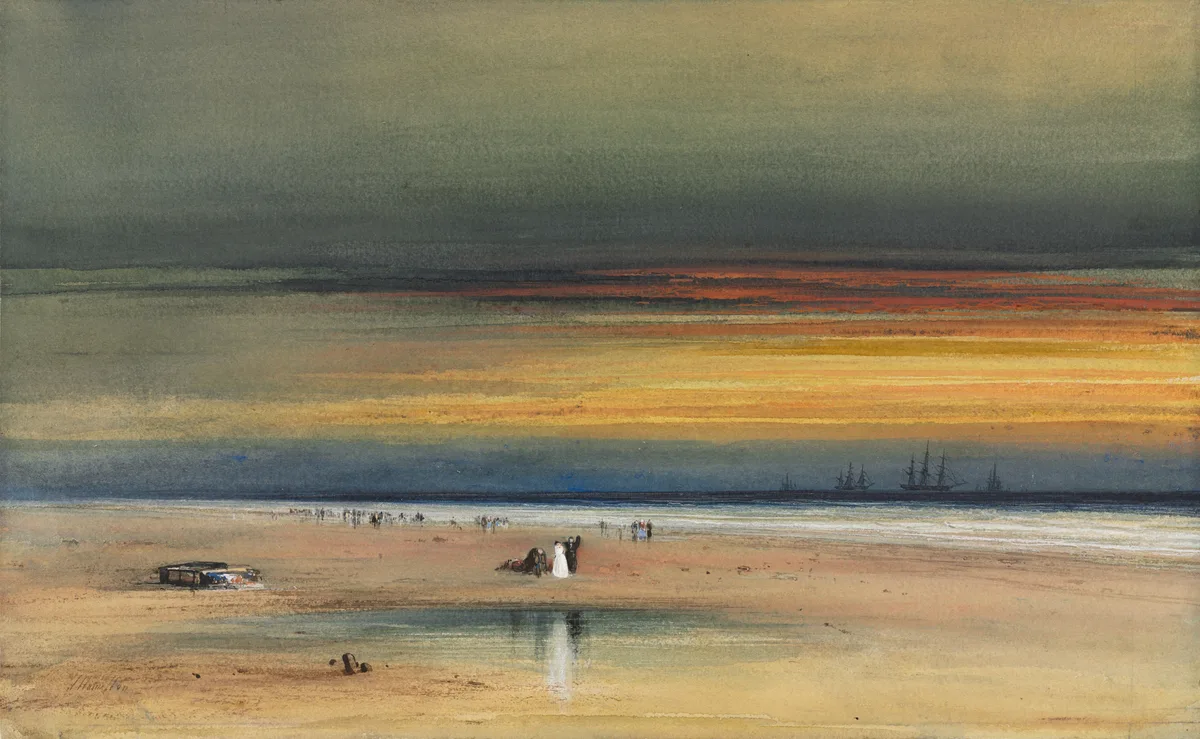 James Hamilton, Beach Scene at Sunset, about 1865 to 1870, watercolor and gouache. The Cleveland Museum of Art, CC0. The sky colors repeat in the wet sand below the blue strip of sea.
A glowing band of sky between a dark cloud and a dark sea. The sand below picks up the same colors. It's the most tempting idea to start with, but paint the sunrise first.
- Palette: rose (PV19), earth yellow (PY42), blue (PB29)
- Paper: 300 gsm cold press
- Time: about 30 to 40 minutes · Difficulty: easy+
1. Paint the glow. On wet paper, lay bands of earth yellow and sunset peach across the middle of the sheet.
2. Add the dark cloud. Brush dusk violet across the top while the paper is still damp, so its lower edge goes soft.
3. Paint the sea when dry. Pull one strip of strong blue below the glow, with a hard straight top edge.
4. Wash in the sand. Cover the bottom with watery earth yellow, then drag one streak of peach through it for the reflection.
4. Big Sky Over an Open Plain
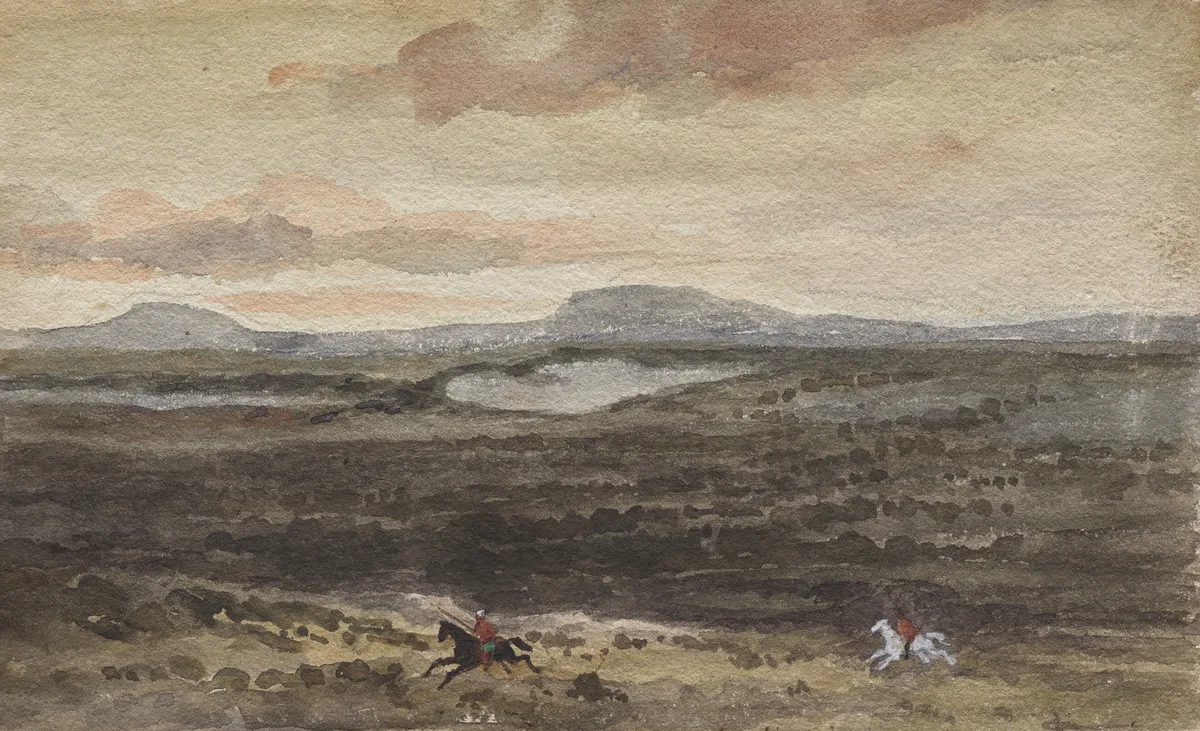 Frédéric Auguste Bartholdi, View of the Midwest Plains, about 1871, watercolor, graphite, ink wash and gouache. The Cleveland Museum of Art, CC0. The far hills are pale and flat. The plain gets darker and rougher as it comes toward you.
A wide dark plain under soft pink clouds, with pale hills on the horizon. Two specks of red give it scale.
- Palette: blue (PB29), red-brown (PR101), rose (PV19)
- Paper: 300 gsm cold press
- Time: about 30 to 40 minutes · Difficulty: easy+
1. Paint the clouds. Wet the top half and touch in watery rose mixed with a little red-brown. Let the shapes spread on their own.
2. Add the far hills. On dry paper, paint flat-topped shapes in pale dusk violet along the horizon.
3. Fill the plain. Use strong storm grey with extra red-brown. Make short sideways strokes that get bigger and darker toward the bottom.
4. Place two specks. Dot pure rose for two distant riders, each smaller than a grain of rice.
GODEEPER: Skies are half of every landscape, and soft clouds need their own timing. The cloud guide shows when to lift, when to leave an edge and which blues behave. How to Paint Clouds in Watercolor: 6 Steps for Soft Skies →
Easy Watercolor Landscape Ideas Built Around Water
Water is the easiest thing to paint badly by overworking it. In these four ideas the water is mostly bare paper or one flat wash.
5. Far Shore Across a Still Lake
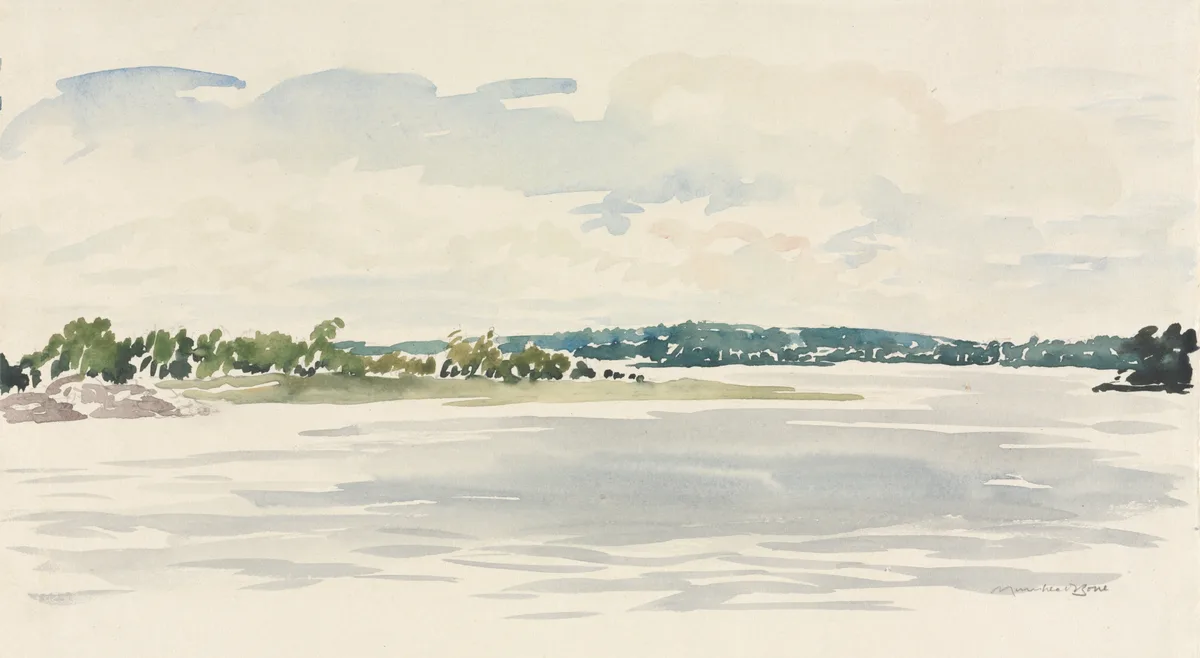 Muirhead Bone, Noonday, Lake Noxen, Sweden, undated, watercolor and graphite. The Cleveland Museum of Art, CC0. The lake is bare paper with a few grey strokes. The tree line is the only strong color.
A thin line of trees on the far side of a lake. It's the easiest idea on the list, because most of the sheet stays white.
- Palette: blue (PB29), earth yellow (PY42), a little red-brown (PR101)
- Paper: 300 gsm cold press
- Time: about 15 to 20 minutes · Difficulty: easy
1. Paint a few clouds. Make four or five pale blue strokes in the top third. Soften their lower edges with a damp brush.
2. Dab the tree line. Run a row of field green dabs along a level line, about a third of the way down. Vary their height, and add more blue at one end.
3. Stroke the water. Pull five or six sideways strokes of very pale storm grey below the trees. Leave the rest as paper.
6. Headland and Open Sea
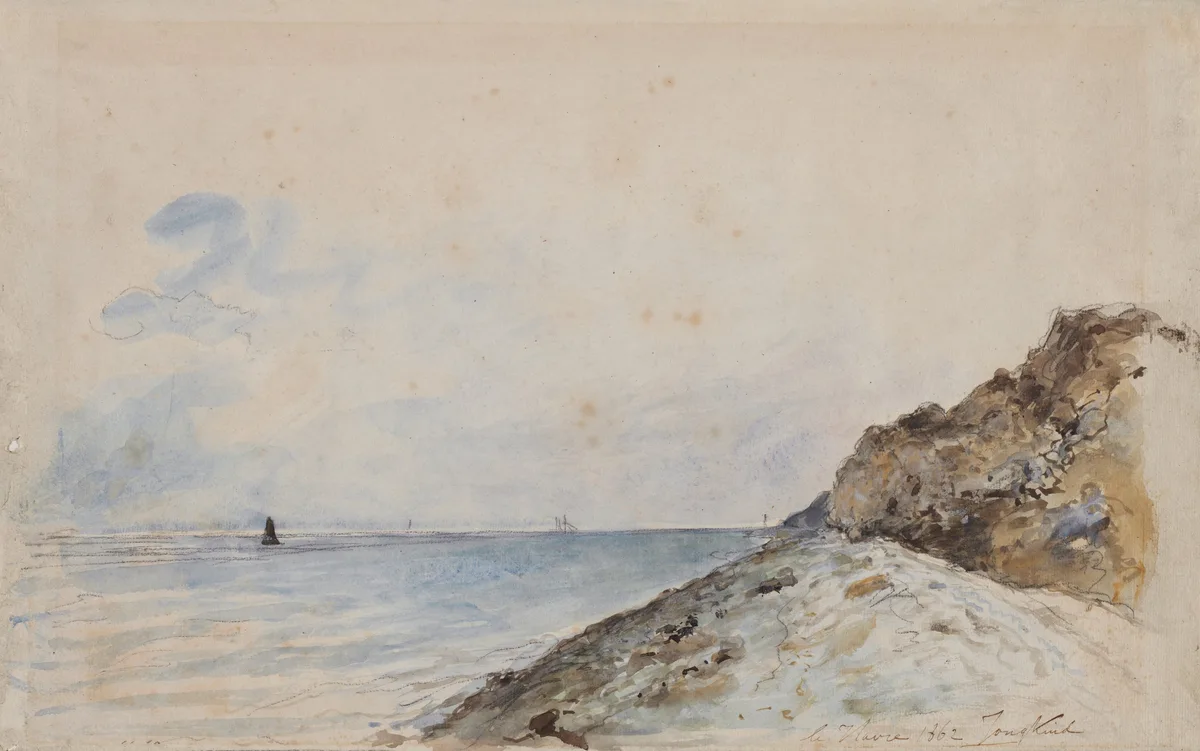 Johan Barthold Jongkind, Le Havre, 1862, watercolor, gouache and black chalk. The Cleveland Museum of Art, CC0. One slope, one flat sea and a nearly empty sky. The tiny sail tells you how big everything is.
A rocky slope running down into a calm sea. The whole scene is one diagonal against one level line.
- Palette: blue (PB29), red-brown (PR101), earth yellow (PY42)
- Paper: 300 gsm cold press
- Time: about 20 to 30 minutes · Difficulty: easy
1. Paint the sea. Wash pale blue across the lower third up to a level horizon. Leave a sloping wedge of bare paper on the right.
2. Fill the headland. Paint the wedge in earth yellow. While it is damp, drop red-brown into the top so it spreads downward.
3. Add rock texture. When dry, drag a nearly dry brush of dark brown across the slope. This is the dry brush technique, and it leaves broken marks like rough stone.
4. Place the sail. Paint one small dark triangle on the horizon.
7. One-Color Bay
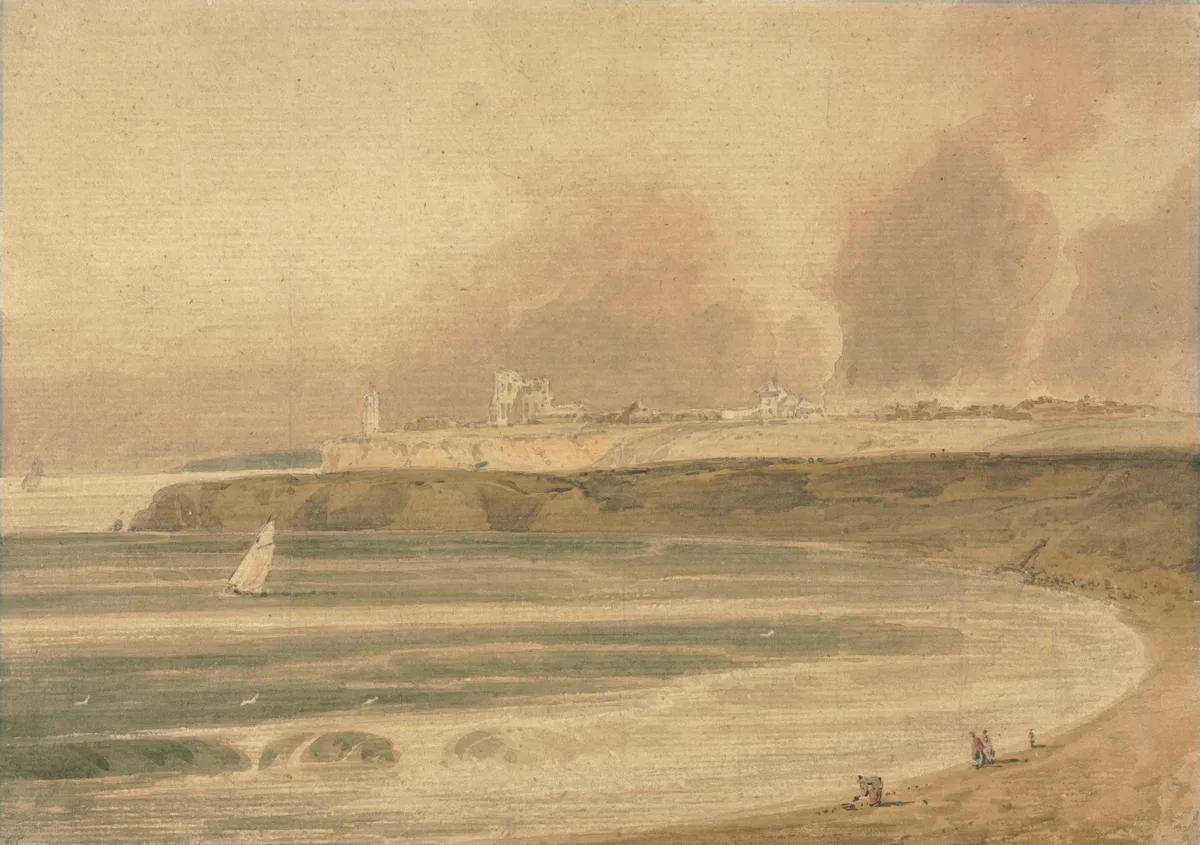 Thomas Girtin, Tynemouth, Northumberland, 1790 to 1802, watercolor. The Cleveland Museum of Art, CC0. Almost the whole picture is one warm brown, used pale, medium and dark.
A curved beach painted in a single brown. With color out of the way, you only have to judge light and dark.
- Palette: red-brown (PR101), blue (PB29)
- Paper: 300 gsm cold press
- Time: about 30 minutes · Difficulty: easy+
1. Mix one puddle. Make a warm brown from red-brown with a little blue. You will thin it with water for the lighter steps.
2. Wash the pale layer. Cover the sky and the beach with a very watery version. Leave a small sail shape as bare paper.
3. Paint the middle tone. When dry, add the cliff and three or four curved bands of surf that follow the bay.
4. Add the darks. Use the brown at full strength for the cliff's shadow side and two or three small figures on the sand.
8. Rocky Shore With a Choppy Sea
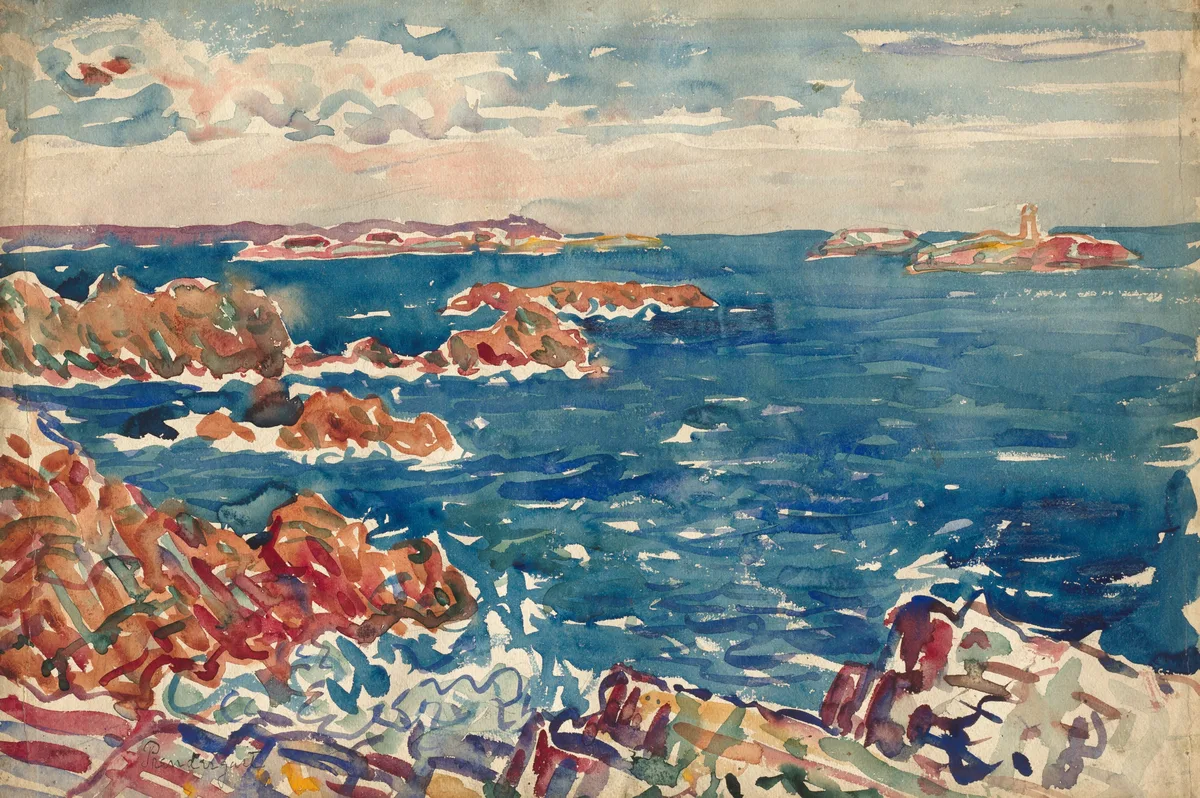 Maurice Prendergast, The Rocky Seashore, about 1907 to 1910, watercolor with traces of graphite. The Cleveland Museum of Art, CC0. Every white fleck in the sea is bare paper between separate strokes.
Bright rocks against a strong blue sea, built from short separate strokes. It has the most marks on the list, but each one is simple.
- Palette: blue (PB29), red-brown (PR101), rose (PV19)
- Paper: 300 gsm cold press
- Time: about 40 to 50 minutes · Difficulty: intermediate
1. Dab the rocks. In the lower left, place short dabs of red-brown, some mixed with rose. Leave white gaps between them.
2. Stroke the sea. On dry paper, lay short sideways strokes of strong blue. Don't join them up. The gaps are the foam.
3. Add the far islands. Paint two or three flat shapes of watery rose-brown on the horizon.
4. Finish the sky. Add a few pale blue and rose strokes at the top, and leave the rest white.
Watercolor Landscape Ideas With Hills and Mountains
Land shapes look hard, but each of these three is a stack of flat layers. Far layers are pale and blue. Near layers are darker and warmer.
9. Misty Mountain Layers
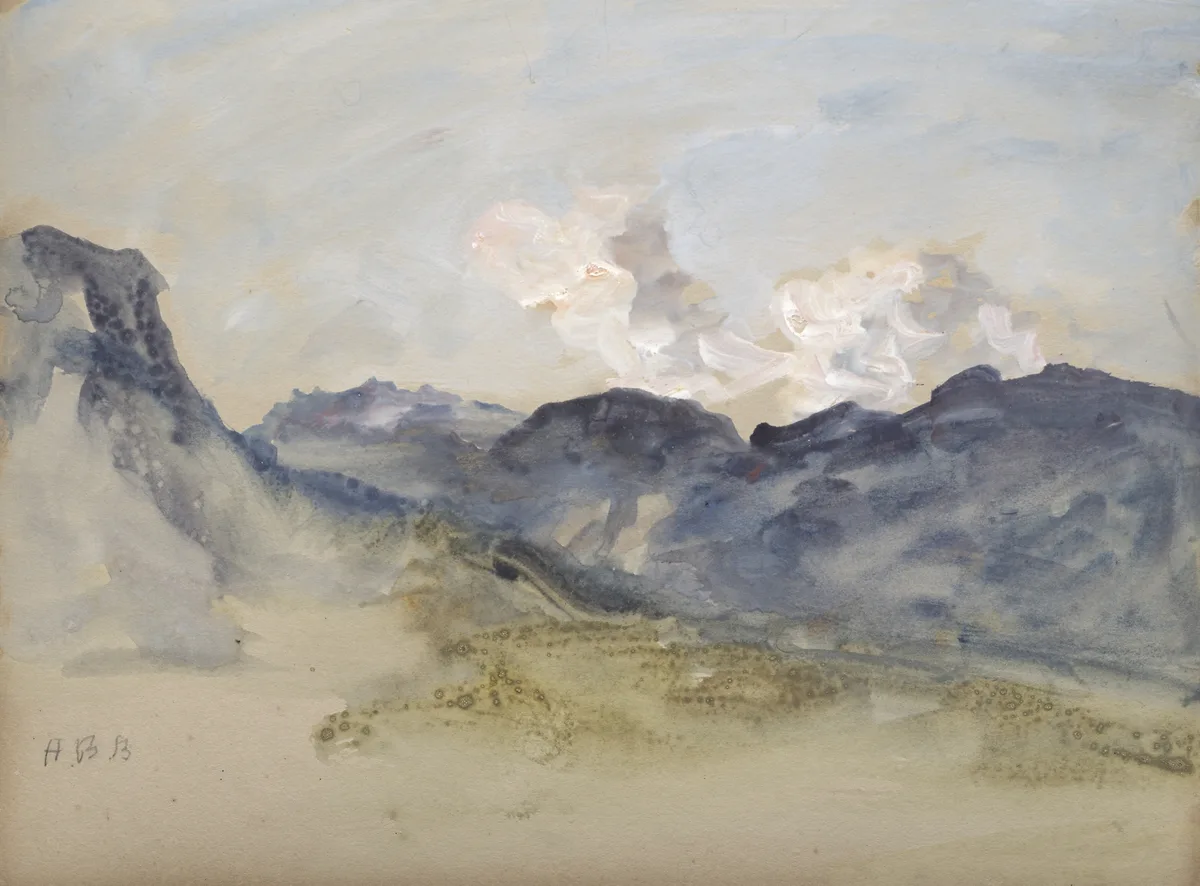 Hercules Brabazon Brabazon, In the Alps, undated, watercolor. The Cleveland Museum of Art, CC0. The near ridge is the darkest blue. The peak behind it is paler, and the cloud is the lightest shape in the picture.
Two or three mountain shapes, each one darker than the one behind it. The white cloud is paper you left alone.
- Palette: blue (PB29), red-brown (PR101), earth yellow (PY42)
- Paper: 300 gsm cold press
- Time: about 30 to 40 minutes · Difficulty: easy+
1. Paint around a cloud. Wash pale blue over the sky, leaving one loose cloud shape as bare paper.
2. Add the far peak. Paint it in watery storm grey with extra blue. Let it dry.
3. Add the near ridge. Paint a darker, stronger blue-grey shape that overlaps the peak. Soften its lower edge with clean water so it fades into mist.
4. Wash the foreground. Finish with watery field green across the bottom.
10. Desert Range in Pale Washes
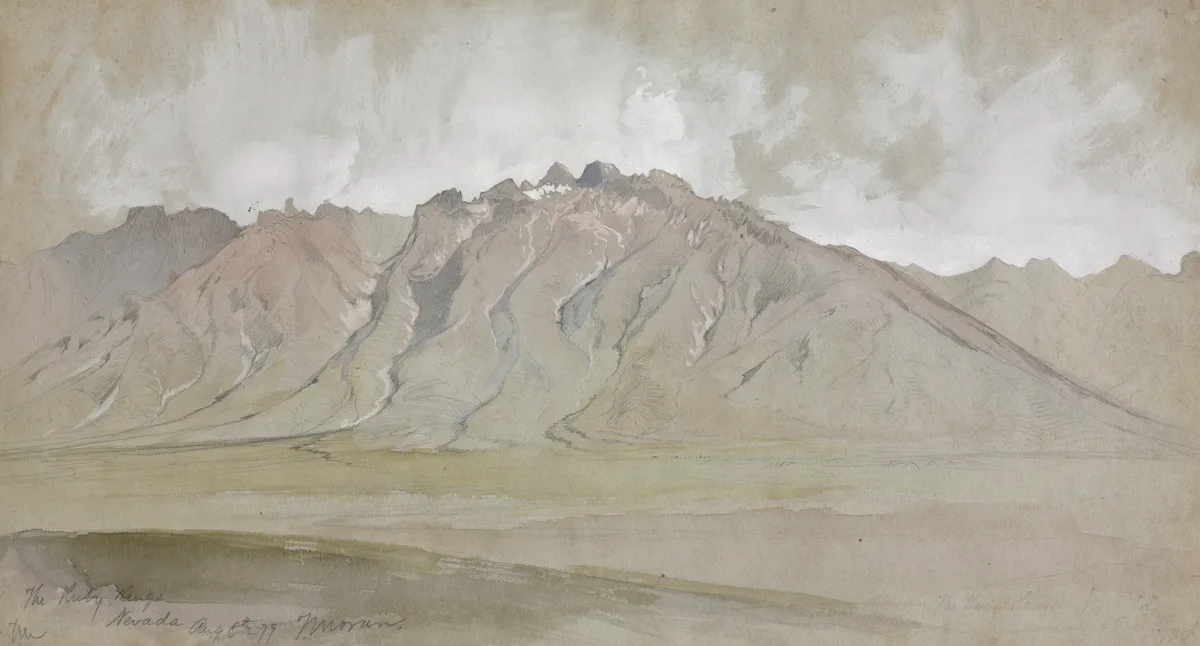 Thomas Moran, The Ruby Range, Nevada, 1879, watercolor, gouache and graphite. The Cleveland Museum of Art, CC0. The range is one pale shape. The slanting ridges are a second layer of the same color on top.
A long mountain range in two layers of the same pale color. The second layer makes the ridges.
- Palette: blue (PB29), rose (PV19), a little red-brown (PR101)
- Paper: 300 gsm cold press
- Time: about 30 to 40 minutes · Difficulty: easy+
1. Paint the whole range. Mix a pale mauve-grey from blue, rose and a touch of red-brown. Paint the range as one flat shape with a jagged top.
2. Let it dry fully. The next layer needs a dry surface to keep its edges.
3. Add the ridges. With the same mix, paint slanting strokes down from the crest. Laying a thin layer over a dry one is called glazing.
4. Wash the plain. Paint one very watery band below the range, with a darker stripe along the bottom edge.
11. Soft Dunes in Earth Colors
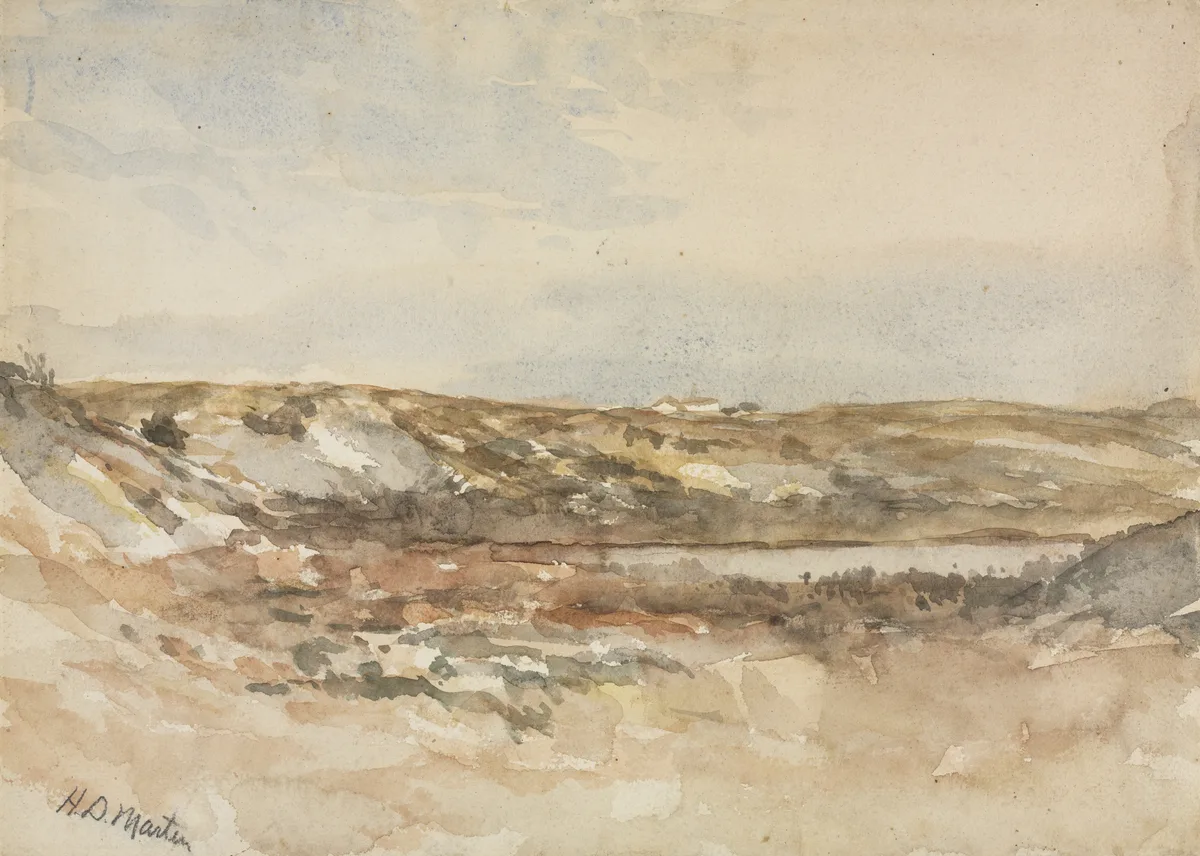 Homer Dodge Martin, Near Newport, mid-1800s, watercolor. The Cleveland Museum of Art, CC0. Loose sideways strokes with paper showing between them. The strip of water is bare paper.
Low dunes in sandy yellows and browns under a pale sky. Loose strokes suit it, so wobbly brushwork helps.
- Palette: earth yellow (PY42), red-brown (PR101), blue (PB29)
- Paper: 300 gsm cold press
- Time: about 30 to 40 minutes · Difficulty: easy+
1. Paint the sky. On wet paper, brush pale storm grey across the top and let it fade to nothing near the horizon.
2. Sweep in the dunes. Use long sideways strokes of earth yellow. Leave gaps, including one thin level strip for the water.
3. Drop in the brown. While the yellow is damp, touch red-brown into the hollows between the dunes.
4. Add a few dark strokes. When dry, drag a little storm grey across the nearest dune.
GODEEPER: This palette has no green tube, so every green here is mixed. The green guide gives six recipes with pigment codes, from olive to spring green. How to Mix Green Watercolor: 6 Recipes With Pigment Codes →
Analysis: Which Landscape to Paint First
The numbers group the ideas by subject. For learning, a different order works better.
Start with the far shore (idea 5). It teaches you to leave paper alone, and every other idea here depends on that. Then paint the sunrise sky (idea 1) to learn how colors spread on a wet sheet.
Next comes the storm clearing (idea 2). It adds a flat wash and the rule of waiting for a layer to dry. The misty mountains (idea 9) use that same rule to build distance, with pale shapes behind dark ones.
After those four, the one-color bay (idea 7) is worth a session. It strips out color so you can practice light, medium and dark. Every other idea gets easier once you can see those three steps.
Save the sunset (idea 3) and the rocky shore (idea 8) for last. The sunset needs fast work on damp paper, and the rocky shore takes patience with many small strokes.
You can also start with three tubes. Six of the 11 ideas use only the blue, the red-brown and the earth yellow: ideas 2, 5, 6, 7, 9 and 11. Add the rose later for the sunrise, the sunset, the plain, the rocky shore and the desert range.
Frequently Asked Questions
What is the easiest landscape to paint in watercolor? A far shore across still water. You paint a few pale cloud strokes, one thin line of trees and five or six grey strokes for the water. Most of the sheet stays bare paper, so there is very little to mix and almost nothing that can go wrong.
What colors do I need for watercolor landscapes? Four tubes cover every idea here: a blue (Ultramarine, PB29), a red-brown (Burnt Sienna, PR101), an earth yellow (Yellow Ochre, PY42) and a rose (Permanent Rose, PV19). The blue and yellow mix a muted green, and the blue and brown mix every grey, so you need no green or black tube.
What paper should I use for watercolor landscapes? Cold-press watercolor paper at 300 gsm (140 lb), ideally 100% cotton. Skies are large wet washes, and thinner paper buckles under them. Tape the sheet to a board on all four sides, or use a block, so it dries flat. A quarter sheet or a 9 x 12 inch pad is big enough.
How do you make a watercolor landscape look far away? Paint distant things paler, bluer and with softer edges than near things. A far mountain is one watery blue-grey shape. A near hill is darker, warmer and has harder edges. Painters call this aerial perspective, and three steps of strength from back to front are enough to show depth.
Can I paint a watercolor landscape without drawing first? Yes. Every idea on this list starts with a brush, not a pencil. The only line worth marking is the horizon, and a strip of masking tape or one light ruled pencil line does that. Shapes such as hills and headlands are painted directly with the side of a round brush.
How long does a simple watercolor landscape take? Most ideas here take 15 to 40 minutes for a first try, and much of that is drying time between layers. The far shore and the sunrise sky are the quickest at about 15 to 20 minutes. The rocky shore takes longest, around 45 minutes, because it has the most brush strokes.
Related Reading
- 10 Easy Winter Watercolor Ideas From a 4-Tube Palette: snow scenes, birches and frozen ponds in the same idea format.
- 12 Easy Watercolor Ideas for Beginners From 3 Tubes: small subjects to paint between landscapes, from three tubes.
- Wet-on-Dry Watercolor Technique: Crisp Edges in 6 Steps: how to get the hard edges that hills and horizons need.
- How to Paint Snow in Watercolor: 9 Tips for Clean Whites: more practice at leaving paper white.
References
- Winsor & Newton: Cotman Watercolour composition and permanence table - Pigment codes, opacity, ASTM lightfastness, staining and granulation for the four tubes. Checked 2026-11-14.
- Blick: Winsor & Newton Cotman Watercolor Tubes - Tube price on 2026-11-14.
- Handprint: watercolor pigment reference - Background on the pigments behind each Colour Index code.
- Lets Paint Watercolors on YouTube: How to Paint a Watercolor Landscape and Sky for Absolute Beginners - The beginner lesson embedded above.
- The Cleveland Museum of Art: Samuel Palmer, The Golden Hour, 2009.3 (CC0)
- The Cleveland Museum of Art: Cloud Study, 1980.110 (CC0)
- The Cleveland Museum of Art: Muirhead Bone, Storm Ending, Norwegian Fijord, 2005.150 (CC0)
- The Cleveland Museum of Art: James Hamilton, Beach Scene at Sunset, 2011.134 (CC0)
- The Cleveland Museum of Art: Frédéric Auguste Bartholdi, View of the Midwest Plains, 2025.146 (CC0)
- The Cleveland Museum of Art: Muirhead Bone, Noonday, Lake Noxen, Sweden, 2005.149 (CC0)
- The Cleveland Museum of Art: Johan Barthold Jongkind, Le Havre, 1955.656 (CC0)
- The Cleveland Museum of Art: Thomas Girtin, Tynemouth, Northumberland, 1940.557 (CC0)
- The Cleveland Museum of Art: Maurice Prendergast, The Rocky Seashore, 1953.655 (CC0)
- The Cleveland Museum of Art: Hercules Brabazon Brabazon, In the Alps, 1940.549 (CC0)
- The Cleveland Museum of Art: Thomas Moran, The Ruby Range, Nevada, 1879, 1938.67 (CC0)
- The Cleveland Museum of Art: Homer Dodge Martin, Near Newport, 1953.652 (CC0)

Written by
Marcus ReedTechnique Editor
Marcus Reed writes Watercolor Daily's step-by-step technique guides: wet-on-wet washes, glazing, dry brush, and the water control underneath them.
NextKeep reading

Features / 10 min
10 Easy Watercolor Christmas Ornaments From Only 4 Tubes
Features / 17 min
11 Easy Watercolor Animals for Beginners, Step by Step
Features / 13 min
10 Easy Watercolor Thank You Card Ideas From Only 3 Tubes
Features / 14 min
12 Easy Watercolor Flower Ideas Sorted by Brush Stroke
Features / 14 min
10 Easy Watercolor Birthday Card Ideas, Step by Step

Features / 14 min
11 Christmas Watercolor Ideas to Paint With 5 Tubes
Features / 14 min
12 Easy Watercolor Ideas for Beginners From 3 Tubes
Features / 13 min
10 Easy Winter Watercolor Ideas From a 4-Tube Palette
Disclaimer
This article is published for informational purposes and is not professional advice. Product formulations, pigment sources, packaging and store listings change. Check the details that matter to you (price, pigment content, regional availability) with the manufacturer or retailer before you buy.