Loading
Watercolor Daily · Guides
How to Mix Brown Watercolor: 6 Named Browns From 5 Tubes
10 min readBy Elena Vance
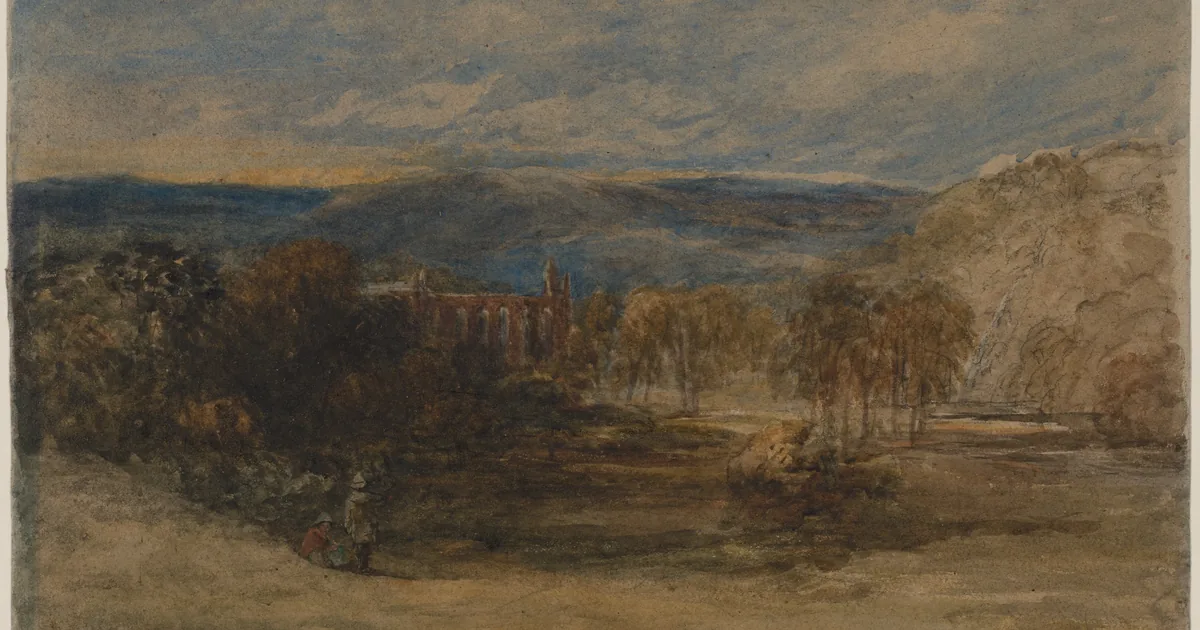
Painting: David Cox, Bolton Abbey (1940.552), c. late 1840s to 1857, The Cleveland Museum of Art, CC0
Review
Watercolor Color Mixing
How to mix brown watercolor has a short answer: make an orange, then add a little blue. Brown is what you get when all three primary colors (red, yellow and blue) meet in one puddle. That's the same recipe as mud, except that here you control the amounts.
The usual advice is to mix opposite colors. That's true, and not much help when you need a chestnut and keep getting gray. This guide names six browns you'll use often (sienna, dark umber, chestnut, chocolate, golden tan and taupe) and builds each from the same five tubes. Every paint has its pigment code so you can buy the right tube. It also explains why a tube of Burnt Sienna from one brand can differ from another.
In short: Mix a warm red and a yellow into an orange, then add blue in specks until it turns brown. More blue makes it darker and cooler, more red makes it warmer, more yellow makes it golden. Lighten a brown with water, not white, and darken it with blue, not black. Keep each mix to three paints and test it dry on scrap paper.
How to mix brown watercolor? (quick answer)
Mix red and yellow into an orange, then stir in a small amount of blue. The blue dulls the orange into brown. Add more blue for a dark, cool brown, more red for a warm one and more water for a light one.
Overview
Brown is a dull orange. Blue sits opposite orange on the color wheel. Opposites are called complementary colors, and they cancel each other when mixed. A little blue takes the brightness out of orange and leaves brown. A lot of blue takes it all the way to gray or near black.
The other pairs of opposites work too. Red with green makes brown. So does yellow with violet. Whichever pair you start from, the puddle ends up holding red, yellow and blue.
The five tubes in this guide come from the split-primary palette, so you may already own them:
| Role | Paint | Code |
|---|---|---|
| Warm red, leans orange | Pyrrol Scarlet | PR255 |
| Middle yellow | Hansa Yellow Medium | PY97 |
| Warm blue, leans purple | French Ultramarine | PB29 |
| Cool blue, leans green | Phthalo Blue (Green Shade) | PB15:3 |
| Cool red, leans purple | Quinacridone Rose | PV19 |
One extra tube is optional: Burnt Sienna, a ready-made red-brown. The names and codes above follow Daniel Smith's range. Other brands sell the same pigments under similar names.
Two properties matter here. Daniel Smith rates Phthalo Blue (Green Shade) as high staining, meaning it soaks into the paper and is hard to lift off. It is also very strong, so a speck goes a long way. French Ultramarine is granulating, meaning the pigment settles into the paper's grain and dries with a faint speckle. A brown made with ultramarine looks slightly textured. A brown made with phthalo looks smooth. The granulating guide covers that effect in full.
You need 300 gsm (140 lb) cold press paper, a palette with a few deep wells, two water jars and a scrap sheet of the same paper. This guide assumes you can paint a simple wash. Allow about 25 minutes to mix all six browns and paint a test card.
Step-by-Step: How to Mix Brown Watercolor in 6 Steps
1. Mix an orange first. Put a puddle of Hansa Yellow Medium (PY97) in a clean well. Add Pyrrol Scarlet (PR255) a little at a time until you have a strong orange. Once the orange is mixed, you only have one more color to control.
2. Add blue in specks. Pick up a tiny amount of French Ultramarine (PB29) on the brush tip and stir it in. The orange will dull to a warm red-brown. Stop as soon as it looks like brown. This is the point of no return: too much blue and the mix turns gray.
3. Steer the brown with the three colors. More red makes it warmer, like brick. More yellow makes it golden, like straw. More blue makes it darker and cooler, like wet bark. Change one color at a time, so you can tell what caused the shift.
4. Set how light or dark it is with water. Add water for a pale brown. Watercolor painters rarely use white paint, so the white of the paper does that job. For a dark brown, use more paint and less water, until the mix is as thick as cream.
5. Test it on scrap and let it dry. Paint a small patch on the same paper as your painting. Watercolor dries lighter than it looks wet. Wait, then judge the dry patch.
6. Write down the recipe. Note the three paints and which one you used most. Browns are hard to match a second time. A labeled test card saves you from guessing next week.
In the ten-minute video above, Liron Yanconsky mixes a basic brown from primary colors. He then pushes it toward blue, red and yellow in turn, which is step 3 in motion.
GODEEPER: You can also build a brown in layers, with a blue glaze over a dry orange wash. The glazing guide shows how to add a layer without lifting the one beneath. Glazing Watercolor Technique: 6 Steps to Layer Clean Color →
6 Browns by Name, With Recipes
Which brown do you need? Knowing how to mix brown watercolor by name saves guessing. These six cover most subjects, from brick walls to tree bark. The recipes follow the mixes a Craftsy watercolor instructor published in 2016, moved onto this guide's five tubes. Treat them as starting points and test each one on scrap. "A speck" and "a touch" are deliberate, because tubes differ between brands.
| Brown | Mix | Where it works |
|---|---|---|
| Sienna (warm red-brown) | Pyrrol Scarlet (PR255) plus Hansa Yellow Medium (PY97), then a speck of French Ultramarine (PB29) | Brick, terracotta pots, autumn leaves |
| Dark umber | The sienna mix plus more French Ultramarine (PB29) | Tree trunks, shadows on wood, dark hair |
| Chestnut | Pyrrol Scarlet (PR255) plus a little Phthalo Blue (PB15:3), then a touch of Hansa Yellow Medium (PY97) | Horses, polished wood, acorns |
| Chocolate | The chestnut mix plus a little more Phthalo Blue (PB15:3) | Rich earth, coffee, deep fur |
| Golden tan | Quinacridone Rose (PV19) plus French Ultramarine (PB29) to make violet, then Hansa Yellow Medium (PY97), thinned with water | Sand, dry grass, baskets, light wood |
| Taupe | The golden tan mix plus a little more French Ultramarine (PB29) | Stone, driftwood, winter fields |
The chestnut mix is the fastest brown here. A warm red already leans toward orange, and a cool blue leans toward green. Together they hold all three primaries, so two tubes give what the instructor calls an instant brown.
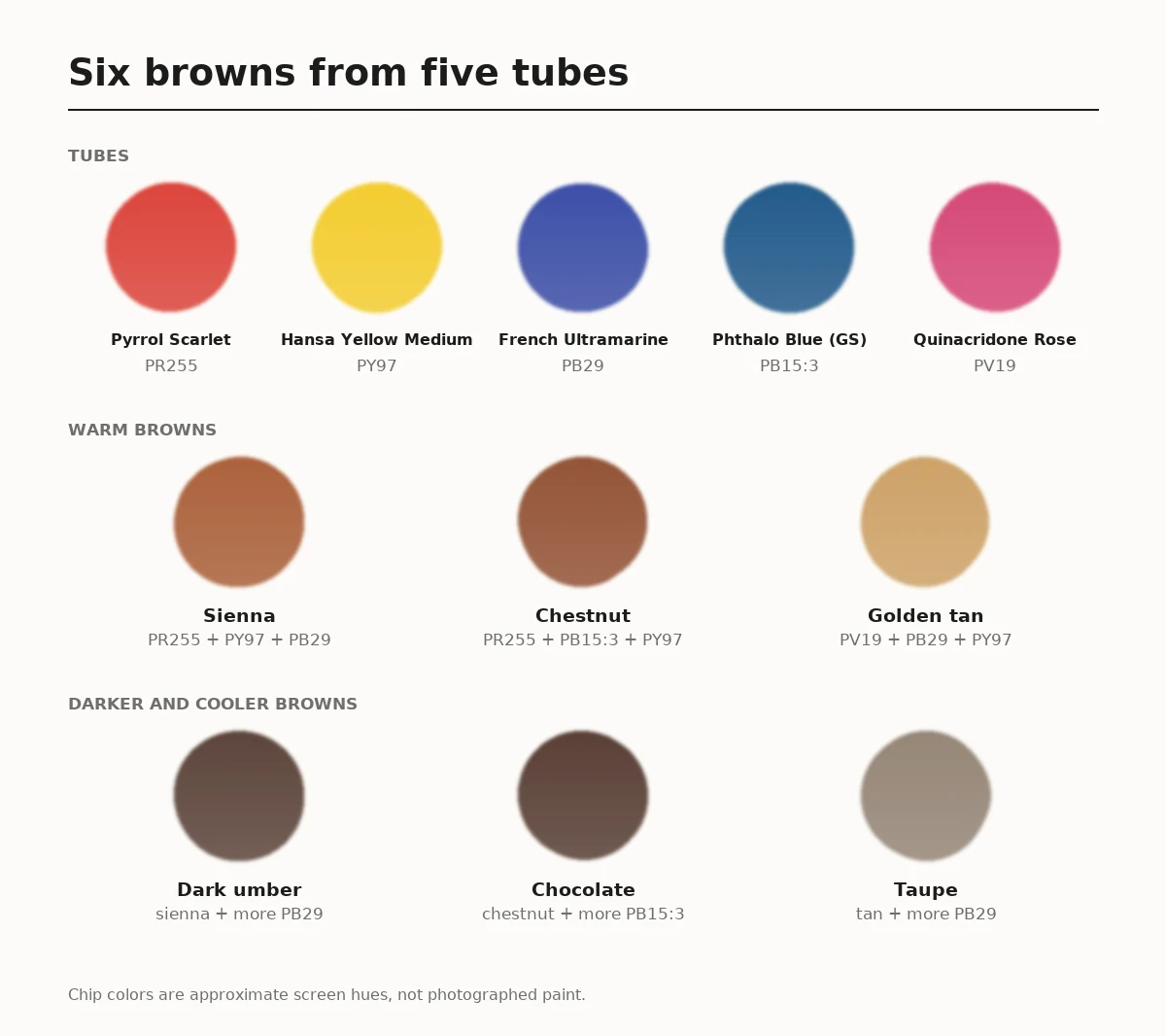 A chart of the five tubes and the six browns they make. The chips are approximate screen colors, not photographed paint, so mix your own tubes to see the real result.
Is It Better to Mix Brown or Buy a Tube?
Do both. A mixed brown is made from the colors already in your painting, so it always fits. A tube brown is faster and gives the same color every time. Most painters keep one tube, usually Burnt Sienna, and mix the rest.
Burnt Sienna works as a dull orange, so it follows the same rule as step 2. Add French Ultramarine and it turns into a dark umber. Painter Jane Blundell, who has tested and swatched many earth paints, makes the same point: burnt umber is easy to mix if you have Burnt Sienna and Ultramarine. She adds that a deep, cool brown such as raw umber is hard to mix. If you paint a lot of bark or rock, it's worth buying that tube.
Check the code before you buy. Daniel Smith lists its Burnt Sienna as PBr7, a natural earth pigment. It rates the paint as granulating and non-staining. Winsor & Newton lists its Professional Burnt Sienna as PR101, a synthetic iron oxide, and describes it as transparent with red-brown tones. So two tubes with the same name hold different pigments. The Daniel Smith and Winsor & Newton comparison has more on how the two ranges differ.
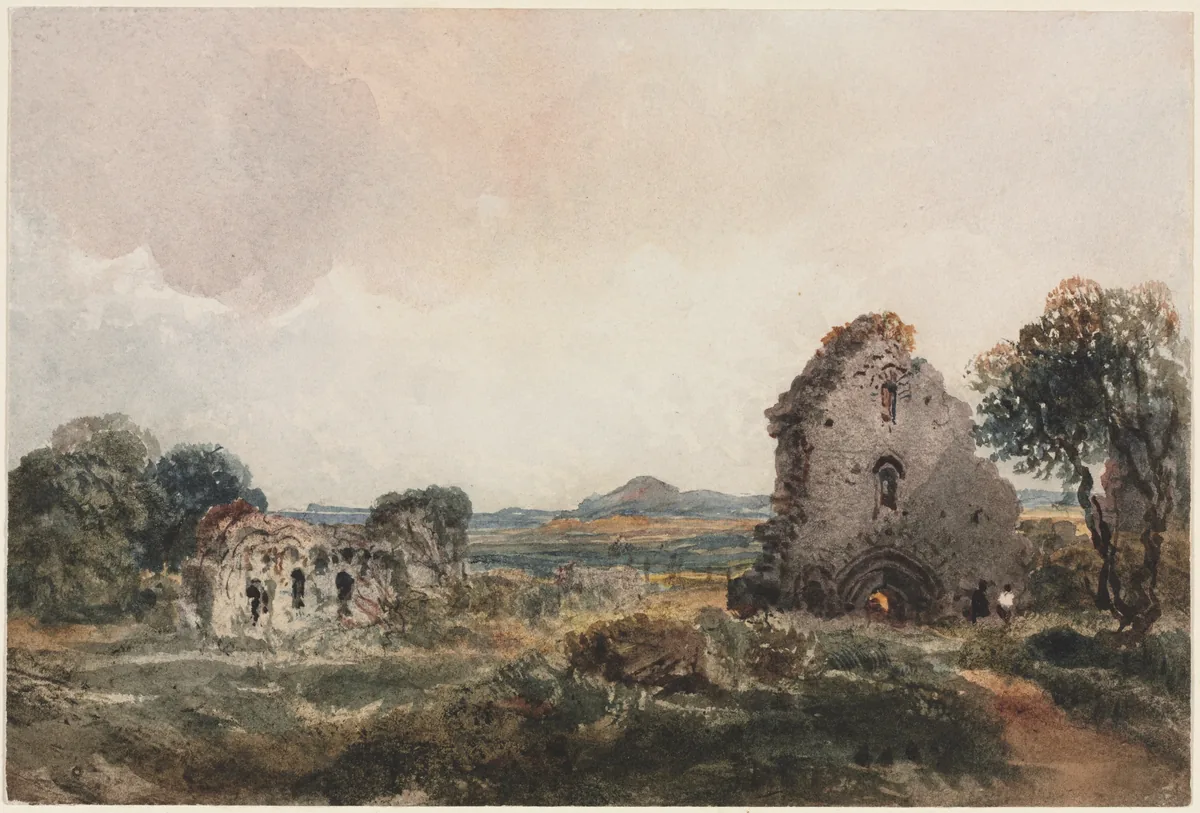 Peter De Wint, Neath Abbey, c. 1840s, watercolor with traces of graphite. The Cleveland Museum of Art, CC0. Warm rust, gray-brown stone and olive ground sit in one painting.
GODEEPER: Brown is the color of bark, rope and weathered wood, and those surfaces need broken marks. The dry brush guide shows how to drag a nearly dry brush for that texture. Dry Brush Watercolor Technique: 8 Tips for Broken Texture →
Tips for Mixing Better Browns
Mix a bigger puddle than you need
A second batch rarely matches the first. Mix enough for the whole tree or wall before you start. Deep wells help, and the ceramic and plastic palette comparison explains which surfaces keep a puddle together.
Lighten with water, darken with blue
White paint makes watercolor chalky. Black paint makes it flat. Water and blue do the same jobs and keep the brown clear.
Vary the browns in one painting
A tree trunk painted in one brown looks like a cutout. Make the sunny side warmer with a little more red. Make the shadow side cooler with more blue. The same idea makes greens look real, as the green mixing guide shows.
Let two browns meet on the paper
Paint a warm brown, then touch a cooler one into it while it is still wet. The two blend softly at the edge. This is wet-on-wet painting, and it suits rocks, fur and old walls.
Use the blue to choose the texture
Pick French Ultramarine when you want a speckled, grainy brown for stone or sand. Pick Phthalo Blue when you want a smooth one for polished wood.
Common Mistakes When Mixing Brown
Adding too much blue at once. The brown turns gray. Stir in more orange to bring it back. You don't need to start over.
Using four or five paints. Each extra paint dulls the mix further. Three is enough for any brown on this page.
Reaching for black. It deadens the color. More blue and less water gets you a dark that still looks like brown.
Judging the color while wet. Brown dries lighter than it looks in the well. Always check a dry patch.
Forgetting how strong phthalo is. Phthalo Blue overpowers a mix fast, and it stains the paper. Add it with the very tip of the brush.
Stirring on the paper. Scrubbing a half-dry wash lifts the layer below and makes real mud. Mix in the well, then lay the stroke once and leave it. Landscape subjects with large brown areas show this most.
Frequently Asked Questions
What colors make brown in watercolor? Red, yellow and blue together make brown. The easy way is to mix red and yellow into an orange, then add blue a speck at a time. Any pair of opposites on the color wheel also works: blue with orange, red with green, or yellow with violet. Each pair gives a slightly different brown.
How do I make dark brown watercolor without black? Use more paint and less water, then add more blue. French Ultramarine (PB29) stirred into Burnt Sienna gives a deep brown close to burnt umber, and more blue pushes it toward a near black. Black paint flattens the color, while a blue and brown mix keeps some warmth in the shadow.
How do I make light brown watercolor? Add water, not white. Watercolor gets lighter as it gets thinner, because the white paper shows through the paint. For a tan or sand color, start from a warm brown with extra yellow in it, then thin it until it looks like weak tea. Test it on scrap paper and let it dry.
Why does my brown look gray or muddy? Too much blue turns brown gray, so add the blue in specks and stop early. Mud usually comes from four or five paints in one puddle, or from stirring a wash on the paper after it starts to dry. Keep each brown to three paints and warm a gray mix back up with orange.
Is it better to mix brown or buy a tube? Do both. A mixed brown matches the other colors in the painting, because it is made from them. A tube of Burnt Sienna saves time and adds texture, since Daniel Smith's version is granulating. A deep, cool brown like raw umber is hard to mix well, so a tube helps if you use it often.
Why is Burnt Sienna a different color in each brand? Burnt Sienna is a color name, and makers use different pigments for it. Daniel Smith lists its Burnt Sienna as PBr7, a natural earth. Winsor and Newton lists its Professional Burnt Sienna as PR101, a synthetic iron oxide. Read the code on the tube, because the two paints mix a little differently.
Related Reading
- Best Watercolor Paints for Beginners: 5 Sets Ranked (2026): which starter sets include a warm red, a yellow and both blues.
- Student vs Artist Grade Watercolor: 6 Pigments Compared: why a cheaper tube can make a weaker, duller brown.
- Daniel Smith vs Schmincke Watercolor: 5 Real Differences: another case of one color name hiding two different pigments.
- 12 Easy Watercolor Ideas for Beginners From 3 Tubes: simple subjects for practicing mixes from a short palette.
References
- Daniel Smith: Burnt Sienna Watercolor (PBr7)
- Daniel Smith: Pyrrol Scarlet Watercolor (PR255)
- Daniel Smith: Phthalo Blue (Green Shade) Watercolor (PB15:3)
- Winsor & Newton: Professional Watercolour, Burnt Sienna (PR101)
- Jane Blundell: Earth watercolour swatches
- Craftsy: Brown watercolor mixing tricks from a watercolor instructor
- Liron Yanconsky: How to Mix BROWNS in Watercolor (YouTube)
- Handprint: The watercolor pigments
- The Cleveland Museum of Art: David Cox, Bolton Abbey, 1940.552 (hero image, CC0)
- The Cleveland Museum of Art: Peter De Wint, Neath Abbey, 2005.198 (CC0)
Was this guide helpful?

Written by
Elena VancePigments & Color Editor
Elena Vance writes Watercolor Daily's pigment and color coverage: Colour Index codes, lightfastness ratings, transparency, and palette building.
NextKeep reading
Guides / 9 min
How to Mix Skin Tones in Watercolor: 6 Mixes, 4 Tubes
Guides / 11 min
How to Mix Green Watercolor: 6 Recipes With Pigment Codes
Guides / 10 min
Watercolor Paper Buckling: Why It Happens and 6 Fixes
Guides / 12 min
How to Paint Clouds in Watercolor: 6 Steps for Soft Skies
Guides / 10 min
Masking Tape for Watercolor Paper: 6 Tips to Stop Tearing
Guides / 10 min
Lifting Watercolor Technique: 7 Tips to Lighten Any Wash
Guides / 11 min
Dry Brush Watercolor Technique: 8 Tips for Broken Texture
Guides / 14 min
How to Clean Watercolor Brushes: 7 Steps, 3 Ways to Dry
Disclaimer
This article is published for informational purposes and is not professional advice. Product formulations, pigment sources, packaging and store listings change. Check the details that matter to you (price, pigment content, regional availability) with the manufacturer or retailer before you buy.