Loading
Watercolor Daily · Features
Daniel Smith vs Schmincke Watercolor: 5 Real Differences
Daniel Smith vs Schmincke comes down to range and price against pans. Five differences, with the same three pigments priced per ml at Blick.
14 min readBy Arthur Sterling
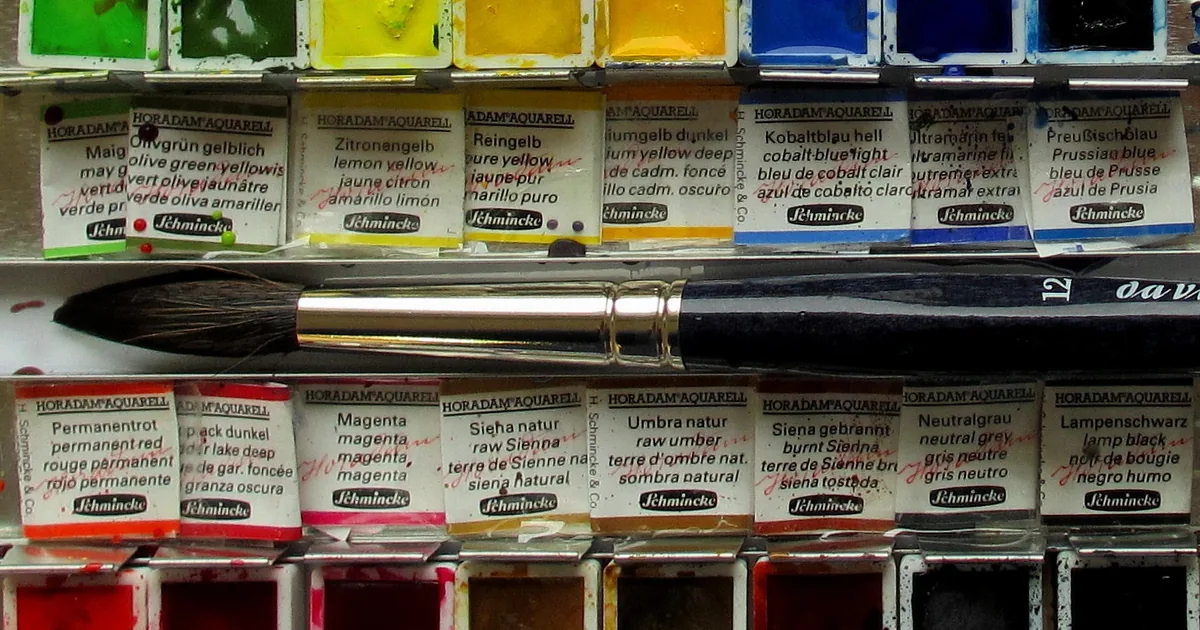
Photo: Usager des couleurs d'aquarelle, Wikimedia Commons, CC BY 3.0
Daniel Smith vs Schmincke is a choice between two artist-grade paints that cost $12 to $29 for a 15 ml tube at Blick. Both makers publish pigment codes and lightfastness ratings for every color, so neither one is the weak option.
This comparison uses what each company publishes about its own range, plus prices for the same pigments at one retailer on one day. It contains no swatch tests of ours. Where a point rests on a retailer's listing instead of the maker's page, the text says so.
In short: Daniel Smith sells 272 colors and cost about a third less per tube at Blick on 15 November 2026: $14.57 for 15 ml of French Ultramarine against $19.97 from Schmincke. Schmincke Horadam has 189 colors, sells all 139 standard ones as half pans and full pans, and pours every pan four times. Buy Daniel Smith for range and value in tubes. Buy Schmincke if you paint from pans.
Daniel Smith vs Schmincke: which should you buy? (quick answer)
Buy Daniel Smith if you fill your own palette from tubes and want the widest choice at the lower price. Buy Schmincke Horadam if you want factory-made pans, or the supergranulating colors. Format, range and price separate them far more than paint quality does.
Overview
Daniel Smith Extra Fine is an American range. The company says it has made artists' materials since 1976 and that its products are made in the USA. Its range page counts "a total of 272 colors across three lines: Extra Fine, PrimaTek and Luminescent" and calls that the widest range of watercolors in the world. PrimaTek is the line made from ground minerals. Luminescent covers the pearly and color-shifting paints.
Schmincke Horadam Aquarell is a German range. Schmincke's company history says the colour chemists Josef Horadam and Hermann Schmincke founded the firm in 1881, and that Horadam patented his liquid-poured watercolor in 1892. The paint still carries his name. The company is based in Erkrath, near Düsseldorf, and labels the range "Made in Germany". It has 139 standard colors and 50 supergranulating colors, 189 in all.
Both are artist grade, the stronger and more expensive tier above student paint. So this is an even comparison, with one caution. Schmincke is imported into the United States and Daniel Smith is made there. The prices below are US prices, and the gap may look different in Europe.
Daniel Smith vs Schmincke: Range and Formats Analysis
Daniel Smith wins on range and Schmincke wins on formats. Daniel Smith offers 272 colors to Schmincke's 189. Schmincke sells each of its 139 standard colors four ways: half pan, full pan, 5 ml tube and 15 ml tube.
A pan is a small plastic tray of dried paint that you wet with a brush. A half pan is the usual travel size, and a full pan is twice as wide. Daniel Smith sells every color as a 15 ml tube. Its range page says "many colors" also come as 5 ml tubes, half pans and watercolor sticks, and it lists no full pans.
So the first question is how you paint. If you squeeze tubes into your own palette, both brands suit you. If you want ready-made pans in every color, only Schmincke offers that. The guide to pans and tubes covers which format to start with.
Schmincke also tells you more about what is inside the range. It says 92 of the 139 standard colors are made from a single pigment. Single-pigment paints matter because a mix of two of them contains only two pigments, which keeps the color clean. Daniel Smith prints the pigment code for every color too, but its range page gives no single-pigment count.
One thing Daniel Smith's size buys you is fine choices between close neighbors. It sells two ultramarines, for example. Its color notes say Ultramarine Blue and French Ultramarine both use the pigment PB29. French Ultramarine has the larger particles, so it leans redder and warmer.
How the Pans Are Made
Schmincke's pans are its strongest selling point, and the company is specific about why. It fills each pan with liquid paint in four pours, not with a pressed cake.
Schmincke describes the process this way: "The watercolour is poured four times in the pans with several weeks of drying phases." It also states that pans and tubes share the same formulation. So a Horadam half pan and a Horadam tube of the same color hold the same paint, in a different state.
Daniel Smith's range page doesn't describe how its half pans are filled. That says nothing about their quality, but it leaves a pan painter with less to go on than Schmincke's page does.
Schmincke names its other ingredients too. The binder, which is the gum that holds pigment to paper, is Kordofan gum arabic. The dispersant, which helps the paint spread, is natural ox gall. Ox gall comes from cattle, so Horadam is not a vegan paint.
Daniel Smith vs Schmincke: Granulation Analysis
Both brands court painters who love granulation, and they go about it differently. Granulation means heavy pigment particles settle into the dips of the paper, so a wash dries speckled instead of flat. Daniel Smith uses ground minerals. Schmincke blends granulating pigments.
Daniel Smith's PrimaTek line is the mineral route, with paints made from ground stone. They are the colors the brand is best known for.
Schmincke counts its granulating colors. The standard range has 22, each marked with a G on the colour chart. Then come the 50 supergranulating colors. Schmincke says each one combines "at least two granulating HORADAM pigments" from different colour families, so the wash separates into two colors as well as two textures. They are sold in ten themed sets of five: Deep Sea, Glacier, Galaxy, Forest, Tundra, Volcano, Shire, Desert, Haze and Urban.
Note the formats. The supergranulating colors come as half pans, 5 ml tubes and 15 ml tubes. There are no full pans. Schmincke adds that rough paper strengthens the effect, as does more water.
Neither approach is better. A mineral paint gives you one pigment's own texture. A supergranulating paint is a ready-made mix, so you can't separate its parts on the palette.
GODEEPER: Granulation depends on the pigment more than the brand. This guide names seven pigments that settle, with each maker's rating. Granulating Watercolors Explained: 7 Pigments That Settle →
Daniel Smith vs Schmincke Price per ml: 3 Shared Pigments
Daniel Smith is cheaper, and by more than the list prices suggest. For three pigments that both brands sell in a 15 ml tube, Schmincke cost between 37 and 87 percent more at Blick on 15 November 2026.
Comparing by pigment code keeps this fair. Each pair below is the same pigment in the same size of tube, from the same shop, on the same day.
- Ultramarine blue (PB29). Daniel Smith French Ultramarine: $14.57, or $0.97 per ml. Schmincke French Ultramarine: $19.97, or $1.33 per ml.
- Phthalo blue. Daniel Smith Phthalo Blue Green Shade: $11.74, or $0.78 per ml. Schmincke Helio Cerulean (PB15:3): $17.60, or $1.17 per ml.
- Cobalt blue (PB28). Daniel Smith Cobalt Blue: $15.72, or $1.05 per ml. Schmincke Cobalt Blue Light: $29.34, or $1.96 per ml.
Buy all three and the Daniel Smith tubes come to $42.03. The Schmincke tubes come to $66.91. That is $24.88 more for the same 45 ml of paint.
Part of the gap comes from the retailer's discounts. Blick sold the Daniel Smith tubes at 40 percent off list price and the Schmincke tubes at about 27 percent off. At list price the ultramarines are closer: $24.28 against $27.22. The cobalts are far apart even at list, $26.20 against $41.14.
Cobalt shows how each brand prices costly pigments. Both makers sort their colors into price series. Daniel Smith's cobalt costs $1.15 more than its ultramarine. Schmincke's cobalt costs $9.37 more than its ultramarine, a steep premium for the same pigment. If your palette leans on cobalts, the brand choice changes your bill a great deal.
Prices move, and sale prices move fastest. Check the current price of your own colors before you order.
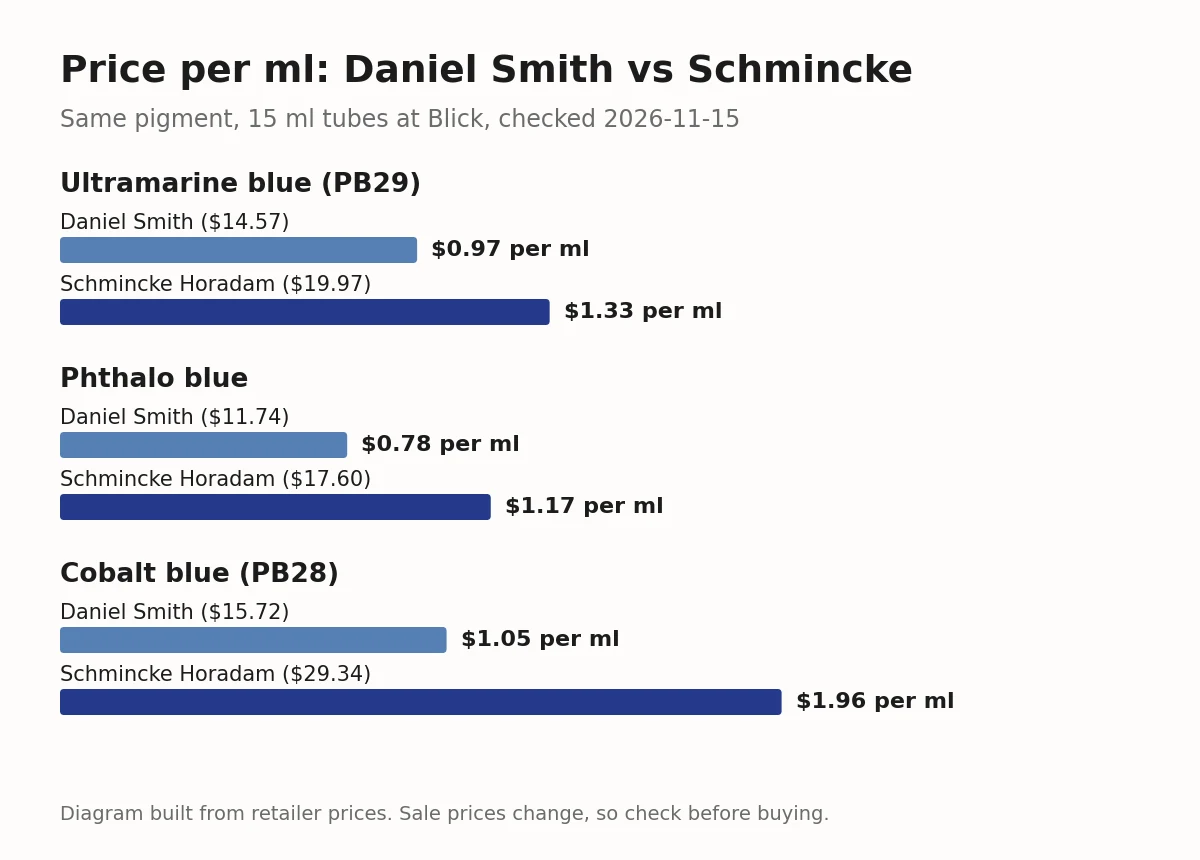 Diagram: price per ml of the same three pigments in 15 ml tubes at Blick on 15 November 2026. Schmincke costs more in every pair, and most for cobalt.
GODEEPER: Daniel Smith's other big rival is British. This comparison covers how its strong, textured color sits against smooth Winsor & Newton washes. Daniel Smith vs Winsor & Newton: Pro Watercolor Review →
Same Name, Different Pigment
A color name tells you less than the pigment code. Two colors show it clearly here: burnt sienna and the cadmiums.
Burnt sienna is the warm red-brown found in most palettes. Blick's pigment information lists Daniel Smith Burnt Sienna as PBr7, a natural earth pigment. It lists Schmincke Burnt Sienna as two pigments, PR101 and PBk9: a red iron oxide with a black. A second US retailer, Jerry's Artarama, gives the same two codes. We did not find the codes on Schmincke's own pages, so confirm them on the tube label. Both tubes cost the same as the phthalo blues above, $11.74 and $17.60.
Why does it matter? A classic gray comes from mixing ultramarine with burnt sienna. A single earth pigment and a red-plus-black mix can behave differently in that gray. If you follow a recipe written for one brand, check the code before you swap in the other.
The cadmiums differ in another way. In this video, painter Jay Nathan swatches Daniel Smith's cadmium hue colors beside Schmincke's genuine cadmium colors. A hue is a paint made from other pigments to look like the original.
Lightfastness: Two Rating Systems
Both brands rate lightfastness, meaning how well a color resists fading in light. They use different scales, so the numbers don't line up side by side.
Schmincke uses stars, with five as the best. It says 162 of its 189 colors earn four or five stars, including every supergranulating color. That leaves 27 colors below four stars. Look for the stars on the colour chart before you buy a color for work you plan to hang.
Daniel Smith prints a Roman numeral on each color, with I as the top grade. The company says every batch is analyzed for "lightfastness, color value, tinting strength, clarity, vibrancy, undertone, particle size, density and viscosity." It gives no range-wide count of top-rated colors on its range page.
On this point neither brand clearly wins. Schmincke gives you a total you can check. Daniel Smith tells you what it tests in each batch. In both ranges, read the rating for the single color you are buying.
Side-by-Side Summary
- Colors in range: Daniel Smith: 272 / Schmincke: 189 (139 standard, 50 supergranulating)
- Single-pigment colors: Daniel Smith: no count published / Schmincke: 92 of 139
- Tube sizes: both 5 ml and 15 ml
- Pans: Daniel Smith: half pans in many colors / Schmincke: half and full pans in all 139 standard colors
- Other formats: Daniel Smith: watercolor sticks / Schmincke: none listed
- Granulation: Daniel Smith: PrimaTek mineral paints / Schmincke: 22 marked G, plus 50 supergranulating
- Lightfastness scale: Daniel Smith: Roman numerals, I is best / Schmincke: stars, five is best
- Ultramarine, 15 ml at Blick: Daniel Smith: $14.57 / Schmincke: $19.97
- Cobalt blue, 15 ml at Blick: Daniel Smith: $15.72 / Schmincke: $29.34
- Made in: Daniel Smith: USA / Schmincke: Germany
Who Should Buy Which
Buy Daniel Smith if you paint from tubes, want the widest choice of colors, or watch the price. At Blick's November prices, the three blues above cost about 37 percent less in total than Schmincke's. A six-tube split-primary palette is the cheapest way in.
Buy Schmincke Horadam if you paint from pans. This is the clearest difference in the whole comparison, since every standard color exists as a half pan and a full pan, poured four times. Buy it too if a supergranulating set does something you want and can't mix yourself.
You don't have to choose one. The two brands share a palette without trouble. Schmincke pans in the travel box and Daniel Smith tubes at the desk is a sensible split. For Daniel Smith vs Schmincke, the choice turns on format first and price second.
Frequently Asked Questions
Is Daniel Smith or Schmincke better? Neither is better across the board. Daniel Smith has the bigger range, 272 colors against Schmincke's 189, and cost about a third less for the same pigments at Blick in November 2026. Schmincke sells every standard color as a half pan and a full pan, poured in four layers at the factory.
Is Schmincke more expensive than Daniel Smith? Yes, at Blick on 15 November 2026. A 15 ml tube of French Ultramarine (PB29) cost $14.57 from Daniel Smith and $19.97 from Schmincke. Cobalt blue (PB28) cost $15.72 against $29.34. Across three shared pigments, the Schmincke tubes cost 37 to 87 percent more.
Can you mix Daniel Smith and Schmincke watercolors? Yes. Both are artist-grade watercolors that re-wet with water, so they can share a palette and mix freely. Match colors by pigment code, not by name. Blick lists Daniel Smith's Burnt Sienna as PBr7 and Schmincke's as a mix of PR101 and PBk9, so the two will not behave the same in a mix.
Which has more granulating colors, Daniel Smith or Schmincke? Schmincke publishes the clearer count. It lists 22 granulating colors in the standard range, marked G on its chart, plus 50 supergranulating colors sold in ten themed sets of five. Daniel Smith is known for its PrimaTek mineral colors, but its range page gives no count of granulating colors.
Are Schmincke pans better than Daniel Smith pans? They are made differently. Schmincke pours each pan as liquid paint four times, with weeks of drying between pours, and uses the same formula as its tubes. All 139 standard colors come as half pans and full pans. Daniel Smith sells half pans in many colors, and its range page lists no full pans.
Is Schmincke Horadam vegan? No. Schmincke lists natural ox gall, which comes from cattle, as the dispersant in Horadam watercolors, with gum arabic as the binder. Painters who avoid animal products should check each maker's ingredient statements before buying. Daniel Smith's range page does not list its additives.
Related Reading
- Best Watercolor Paints for Beginners: 5 Sets Ranked (2026): where a six-tube Daniel Smith set ranks against four pan boxes.
- Winsor & Newton Cotman Watercolor Review: 48 Colors Decoded: the student-grade option if both of these cost too much.
- Best Travel Watercolor Sets: 5 Pocket Boxes Compared: how a Schmincke Horadam pan box compares with other pocket sets.
References
- Daniel Smith: Extra Fine Watercolors - Range size across three lines, formats, and the batch testing Daniel Smith describes.
- Daniel Smith: French Ultramarine - The note on PB29 particle size in its two ultramarines.
- Schmincke: HORADAM Aquarell - Color counts, formats, the four-pour pans, binder and lightfastness totals.
- Schmincke: About Schmincke - The 1881 founding and Josef Horadam's 1892 patents.
- Blick: Daniel Smith Extra Fine Watercolor, French Ultramarine, 15 ml - Price and pigment information, checked 15 November 2026.
- Blick: Schmincke Horadam Aquarell, French Ultramarine, 15 ml - Price and pigment information, checked 15 November 2026.
- Jay Nathan Watercolor: Daniel Smith Cadmium Hues Vs Schmincke Cadmium Watercolors (YouTube) - Side-by-side swatches of the cadmium hue and genuine cadmium colors.

Written by
Arthur SterlingSupplies & Reviews Editor
Arthur Sterling writes Watercolor Daily's supply reviews and brand comparisons: paints, cotton papers, and brushes, compared on published specifications.
NextKeep reading
Reviews / 8 min
Daniel Smith vs Winsor & Newton: Pro Watercolor Review
Features / 10 min
Student vs Artist Grade Watercolor: 6 Pigments Compared
Reviews / 9 min
Van Gogh Watercolor Review: 72 Colors and Pigments Checked
Reviews / 9 min
Winsor & Newton Cotman Watercolor Review: 48 Colors Decoded
Features / 12 min
Granulating Watercolors Explained: 7 Pigments That Settle
Features / 10 min
Synthetic vs Kolinsky Sable Brushes: What You Pay For
Features / 14 min
Watercolor Paper Weight Comparison Chart: GSM vs lb Guide
Features / 12 min
Ceramic vs Plastic Watercolor Palette: 5 Differences
Disclaimer
This article is published for informational purposes and is not professional advice. Product formulations, pigment sources, packaging and store listings change. Check the details that matter to you (price, pigment content, regional availability) with the manufacturer or retailer before you buy.