Loading
Watercolor Daily · Features
Best Watercolor Paper for Card Making: 7 Picks Ranked
Best watercolor paper for card making is 300 gsm cotton cut to size, as no ready-made card is all cotton. 7 picks ranked by fiber, weight and cost per card.
9 min readBy Elena Vance
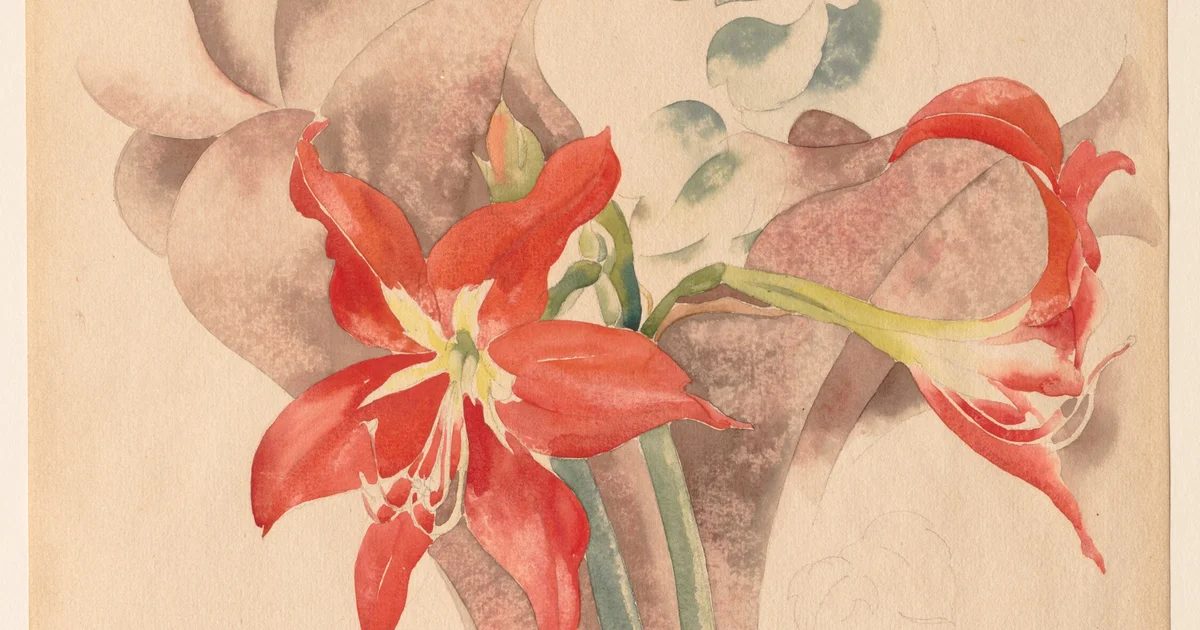
Painting: Charles Demuth, Amaryllis, c. 1923, Cleveland Museum of Art, CC0
The best watercolor paper for card making is a 300 gsm cotton paper cut to size. We checked every watercolor card and postcard Blick sells and found none made of all cotton. So we ranked seven options on three published facts: fiber, weight and cost per card. Prices are from Blick on 2026-11-17 unless a date says otherwise. We did not paint test cards, so nothing here is a buckling or lifting result.
In short: For your best cards, cut Arches 300 gsm cotton paper to size, at about $0.81 to $1.08 a card. For ready-made cards, the Rembrandt postcard pad (25% cotton, 300 gsm) is the best quality at $0.65 each. For a big batch of folded cards with envelopes, Strathmore's box of 100 costs $0.52 a card but is wood pulp.
What is the best watercolor paper for card making? (quick answer)
Arches 300 gsm cold pressed, cut from a full sheet, is the best watercolor paper for card making, because it is 100% cotton and costs about a dollar per card. If you want ready-made cards, pick a 300 gsm pad with some cotton, such as Rembrandt or Fabriano.
Overview: How We Ranked the Best Watercolor Paper for Card Making
We started from Blick's full category of watercolor cards and postcards: ten products from Strathmore, Canson, Hahnemühle, Fabriano, Rembrandt, Richeson and Cricut. To those we added one cut-to-size option, because a card is only as good as its paper.
Each pick was ranked on three facts, in this order:
- Fiber. Cotton paper holds water longer and survives lifting and layered washes better than wood pulp, also called cellulose. Our beginner paper guide explains why.
- Weight. 300 gsm (140 lb) is the standard. Heavier paper buckles less when wet and stands up better when folded.
- Cost per card. We divided the pack price by the number of cards.
We left out anything without a published weight, and any listing from third-party marketplace sellers.
The result that surprised me most: no ready-made card or postcard in the category is all cotton, and the best of them, two postcard pads, are 25% cotton. Canson and Hahnemühle don't state the fiber of their cards at all, so we say so where it applies.
GODEEPER: Not sure what 300 gsm means or why it matters for a card? Our weight guide compares every common weight side by side. Watercolor Paper Weight Comparison Chart: GSM vs lb Guide →
Analysis: The 7 Best Watercolor Papers for Card Making Ranked
1. Arches 300 gsm cold pressed sheet, cut to card size
What it is: a 22 x 30 inch sheet of 100% cotton, mould-made paper, sized with gelatin, which you cut into cards yourself.
Why it made the list: it's the only all-cotton option, and it still costs less per card than some ready-made boxes. One sheet cut into flat 5 1/2 x 8 1/2 inch pieces gives 12 cards that fold to 4 1/4 x 5 1/2 inches. Cut to 7 x 10 inch pieces, it gives 9 cards that fold to 5 x 7. Cold pressed means a medium texture, the usual choice for cards. Our Arches watercolor paper review covers the mill's specification in detail.
Price: $9.74 a sheet at Blick on 2026-11-14. That is about $0.81 per small card or $1.08 per 5 x 7 card.
Best for: cards you want to keep, frame or paint with several layers.
One caveat: you buy envelopes separately, and you must score each fold.
2. Rembrandt Watercolor Postcard Pad
What it is: 30 cold pressed postcards of 300 gsm (140 lb) paper, 4.1 x 5.8 inches.
Why it made the list: at 25% cotton, it is one of the two cotton-blend ready-made options, and Blick describes it as pH neutral, acid free and buffered. The size fits USPS postcard rules, so you can mail it without an envelope.
Price: $19.36 for 30, about $0.65 a card.
Best for: small paintings you want to mail as postcards.
One caveat: these are flat postcards, not folded cards.
3. Fabriano Studio Watercolor Postcard Pad
What it is: 20 machine-made, cold pressed postcards of 300 gsm (140 lb) paper, 4 x 6 inches, with a printed postcard back.
Why it made the list: it matches Rembrandt on weight and cotton content (25%) for less money per card. The 4 x 6 size is the largest that still mails at the postcard price.
Price: $8.80 for 20, about $0.44 a card.
Best for: travel sketches you send home.
One caveat: machine-made paper has a more even, less lively texture than mould-made cotton.
4. Strathmore Watercolor Cards and Envelopes, box of 100
What it is: 100 folded cards of cold pressed, acid-free, 140 lb (300 gsm) paper, 5 x 6 7/8 inches, with envelopes.
Why it made the list: it is the cheapest folded card with an envelope in the category. A Blick product specialist states the paper is wood pulp with no cotton, so it ranks below the cotton blends.
Price: $51.98 for 100, about $0.52 a card. The box of 50 is $29.66, about $0.59 a card.
Best for: holiday batches, classes and practice cards.
One caveat: wood pulp paper dries faster and handles heavy lifting less well than cotton. Keep to simple flat washes.
5. Canson Blank Watercolor Greeting Cards
What it is: folded 5 x 7 inch cards of cold pressed 140 lb (300 gsm) paper, with envelopes.
Why it made the list: the 5 x 7 size gives more painting room than most boxed cards, and the envelopes are included. Blick's listing does not state the fiber, so we can't credit it with cotton.
Price: $26.98 for 30, about $0.90 a card. A pack of 6 is $6.79, about $1.13 a card.
Best for: a few larger cards for special occasions.
One caveat: it costs more per card than Strathmore with no stated advantage in fiber. I'd buy it only for the larger 5 x 7 format.
GODEEPER: Got your paper and need a subject? These designs each use three or four tubes and fit a 5 x 7 card. 12 Easy Watercolor Christmas Card Ideas for Beginners →
6. Hahnemühle Watercolour Postcards tin
What it is: 30 postcards of 230 gsm (105 lb) paper, A6 size (10.5 x 14.8 cm), in cold pressed or rough, in a metal tin.
Why it made the list: the round-cornered cards have an address field printed on the back, and the tin makes a good gift. Hahnemühle does not state the fiber on its product page.
Price: $14.12 for 30, about $0.47 a card.
Best for: gifts and light sketches.
One caveat: at 230 gsm it is lighter than every other pick here, so heavy washes will make it buckle more.
7. Richeson Watercolor Postcards
What it is: 50 cold pressed, acid-free postcards of 290 gsm (135 lb) paper, 4 x 6 inches.
Why it made the list: it is by far the cheapest card here, and the weight is close to 300 gsm. A Blick product specialist states it has no cotton content.
Price: $8.92 for 50, about $0.18 a card.
Best for: practicing a design before you paint the final card.
One caveat: no cotton, so it suits simple washes better than layered glazes.
Cost per Card at a Glance
| Rank | Product | Fiber | Weight | Size (inches) | Cost per card |
|---|---|---|---|---|---|
| 1 | Arches sheet, cut down | 100% cotton | 300 gsm | Your choice | $0.81 to $1.08 |
| 2 | Rembrandt postcard pad | 25% cotton | 300 gsm | 4.1 x 5.8 | $0.65 |
| 3 | Fabriano Studio postcard pad | 25% cotton | 300 gsm | 4 x 6 | $0.44 |
| 4 | Strathmore cards, box of 100 | Wood pulp | 300 gsm | 5 x 6 7/8 folded | $0.52 |
| 5 | Canson greeting cards, 30 | Not stated | 300 gsm | 5 x 7 folded | $0.90 |
| 6 | Hahnemühle postcard tin | Not stated | 230 gsm | 4.1 x 5.8 | $0.47 |
| 7 | Richeson postcards | No cotton | 290 gsm | 4 x 6 | $0.18 |
How to Cut, Fold and Mail Watercolor Cards
Cutting. A full 22 x 30 inch sheet divides cleanly into 12 pieces of 5 1/2 x 8 1/2 inches (4 across, 3 down). Tear against a metal ruler for a soft edge, or cut with a craft knife for a straight one.
Scoring and folding. Heavy paper cracks along the fold if you bend it cold. Press a line with a bone folder, or the back of a butter knife, along a ruler first. Then fold along the line. It's best to score before you paint, so the fold doesn't crack a finished wash.
Envelopes. A folded 4 1/4 x 5 1/2 inch card fits an A2 envelope, which measures 4 3/8 x 5 3/4 inches. A 5 x 7 card fits an A7 envelope of 5 1/4 x 7 1/4 inches.
Mailing a postcard. The US Postal Service charges the cheaper card price only for rectangular cards between 3 1/2 x 5 inches and 4 1/4 x 6 inches, and between 0.007 and 0.016 inch thick. The 4 x 6 and A6 postcards above fit the size range. Measure the thickness of a painted card before you rely on the card price, and send anything larger in an envelope at the letter price.
Whichever paper you choose, cold pressed is the usual surface for cards, and every boxed card above uses it. Hot pressed is smoother and suits fine line work. Our hot press vs cold press guide explains how washes behave on each.
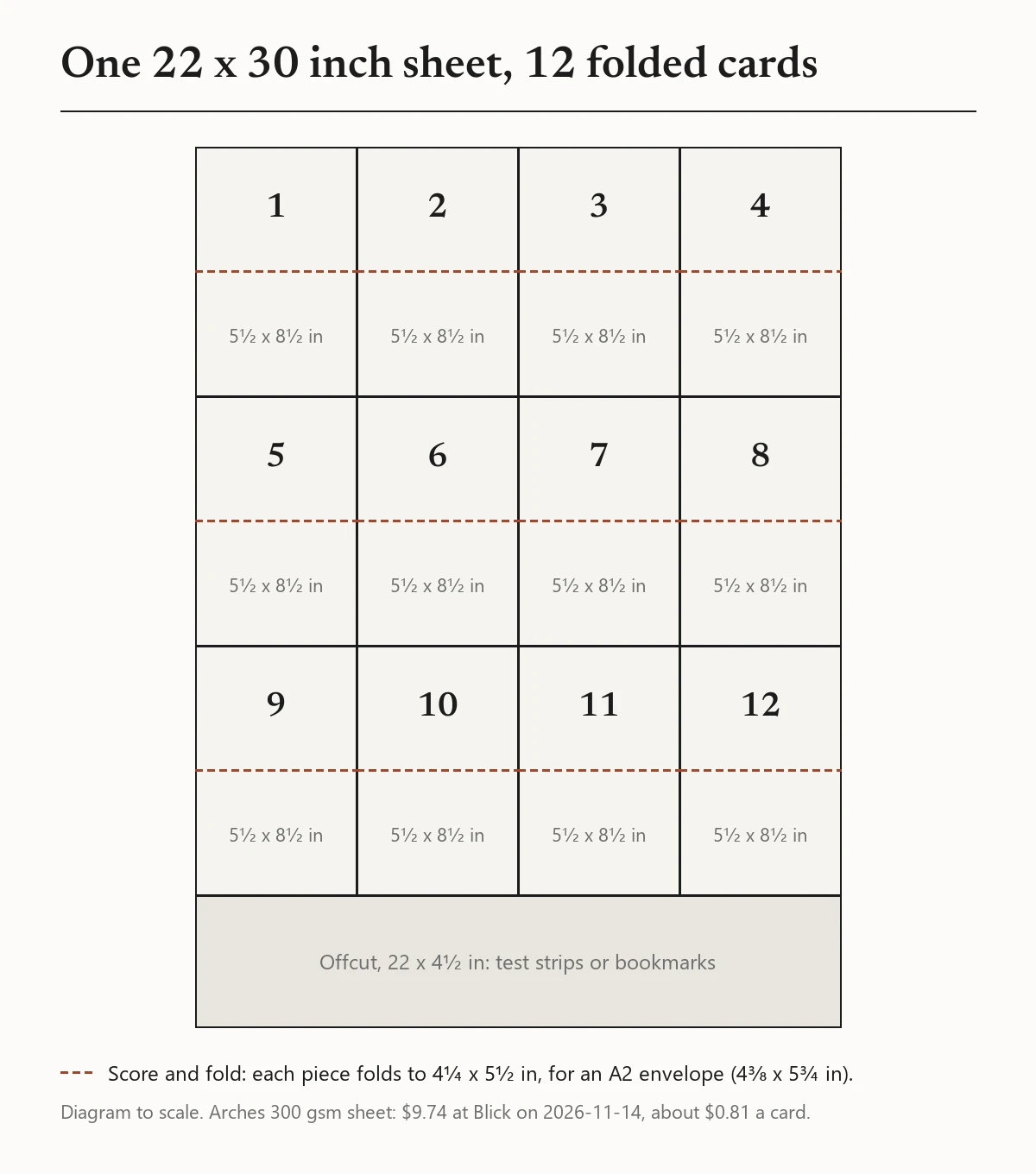 Our to-scale diagram of the cut described above: 12 card blanks from one full sheet, a fold line across each, and a 4 1/2 inch offcut left over.
Honorable Mentions
- Strathmore 400 Series Watercolor Cards and Envelopes: the same 140 lb cold pressed weight, but sold in packs of 6 at $6.89 for the full size, about $1.15 a card.
- Strathmore 300 Series Watercolor Cards and Envelopes: $7.80 for 6 full-size cards on the same day. That made the cheaper-sounding 300 Series dearer than the 400 Series, so skip it unless the price changes.
- Cricut Watercolor Cards and Envelopes: 140 lb alpha cellulose cards sized for Cricut machines, at $13.74 for 10, about $1.37 a card.
- Hahnemühle Burgund Watercolor Postcard Pad: 250 gsm rough cellulose, by Hahnemühle's paper chart. The long 4.1 x 8.3 inch version is too long to mail at the postcard price.
Frequently Asked Questions
What is the best watercolor paper for card making? A 300 gsm (140 lb) cotton watercolor paper cut to size, such as Arches cold pressed. No ready-made watercolor card at Blick is all cotton. The closest ready-made options are the Rembrandt and Fabriano postcard pads, which are 25% cotton at 300 gsm.
What weight of watercolor paper is best for cards? 300 gsm, which is 140 lb. It is stiff enough to stand up when folded and takes a few washes without much buckling. Lighter papers such as 230 gsm postcards are fine for quick sketches but cockle more under heavy water.
Can you fold 300 gsm watercolor paper into a card? Yes, but score it first. Run a bone folder or the back of a butter knife along a ruler where the fold goes, then fold along that line. Folding 300 gsm paper without a score line often cracks the surface along the crease.
What size envelope fits a 5x7 watercolor card? An A7 envelope, which measures 5 1/4 x 7 1/4 inches. A smaller A2 card of 4 1/4 x 5 1/2 inches fits an A2 envelope of 4 3/8 x 5 3/4 inches. Most boxed watercolor cards, such as Strathmore and Canson, already include matching envelopes.
Can you mail a watercolor postcard without an envelope? Yes, if it fits USPS card rules. A postcard must be rectangular, between 3 1/2 x 5 and 4 1/4 x 6 inches, and 0.007 to 0.016 inch thick. A 4 x 6 inch card fits the size range. Anything larger is charged as a letter.
Are Strathmore watercolor cards cotton? No. A Blick product specialist states that Strathmore Watercolor Cards are made of wood pulp with no cotton content. They are 140 lb (300 gsm), cold pressed and acid free, and they come with envelopes. They suit practice and quick cards more than layered washes.
Related Reading
- 10 Easy Watercolor Birthday Card Ideas, Step by Step: ten birthday designs from three tubes of paint.
- Watercolor Block vs Pad vs Sheets: Cost per Square Inch: which paper format costs least per square inch.
- Best Watercolor Sketchbooks: 4 With 100% Cotton Paper: cotton paper in a bound book, for sketching card ideas first.
References
- Blick: Watercolor Cards and Envelopes category - All products and prices, checked 2026-11-17.
- Blick: Strathmore Watercolor Cards and Envelopes - Weight, size and the wood pulp statement.
- Blick: Rembrandt Watercolor Postcard Pad - 25% cotton, 300 gsm.
- Blick: Fabriano Studio Watercolor Postcard Pad - 25% cotton, machine-made, 4 x 6.
- Blick: Richeson Watercolor Postcards - 290 gsm, no cotton.
- Hahnemühle: Watercolour Postcards in Metal Box - 230 gsm, A6, cold pressed and rough.
- Hahnemühle: Postcard Pad (Burgund) - 250 gsm rough Burgund board.
- USPS Postal Explorer: Sizes for Postcards - Card price size and thickness limits.
- Wikipedia: Envelope - North American A2 and A7 envelope sizes.
- Cleveland Museum of Art: Charles Demuth, Amaryllis - Hero image, CC0.
- Hahnemühle: Artist papers matrix (PDF) - Burgund 250 listed as 100% cellulose.

Written by
Elena VancePigments & Color Editor
Elena Vance writes Watercolor Daily's pigment and color coverage: Colour Index codes, lightfastness ratings, transparency, and palette building.
NextKeep reading
Guides / 10 min
Watercolor Paper Buckling: Why It Happens and 6 Fixes
Features / 11 min
Watercolor Block vs Pad vs Sheets: Cost per Square Inch
Guides / 11 min
How to Stretch Watercolor Paper: 3 Methods by Weight
Features / 14 min
Watercolor Paper Weight Comparison Chart: GSM vs lb Guide
Guides / 12 min
Rough Watercolor Paper: Granulation, Dry Brush and 6 Steps
Features / 12 min
Best Watercolor Sketchbooks: 4 With 100% Cotton Paper
Features / 11 min
Hot Press vs Cold Press Watercolor Paper: 3 Surface Types
Guides / 9 min
Best Watercolor Paper for Beginners: Why 100% Cotton Matters
Disclaimer
This article is published for informational purposes and is not professional advice. Product formulations, pigment sources, packaging and store listings change. Check the details that matter to you (price, pigment content, regional availability) with the manufacturer or retailer before you buy.