Loading
Watercolor Daily · Guides
How to Paint Clouds in Watercolor: 6 Steps for Soft Skies
12 min readBy Marcus Reed
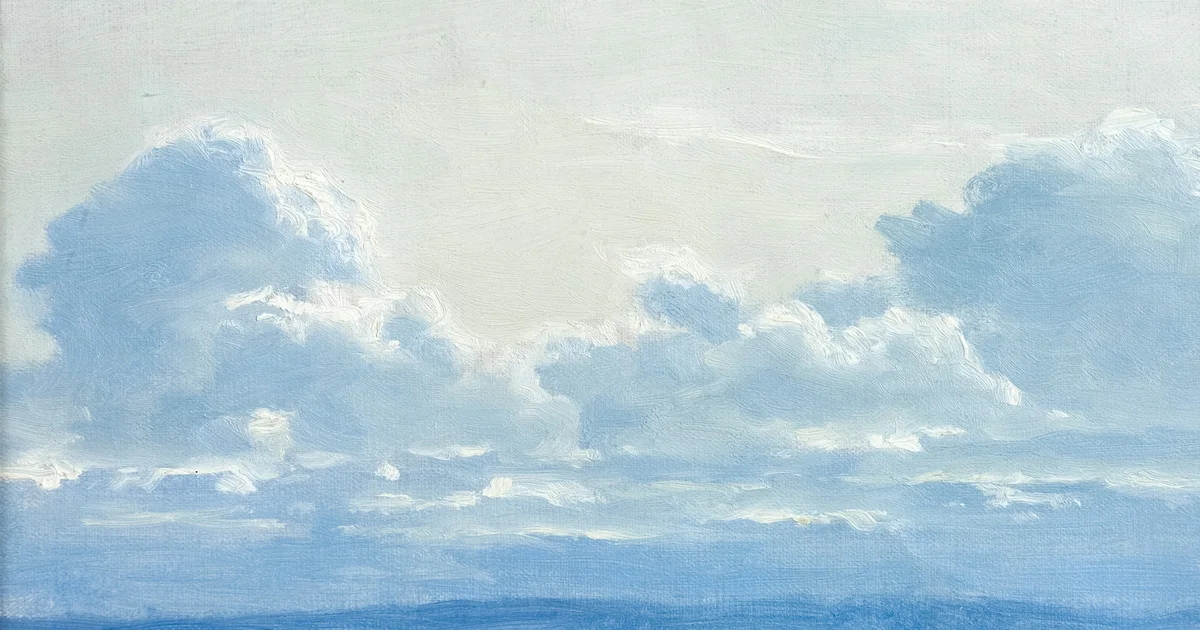
Painting: Eero Järnefelt, Pilviä (Clouds), detail, Järvenpää Art Museum via Europeana, CC0
Review
Watercolor Technique
How to paint clouds in watercolor depends on when you touch the paper. You paint the blue sky, then lift or leave the white, so the cloud itself is never painted. That makes a hard-looking subject a short exercise.
This guide gives six steps for soft clouds, a three-tube palette, the variations for storm and sunset skies, and the reasons clouds go wrong.
In short: Tape a sheet of 300 gsm paper, wet the sky area until it shows an even sheen (not a puddle), and brush blue across it, palest near the horizon. While the sheen remains, blot cloud shapes out with a crumpled tissue. Touch a blue-grey mix to the cloud bottoms, let the sheet dry flat, then remove the tape. Clouds that look hard-edged dried too early.
How to paint clouds in watercolor? (quick answer)
Wet the sky with clean water, brush blue over it, and lift cloud shapes out with a crumpled tissue while the paper is still damp. Then add a grey of blue and brown to the cloud bottoms and leave the painting alone. The cloud is white paper, not white paint.
Overview
The brightest part of a watercolor cloud is bare paper, either paper you protected or paint you removed, because watercolor has no opaque white that behaves like the paper. Winsor & Newton's skyscape tutorial by artist Tim A Shaw makes the same point from the other direction: he tapes off the picture area, builds the sky in layers, and removes the tape last, so the white border and the sky both come from the paper.
Skies are usually painted wet into wet, meaning you apply paint to paper that is already damp so the color spreads on its own. The wet-on-wet guide explains the drying stages. For clouds, one stage matters most: the sheen. Paper that is soaked and shining like a puddle floods any lifted area back with blue. Paper that has gone matte makes hard edges. You work in the narrow band between the two.
What you need for the six steps below:
- Paper. 300 gsm (140 lb) cotton, cold press, taped to a board on all four sides or in a block. A quarter sheet is plenty.
- A tilt. Prop the top of the board on a book so it slopes about 15 degrees, the same set-up as the flat wash.
- Brushes. A big flat or a size 12 round for the sky, a smaller round for the cloud bottoms.
- Tissue or paper towel. One sheet of plain tissue, torn in four.
- Three tubes. French Ultramarine (PB29), Burnt Sienna (PBr7) and Quinacridone Rose (PV19). For a greener, softer sky, swap in Cerulean Blue Chromium (PB36).
French Ultramarine and Cerulean Blue Chromium both granulate, meaning their pigment settles into the grain of the paper and gives a faint speckle. In a sky that speckle reads as haze and cloud texture. The granulating guide shows which blues do it and which don't. Daniel Smith lists French Ultramarine at the top lightfastness category, ASTM I.
First-time painters can do this exercise. Allow about 20 minutes plus drying.
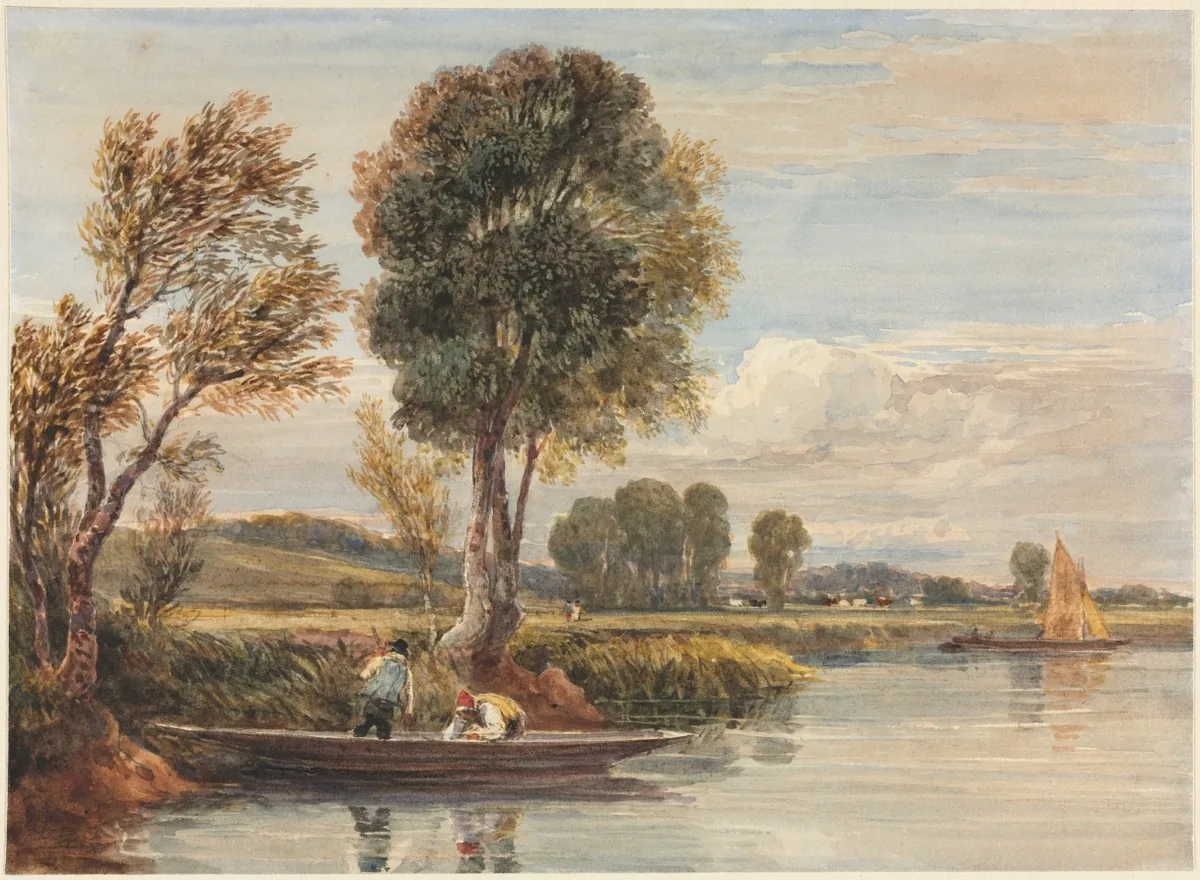 David Cox, On the Thames, c. 1827 to 1829, watercolor with graphite and scraping. The Cleveland Museum of Art, CC0. The bright cloud on the right reads as white paper against the soft blue-grey wash around it.
Step-by-Step: How to Paint Clouds in Watercolor in 6 Steps
1. Tape, tilt and plan the shapes. Tape the sheet down and tilt the board. Draw nothing dark. If you need a guide, mark two or three loose cloud shapes with a very light pencil dot at the corners. Decide where the light comes from: clouds are brightest on top, nearest the light.
2. Wet the sky. Brush clean water across the whole sky area with the big brush, working side to side. Stop when the paper has a low, even sheen. If water beads or pools at the bottom of the tilt, you added too much, so soak it up with a squeezed brush.
3. Lay the blue. Mix a puddle of French Ultramarine thinner than you think you need. Brush it across the top of the sky first, then pull it down and thin it with water as you go, so the sky is deepest at the top and palest at the horizon. Leave a few gaps. Colors lighten as the paper dries, so aim a shade stronger than the result you want.
4. Lift the clouds. While the sheen is still visible, press a crumpled tissue into the blue where a cloud should be. Don't scrub. Dab, lift and turn the tissue to a clean side before each dab, otherwise it puts blue back. Shape each cloud thick at the top and narrower at the bottom.
5. Add the shadows. Mix a grey from French Ultramarine and a little Burnt Sienna. Touch it to the underside of each cloud with the small brush, and let it bleed upward into the damp paper. The grey should be paler than the sky above it, with the edge fading into white. Brown and blue are near opposites on the color wheel, so they cancel into a grey that stays clean.
6. Dry flat and finish. Lay the board flat and leave it until the sheet is dry and the paper is flat again. Peel the tape slowly at a low angle. If one cloud needs a crisp rim, glaze a thin grey stroke along its bottom edge on dry paper.
Matthew White's nine-minute demonstration above shows wet-into-wet cloud painting and talks through the timing of when to lift and when to stop.
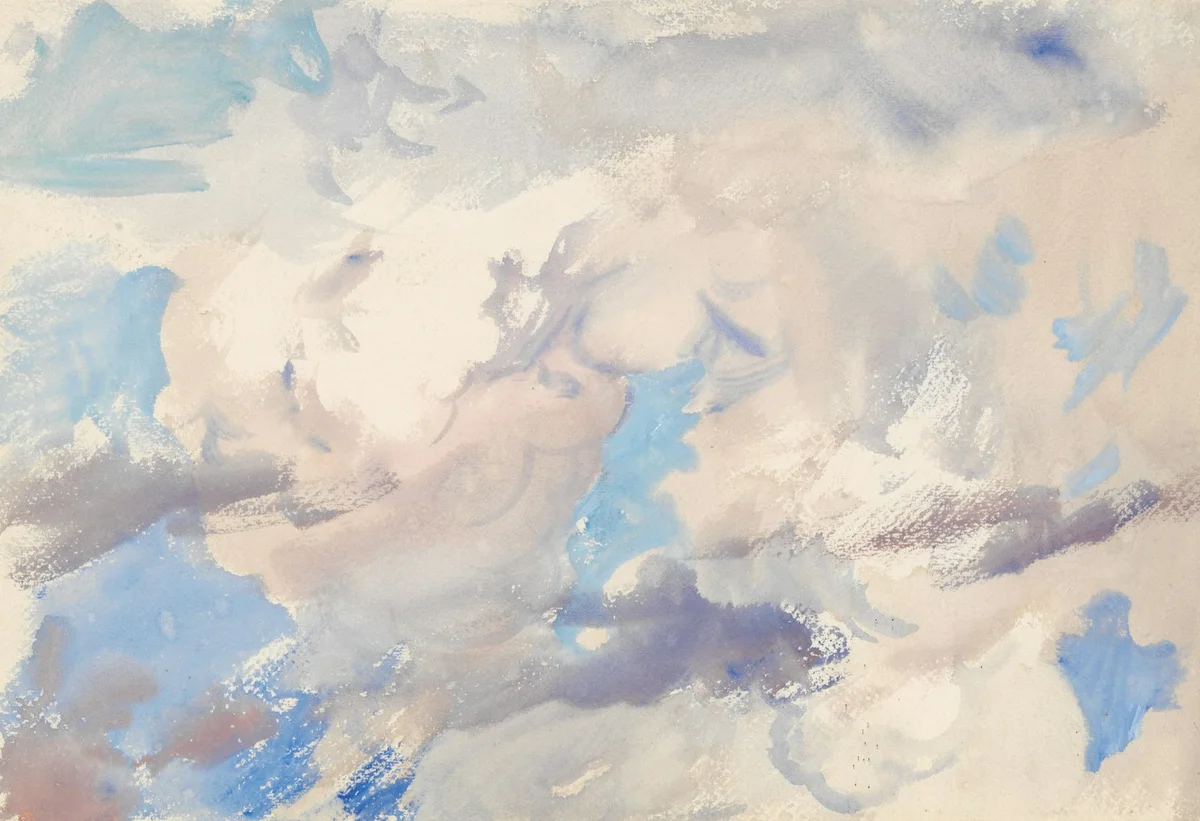 John Singer Sargent, Sky, about 1900 to 1910, watercolor. The Metropolitan Museum of Art, public domain. Soft-edged clouds, blue gaps and bare paper for the brightest whites.
GODEEPER: Lifting is the step that makes soft clouds, and some blues lift far better than others. The lifting guide explains why and how to test your own tubes. Lifting Watercolor Technique: 7 Tips to Lighten Any Wash →
Three Ways to Make a Cloud, and Which Sky Each Suits
The six steps use lifting, which gives soft cumulus clouds. Two other methods give different skies, and the pigment decides which one works.
| Method | What you do | Cloud it makes | Works best with |
|---|---|---|---|
| Lift from a damp wash | Blot the blue off with tissue | Soft, fluffy cumulus | Blues that lift well (check the maker's chart) |
| Paint around the white | Wet or paint blue around a shape and leave the gap | Clouds with a firm outline, flat-bottomed cumulus | Any blue; add masking fluid for tiny gaps |
| Drop in dark color | Touch a grey or blue-black into a wet sky | Storm clouds, heavy and dark | Granulating pigments for mottled texture |
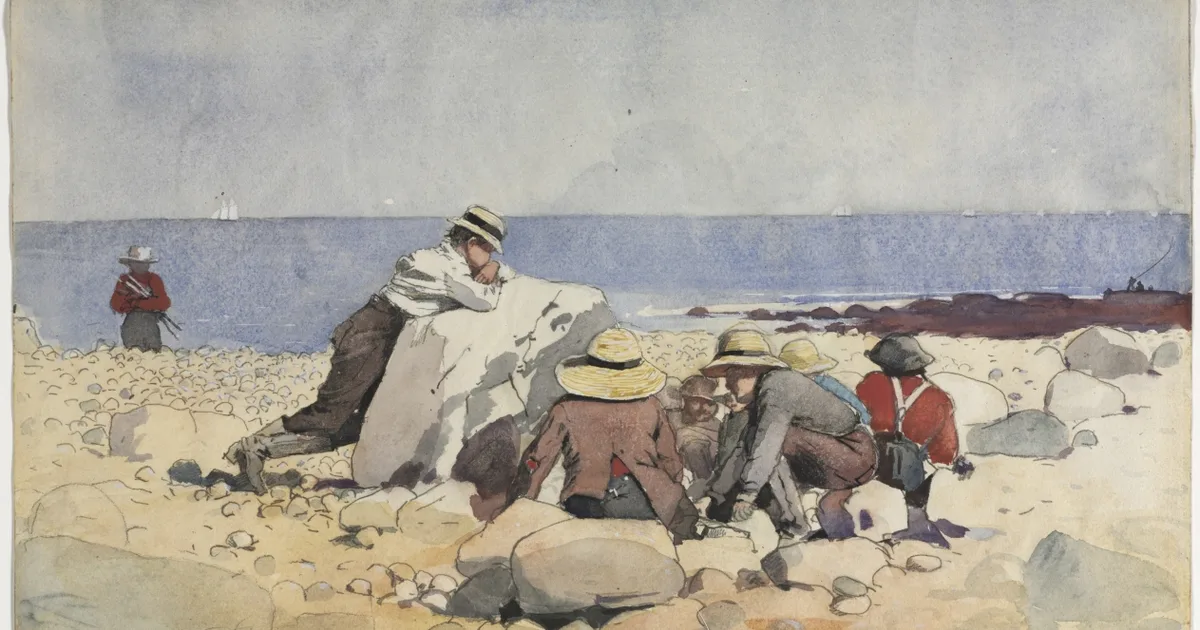
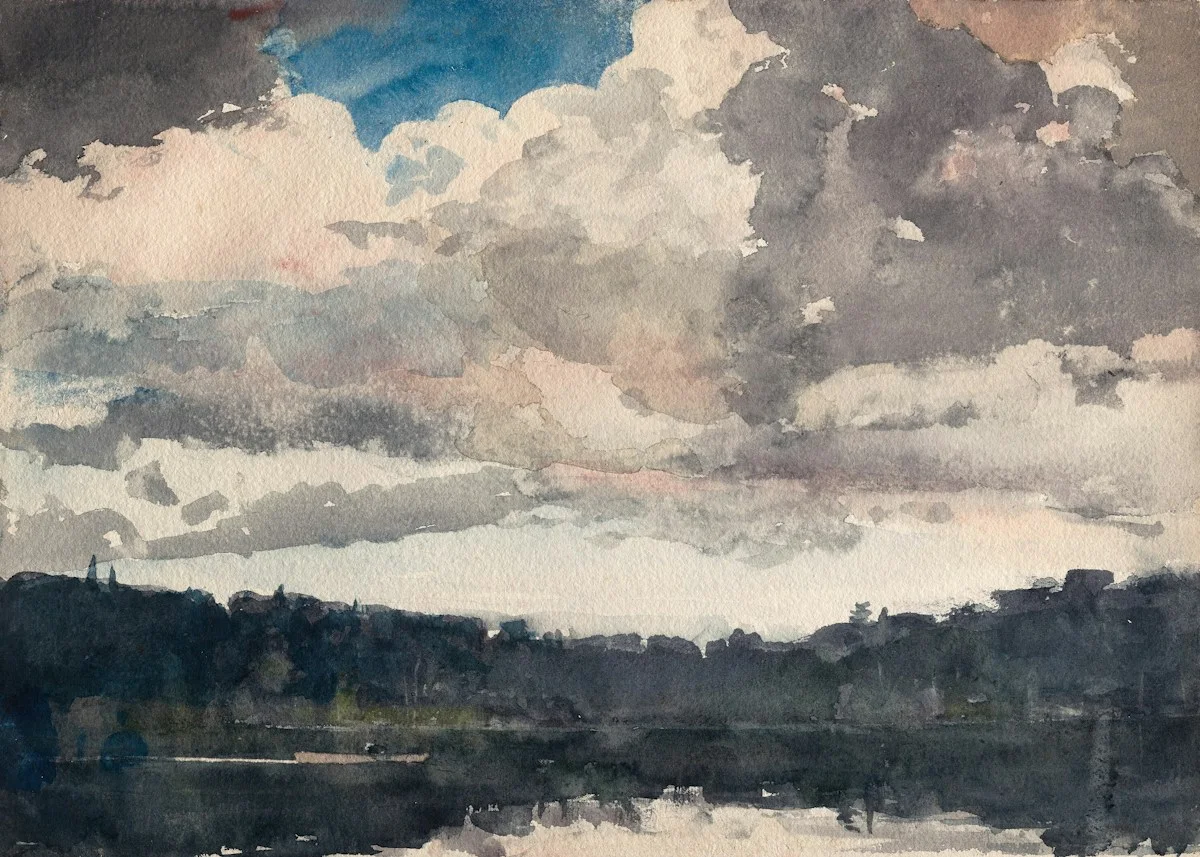 Winslow Homer, The Lone Boat, North Woods Club, Adirondacks, 1892, watercolor with rewetting, blotting and scraping. Art Institute of Chicago, public domain. White clouds with firm edges sit beside dark storm clouds in one sky.
Staining pigments resist lifting. Phthalo Blue (PB15:3) is a strong staining blue, so a lifted cloud in a phthalo sky leaves a pale blue tint instead of white. For lifted clouds choose a blue the maker lists as non-staining, such as Indanthrene Blue in Winsor & Newton's chart, or paint around the white instead. Daniel Smith rates French Ultramarine as medium staining, so lifted clouds in it come out soft but not pure white. For brighter whites, paint around them. Winsor & Newton lists Burnt Sienna as non-staining, which is why it works in a grey shadow mix: it stays on the surface and lifts.
How to Paint Clouds in Watercolor: Storm and Sunset Skies
Both start from the same wet sky. Only the color choices change.
Storm clouds. Start with a pale wet sky of Ultramarine. While it is wet, drop a heavier mix of Ultramarine and Burnt Sienna into the upper half, and tilt the board so the dark spreads downward. Leave a lighter band near the horizon. The heavier the mix, the darker the cloud, so test the strength on a scrap first. Winsor & Newton's skyscape tutorial builds drama by layering: a first wash, a darker area added once that dries, then short strokes of similar colors on top for storm-cloud shapes.
Sunset clouds. Wet the paper, then run a pale Quinacridone Rose across the middle and a thin blue across the top. Let them meet and blend. Lift soft cloud shapes through the pink. The rose and the blue mix to violet where they overlap, which is the dusky band in a real sunset. Winsor & Newton's tutorial builds its warm sunset from a crimson, a yellow and a cerulean blue, so the idea is the same: a warm band low, a cooler band above.
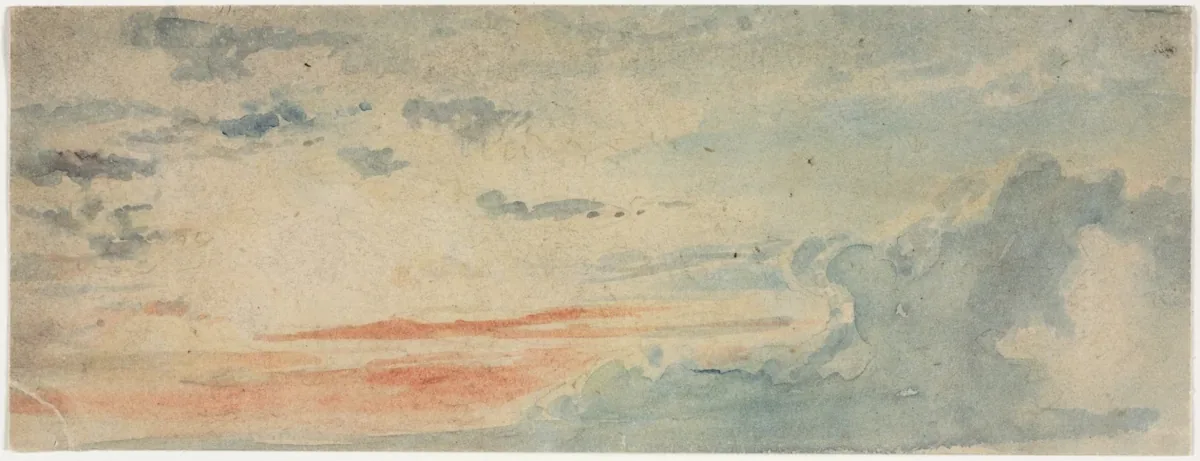 Cloud Study, anonymous, 1800s, watercolor. The Cleveland Museum of Art, CC0. Warm streaks sit low, and the cooler blue-grey clouds sit above them.
GODEEPER: A snow scene is a sky painted the other way up: the white is the ground, and the shadows are blue-grey. The snow guide shows how to keep it clean. How to Paint Snow in Watercolor: 9 Tips for Clean Whites →
Tips for Better Watercolor Clouds
These habits make how to paint clouds in watercolor easier on every sky.
Keep the horizon pale. Skies are lighter and warmer near the horizon and deeper at the top. Painting blue to the bottom edge flattens the picture.
Vary the cloud sizes. Three clouds the same size look like stamps. Make one large, one medium and one small, and overlap two of them.
Blot, don't scrub. Scrubbing can pill the paper's surface and leave a rough patch that holds paint. Dab, lift, turn the tissue.
Mind the edges. Clouds with every edge soft look like fog. Keep at least one defined edge, usually the lower edge in shadow.
Don't go back. A sky that looks messy while wet often settles as it dries. Touching a half-dry wash makes a bloom, a pale flower shape with a dark rim.
Use the tilt. A little tilt makes the blue and grey drift downward. A flat board lets them pool.
Common Mistakes With Watercolor Clouds
Hard edges on every cloud. The paper dried before you lifted. Work quickly, or re-dampen the sky with a clean, soft brush for a minute.
Blue flooding back into lifted clouds. The paper was too wet. Wait for a sheen instead of a shine, then lift again.
Muddy, dirty grey. A grey made from three or four colors turns to mud. Use two: a blue and a brown.
Clouds that look like cotton balls. The shapes are round, the same size and have no shadow. Add a shadow underside and flatten the bottoms.
A sky that dries too pale. Watercolor lightens as it dries. Mix the sky a shade stronger than the final look.
Buckled paper. A heavy wet sky on thin paper ripples. Use 300 gsm cotton or stretch the sheet first.
Frequently Asked Questions
How do you paint clouds in watercolor for beginners? Wet the sky area with clean water until it shows a soft sheen, brush blue across it, then blot out cloud shapes with a crumpled tissue. Add a grey mix to the cloud bottoms while the paper is still damp. The paper stays white where you lifted, so the clouds are never painted, only left.
Should I paint clouds wet on wet or wet on dry? Wet on wet gives soft, drifting clouds and suits most skies. Wet on dry gives crisp edges, so it is better for the hard, flat bottom of a cumulus or the sharp rim of a storm cloud. Many good skies use both: a damp base for softness, then a dry glaze for one defined edge.
What colors do you use to paint clouds in watercolor? A blue for the sky, such as French Ultramarine (PB29) or Cerulean Blue Chromium (PB36), and a grey for the shadows. Mix the grey from ultramarine and Burnt Sienna (PBr7). Add Quinacridone Rose (PV19) for the warm underside of sunset clouds. Three tubes are enough for a full sky.
Why do my watercolor clouds have hard edges? A hard edge forms when wet paint meets paper that has already begun to dry. Either the sky wash dried before you added the cloud, or you worked into it too late. Keep the sheen on the paper, work quickly, and soften any edge that dried with a clean, damp brush.
How do I stop the blue flooding back into my lifted clouds? Flooding back means the paper was too wet. Blue pigment and water keep flowing into any gap you lift while the surface is soaked. Wait until the shine changes from a wet puddle to a thin, even sheen, then lift again. Blot with a clean tissue and turn it between dabs.
What paper is best for painting clouds in watercolor? Use 300 gsm (140 lb) cotton watercolor paper, taped down or in a block. Cotton holds water longer, which gives you more time to lift and soften. Cold press paper adds a little texture that helps granulating blues look mottled. Thin or cellulose paper dries faster and buckles under a wet sky.
Related Reading
- 12 Easy Watercolor Ideas for Beginners From 3 Tubes: the sunset sky and the rain cloud are two cloud exercises on a three-tube palette.
- Rough Watercolor Paper: Granulation, Dry Brush and 6 Steps: a granulating sky on rough paper, painted step by step.
- Split-Primary Palette Guide: Mix Any Color with 6 Tubes: how to mix the greys and violets that skies need.
References
- Winsor & Newton: How to paint watercolour skyscapes, by Tim A Shaw
- Daniel Smith: French Ultramarine Watercolor
- Parka Blogs: Cerulean Blue Chromium (PB36), Daniel Smith
- Matthew White: How to Paint Clouds in Watercolor, step-by-step (YouTube)
- Handprint: The watercolor pigments
- Unsplash, Europeana: Eero Järnefelt, Pilviä, Järvenpää Art Museum (hero image, detail, CC0)
- The Metropolitan Museum of Art: John Singer Sargent, Sky, 50.130.68 (public domain)
- Unsplash, Art Institute of Chicago: Winslow Homer, The Lone Boat, North Woods Club, Adirondacks, 1892 (public domain)
- The Cleveland Museum of Art: Cloud Study, 1980.112 (CC0)
- The Cleveland Museum of Art: David Cox, On the Thames, 2005.201 (CC0)
Was this guide helpful?

Written by
Marcus ReedTechnique Editor
Marcus Reed writes Watercolor Daily's step-by-step technique guides: wet-on-wet washes, glazing, dry brush, and the water control underneath them.
NextKeep reading
Guides / 11 min
Flat Wash Watercolor Technique: Flat and Graded in 5 Steps
Guides / 12 min
Glazing Watercolor Technique: 6 Steps to Layer Clean Color
Guides / 12 min
Masking Fluid Watercolor Guide: 7 Steps and 3 Products
Guides / 9 min
Negative Painting Watercolor: 9 Tips and a Leaf Exercise
Guides / 10 min
How to Paint Snow in Watercolor: 9 Tips for Clean Whites
Guides / 9 min
Wet-on-Wet Watercolor Technique: Complete Beginner Guide
Guides / 10 min
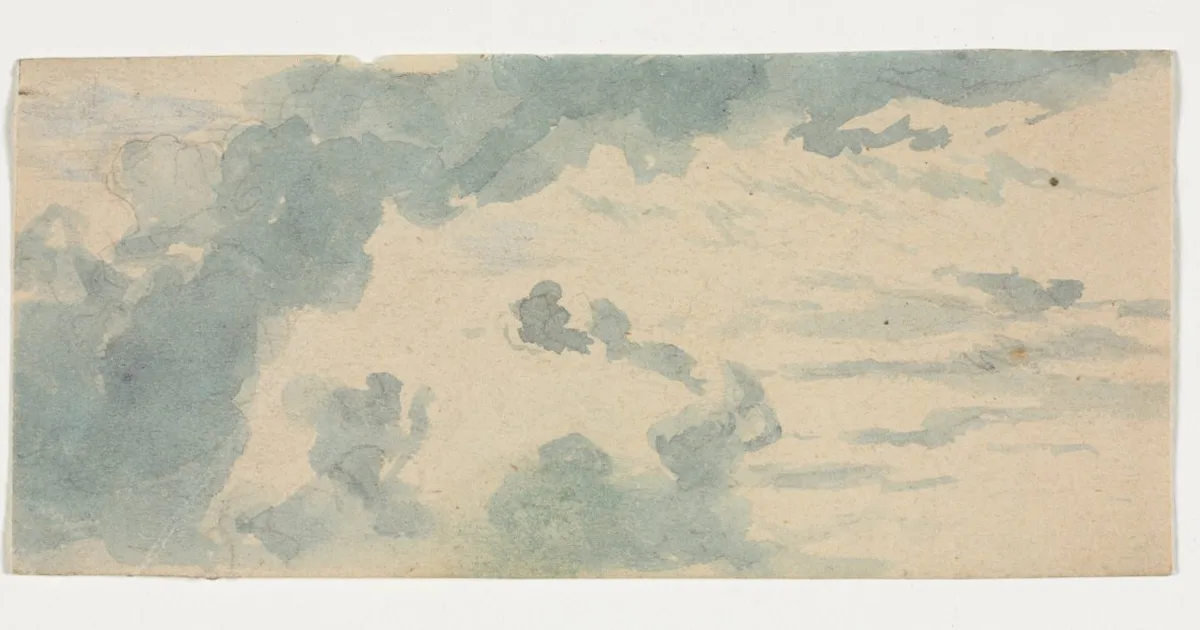
Lifting Watercolor Technique: 7 Tips to Lighten Any Wash
Guides / 11 min
Dry Brush Watercolor Technique: 8 Tips for Broken Texture
Disclaimer
This article is published for informational purposes and is not professional advice. Product formulations, pigment sources, packaging and store listings change. Check the details that matter to you (price, pigment content, regional availability) with the manufacturer or retailer before you buy.